
 Worksheets
Plant and Ecology Review
Total questions: 54
Worksheet time: 42mins
What structure transports food and water back and forth from roots to leaves?
petals
stems
guard cells
ground tissue
Which structure is the main site of photosynthesis?
stem
roots
leaves
flowers
In what part of the plant does transpiration occur?

How do the guard cells regulate the size of the stoma?
WHY does a plant not allow the stoma to be open all of the time?
Too much carbon dioxide would leave the leaf.
Water loss would be a problem.
Oxygen would escape.
None of these answers.

What is the function of the root hairs?
Increase surface area for absorption of water and nutrients
They assist with the storage of excess nutrients
They help the regulation of plant growth
They are involved with the production of oxygen
Water travels through
phloem
xylem
veins
tubes
Moves sugar (GLUCOSE) from leaves to the roots
Xylem
Phloem
This cell structure stores water and other materials for plant cells
chloroplast
nucleus
large vacuole
nucleus
What is the difference between the xylem and phloem?
They move different materials in the plant
They are different shapes
They are found in different areas of the vascular bundle
All of these are correct

Plants curling around a pole or mailbox is an example of:
Phototropism
Germination
Turgor pressure
Thigmotropism

When plants grow in towards the light, this is called:
Phototropism
Geotropism
Germination
Thigmotropism

What hormone is responsible for plant tropisms?
What are hyphae?

Which best describes what a food chain shows you?
Energy flow through an ecosystem
Food flowing through an ecosystem
Consumers going into other consumers
Who eats who

What is the role of a producer?
Gain energy from eating other organisms
Breaking down dead stuff
Use sunlight to make food
Keep other species from overpopulating
An organism that needs to eat other organisms to obtain energy is known as a:
Autotroph
Producer
Mutualist
Consumer

An energy pyramid represents what?
How much energy a particular organism needs.
How much sunlight is available for the ecosystem to use.
How much energy is needed to build a pyramid.
The amount of energy available to the next 'feeder' in a food web.
What is the relationship between egret birds and cows?
How do remora fish benefit from staying close to sharks?
How do sharks benefit from remora fish?
What is the relationship between plover birds and crocodiles?
Commensalism is a relationship where........
Mutualism is a relationship where......
As the population of prey decreases, the population of the predator which eats it will...
Increase
Decrease
Remain Constant

Predator population lags behind prey population because......
Increase in predators leads to decrease in prey
Increase in predators leads to increase in prey
Increase in predators leads to decrease in producers
Increase in producers leads to increase in prey
What is another name for producers?
heterotrophs
autotrophs
What is another name for consumers?
heterotrophs
autotrophs
A community of organisms and their abiotic environment.
Environment
Biosphere
Ecosystem
Community
An ecosystem comprising the ENTIRE EARTH and the organisms that inhabit it.
Biosphere
Biome
Abiotic
Ecoregion
A large region characterized by a specific type of climate and certain types of plant and animal communities.
Biome
Ecosystem
Ecoregion
Microhabitat
Occurs slowly, requires pioneer species, nothing previously there or previous ecosystem completely wiped out from a major disaster
Primary Succession
Secondary Succession
Faster, soils undisturbed, same (or similar) climax community
Primary Succession
Secondary Succession
Select the example of Secondary Succession
A forest grows back after a fire destroys old/weak vegetation, soils undisturbed (ashes actually add nutrients to the soil).
A meteorite vaporizes an entire ocean, a desert forms in its place.
An area is uncovered by a retreating glacier, allowing for a new ecosystem to form.
A volcanic eruption covers an entire grassland in many feet of lava, which hardens into stone.
The first organisms to settle a new area
Pioneer Species
Primary Consumer
Secondary Consumer
Tertiary Consumer
Many different species living in the same area.
Population
Community
Biome
Biosphere
Covers most of the Earth's surface
Energy Pyramid
Aquatic Biome
Succession
Climax Community
Gradual replacement of populations in an area
Energy Pyramid
Aquatic Biome
Succession
Climax Community
group of individuals of the same species that live in the same area
individual
population
ecosystem
biome
A biological community of interacting organisms and their physical environment.
climate
ecosystem
abiotic
niche
The pioneer species in primary succession is usually......
The pioneer species in secondary succession is usually......
annual plants
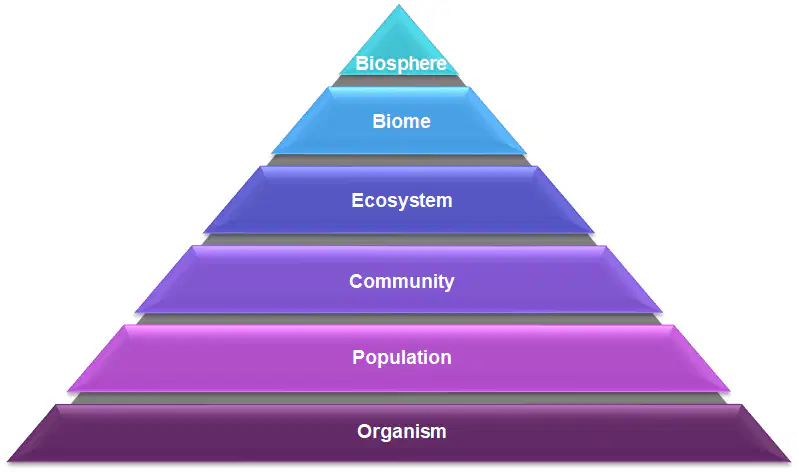
What does an ecological community consist of?
What does an ecological population consist of?
All the individuals of a single species in a specific area.
What organelle would NOT be found in the cells of the root of a plant?

