
 Worksheets
General Physics 2
Total questions: 35
Worksheet time: 18mins
It is a physical property of an object that causes to be attracted toward or repelled from another charged object.
Electromagnetic force
Electric charge
Electric field
Static electricity
Each charged object generates and is influenced by a force is called__________.
Electric charge
Electromagnetic force
Electric field
Static electricity
The build- up of electric charge on the surface of an object is called_________.
Electric charge
Electromagnetic force
Electric field
Static electricity
Which statements are true about Electron Transfer?
I. It is a reaction in which a single electron is transferred from one molecule to another.
II. When rubbing two materials, electrons may be transferred from one material to another.
III. Electron transfer occurs when atoms gain or lose electrons.
IV. Electrons always move from a region of higher potential energy to a region of lower potential energy.
I and IV
II, III, and IV
I, II, III, and IV
None of the above
Any substance that has a free electrons and allows charge to move freely through is called_______.
Conductors
Insulator
Superconductor
Electroscope
A material that can conduct electricity without resistance or energy loss when cooled to a critical temperature.
Conductors
Insulator
Superconductor
Electroscope
These materials can hold electrons securely within their atomic orbit. It prevents the easy transfer of energy, such as heat, cold, or electricity.
Conductors
Insulator
Superconductor
Electroscope
Who is Charles-Augustin de Coulomb?
An English mathematician famous for his work in calculus.
French physicist known for his contributions to the study of electricity and magnetism.
An Italian astronomer renowned for his discoveries about planetary motion.
A German chemist recognized for his experiments on atomic structure.
The mathematical formula to calculate the electrostatic force vector between two charged particles is ________.
Coulomb’s Law
Ohm’s Law
Equipotential line
Electric Field
The SI unit for charge is the _________, with protons and electrons having charges of opposite sign but equal magnitude; the magnitude of this basic charge /qe / is qe = 1.60x10⁻¹⁹ C.
Coulomb
Newton
Voltage ( V)
Joules
Which is the mathematical equation of Coulomb’s Law?


E(x)= - dV(x)/dx
V = IR
Constant k in Coulomb’s Law has the value of_____________.
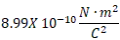



Which of the following statement are correct about .
I. The electrostatic force between two subatomic particles is far greater than the gravitational force between the same two particles.
II. The electrostatic force exerted by a point charge on a test charge at a distance r depends on the charge of both charges, as well as the distance between the two.
III. An insulator does not hold charge within its atomic structure.
I and II
II and III
III and I
I, II, and III
It is an energy that an object possesses due to its position, shape, or state. It is often associated with the forces acting on the object and the potential for those forces to do work.
Kinetic Energy
Potential energy
Electric Energy
Gravitational Energy
It is the energy possessed by an object due to its motion. It depends on both the mass of the object and its velocity .
Kinetic Energy
Potential energy
Electric Energy
Gravitational Energy
The relationship between potential and kinetic energy can be stated as:
Potential energy is always greater than kinetic energy.
Kinetic energy is always greater than potential energy.
Potential energy and kinetic energy are independent of each other.
Potential energy can be converted into kinetic energy and vice versa, as energy is conserved.
Potential Energy is expressed in the formula___________.
PE = mgh
KE= mgh
PE= 1/2mV2
KE= 1/2mV2
Kinetic Energy is expressed in the formula___________.
PE = mgh
KE= mgh
PE= 1/2mV2
KE= 1/2mV2
What are the different types of potential energy?
Gravitational potential energy
Electric potential energy
Elastic potential energy
All of the above
Voltage is also known as__________.
Potential difference
Work difference
Electrostatic Force
Magnetic Force
It is a line along which the electric potential is constant.
Electric field
Equipotential
Potential difference
Magnetic Field
What type of force is electric force?
Gravitational
Magnetic
Electrical
Kinetic
Two point charges, q1 = +8µC and q2 =- 5µC, are separated by a distance r= 10cm.
What is the magnitude of the electrostatic force?
F= 36 N
F= 36.99 N
F= 28 N
F= 28.8 N
A +10µC point charge is 25 cm away from a -20µC point charge.
Calculate the magnitude of the electric force between them.
F= 36 N
F= 36.5 N
F= 28 N
F= 28.8 N
The electric field is defined to be_____ , where F is the Coulomb or Electrostatic force exerted on a small test charge q. E has a unit of _____.
E= F/ r2; J/C
E= F/ r2; J/C
E= F/ q2; N/C
E= F/ q; N/C
Capacitor is a device________.
Capacitor is a device used to store electric charge.
Capacitor is a device used to amplify the input signal.
Capacitor is a device used to block the flow of direct current (DC).
Capacitor is a device used to regulate the voltage.
Which statement is correct about a dielectric?
Dielectrics increase the capacitance of a capacitor by decreasing the electric field.
Dielectrics conduct electricity effectively.
Dielectrics decrease the capacitance of a capacitor by increasing the electric field.
Dielectrics have no effect on the capacitance of a capacitor.
Which statement is correct about Coulomb force?
Coulomb force is a type of frictional force.
Coulomb force is responsible for the acceleration of an object due to gravity.
Coulomb force describes the attraction or repulsion between charged particles.
Coulomb force acts only on neutral particles.
What determines the magnitude of Coulomb force between two charged particles?
The velocity of the charged particles.
The mass of the charged particles.
The distance between the charged particles and the magnitude of their charges.
The temperature of the medium surrounding the charged particles.
What is the value of the electric force constant (k)?
answer choices
9.8 x 10⁹ N m²/C²
9 x 10⁹ N m²/C²
4.2 x 10⁹ N m²/C²
8 x 10⁹ N m/C2
What is the Voltage 5.00 cm away from the center of a 1 -cm diameter metal sphere that has a -3.00 nC static charge if you use the formula V= kQ/r?
- 539 V
- 538 V
- 537 V
- 536 V
How do ions contribute to electrical conductivity in solutions?
By being electrically neutral.
By being immobile.
By carrying electric charge through the movement of ions.
By forming covalent bonds.
Which statement is correct about unlike charges?
Unlike charges repel each other.
Unlike charges attract each other.
Unlike charges have the same sign.
Unlike charges cancel each other out.
How do unlike charges interact in an electric field?
They move away from each other.
They move towards each other.
They remain stationary.
They oscillate randomly.
Which statement is correct about Coulomb force compared to gravitational force?
Coulomb force acts between electrically charged particles, while gravitational force acts between any two objects with mass.
Coulomb force is always attractive, while gravitational force can be either attractive or repulsive..
Coulomb force obeys an inverse square law, while gravitational force obeys an inverse cube law.
Coulomb force is always weaker than gravitational force

