
 Worksheets
porifera and cnidaria
Total questions: 22
Worksheet time: 20mins
Name
Class
Date
1.
The hard "skeleton" structures in a sponge are called...
a)
Spongin
b)
Spicules
c)
Amebocytes
d)
Pinococytes
2.

What kind of symmetry does a Cnidarian have?
a)
No Symmetry
b)
Bilateral Symmetry
c)
Radial Symmetry
d)
Square
3.
What phylum has two different forms that exist which are called the medusa and the polyp?
a)
Phylum Porifera
b)
Phylum Cnidaria
c)
Phylum Platyhelminthes
d)
Kingdom Animalia
4.
Which part of the sponge body is a large opening at the top of the central cavity through which water leaves the sponge?
a)
Ostia
b)
Meenchyme
c)
Spongecoel
d)
Osculum
5.
What kind of feeders are Cnidarians?
a)
autotrophic
b)
mostly carnivorous with some filter feeders
c)
omivores
d)
only filter feeders
6.

What phylum of invertebrates does the following picture belong?
a)
Platyhelminthes
b)
Cnidaria
c)
Porifera
d)
Mollusca
7.

What phylum of invertebrates does the following picture belong?
a)
Cnidaria
b)
Porifera
c)
Platyhelminthes
d)
Animalia
8.
The structure of a sponge that attaches to the rocks and other substrate is called a/an ________________________?
a)
holdfast
b)
false foot
c)
root
d)
spicule
9.

Tentacles contain cnidoblasts that hold/secrete coiled thread with an attached barb called a ...
a)
nematocyst
b)
spicule
c)
ectoderm
d)
spirocyst
10.
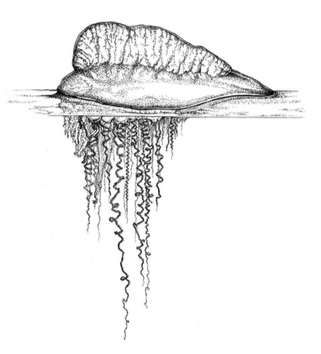
What phylum does this animal belong in the image?
a)
Platyhelminthes
b)
Cnidaria
c)
Porifera
d)
Plantae
11.
Instead of a brain or central nervous system, jelly fish have what in place to help them respond to the environment.
a)
Stinging Cells
b)
Nerve Net
c)
Nematocysts
d)
Chloroplast
12.
Jellyfish can reproduce
a)
sexually only
b)
asexually only
c)
both sexually and asexually
d)
neither sexually or asexually
13.
What do organisms from the phylum Porifera eat?
a)
small marine fish
b)
plankton,bacteria, and detritus
c)
choanocytes
d)
krabby patties
14.
What kingdom do invertebrates such as the Porifera and Cnidaria belong?
a)
Plantae
b)
Animalia
c)
Fungi
d)
Porifera
15.
A flexible, fibrous material that can make up the skeleton of a sponge?
a)
spicule
b)
spongin
c)
grass sponge
d)
spongocoel
16.
Sponges can reproduce asexually through a process called __________________.
a)
budding
b)
regeneration only
c)
fusion
d)
amphiblastula
17.
Which of the following is NOT a characteristic of the Phylum Cnidaria?
a)
Radial symmetry
b)
Presence of nematocysts
c)
Bilateral symmetry
d)
A simple digestive system
18.
How do sponges primarily obtain their food?
a)
Through photosynthesis
b)
Filter feeding from water currents
c)
Hunting small animals
d)
Absorbing nutrients from the substrate
19.
Which of the following are found within coral polyps?
a)
zooxanthellae (algae)
b)
sponges
c)
bleach
d)
collar cells
20.
In cnidarians, the _________________ stage is sessile.
a)
medusa
b)
polyp
c)
holdfast
d)
larvae
21.
The most complex level of organization found in cnidarians are
a)
cells
b)
tissues
c)
organs
d)
organ systems
22.
Coral bleaching occurs primarily as a result of
a)
increasing ocean temperatures
b)
ocean acidification
c)
pollution
d)
predation
100 %

