wayground logo

Free Printable Worksheets

Font size

S
M
L
XL
Worksheets

Mix + Flow of Matter: Final Review Practice

Total questions: 47

Worksheet time: 38mins
Name
Class
Date
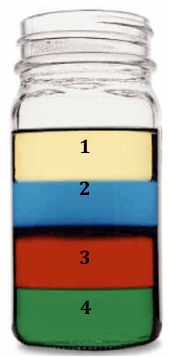
1.
Put the liquids in order from most dense to least dense?
a)
4, 3, 2, 1
b)
1, 2, 3, 4
c)
3, 4, 2, 1, 
d)
4, 3, 1, 2
2.
Why do ice cubes float in a  glass of water?
a)
the ice cubes are more dense than the water
b)
the water is more dense than the ice cubes
c)
the water is more dense than the glass
d)
the ice is more dense than the glass
3.
Why do objects sink or float in H2O
a)
Because their densities are higher or lower than compared to water
b)
Because their densities are using gravity to pull down
c)
Because their densities are heavier or lighter
d)
Because their mass and volumes are equal 
4.
Where can matter be found?
a)
Everywhere
b)
On Earth only
c)
In a solid and liquid only
5.
The water is ______ dense than the boat
a)
more
b)
less
6.
If you poured 3 liquids that do not mix how could you tell which one is the most dense?
a)
The liquid on top
b)
The liquid in the middle
c)
The liquid at the bottom
7.

Name the piece of equipment used to measure mass

a)

Measuring cylinder

b)

Balance

c)

Thermometer

d)

Measuring tape

8.

What piece of equipment would you use to measure the volume of a liquid?

a)

Measuring tape

b)

Balance

c)

Ruler

d)

Measuring cylinder

9.

What two types of measurements make up DENSITY?

a)

Mass and Volume

b)

Temperature and Mass

c)

Grams and Centimeters

d)

Volume and Weight

10.

Give the units for volume

a)

cm

b)

kg

c)

cm3

d)

cm2

11.

State the units for mass

a)

cm

b)

ml

c)

kg

d)

s

12.

The density of a material is the SAME no matter what the size or shape of the material

a)

True

b)

False

13.
What is the formula for density?
a)
density = mass x volume
b)
density = mass / volume
c)
density = mass + volume
d)
density = mass - volume
14.

What is used to find the volume of an irregular shaped object?

a)

Graduated cylinder

b)

Scale

c)

Test tube

d)

Oil

15.

What property of matter explains its ability to flow and take the shape of its container?

a)

Solidity

b)

Density

c)

Fluidity

d)

Elasticity

16.

Which state of matter has a definite volume but no definite shape?

a)

Solid

b)

Liquid

c)

Gas

d)

Plasma

17.

How does temperature affect the density of a substance?

a)

Temperature increase makes substances more dense

b)

Temperature decrease makes substances less dense

c)

Temperature increase makes substances less dense

d)

Temperature has no effect on density

18.

You have a rock with a volume of 15cm3 and a mass of 45 g. What is its density?

19.

A cube measures 3.0 cm on each side
(hint: V = L X W X H)
and has a mass of 25 g.

Water has a density of 1g/cm3

Will the cube float or sink?

a)

Float

b)

Sink

20.

How much KNO3 solute is saturated at 40 degrees?

a)

75

b)

55

c)

65

d)

85

21.

How much NaBr solute is saturated at 70 degrees?

a)

110

b)

120

c)

130

d)

140

22.

At what temperature does the solubility of sodium chloride, NaCl, match potassium dichromate, K2Cr2O7?

a)
60 ºC
b)
30 ºC
c)
50 ºC
d)
83 ºC
23.
Solubility is defined as
a)
the ability to catch on fire
b)

the ability of a solute to be dissolved

c)

how dense a mixture is

d)

a pure substance

24.
The substance being dissolved in a solution.
a)
sands
b)
solute
c)
solvent
d)
alloy
25.
The substance in which a solute is dissolved
a)
sands
b)
solvent
c)
alloy
d)
negative particles
26.
Solutions are composed of __________ .
a)
salts and solutes
b)
solvents and salts
c)
solutes and alloys
d)
solutes and solvents
27.

In a sample of salt water, salt would be considered the ______.

a)
Solution
b)
Solute
c)
Solvent
d)
Solvation
28.
If we are making Kool-aid with sugar, Kool-aid powder, and water, which part is the solvent?
a)
water
b)
powder
c)
sugar
d)
powder and sugar
29.
Lemonade - Water, lemon juice, and sugar
Identify the solute
a)
water
b)
lemon juice
c)
sugar and lemon juice 
30.
What is a solvent?
a)
The substance that does the dissolving in a solution.
b)
The substance that is being dissolved in a solution.
c)
The mixing of different substances.
d)
The process in which neutral molecules lose or gain electrons
31.
What is the simplest form that cannot be broken down to anything simpler? 
a)
element 
b)
solution
c)
compound
32.
When materials combine to form a mixture, they
a)
A. keep their original properties.
b)
B. react to form a new substance with new properties.
c)
C. combine in a specific ratio.
d)
D. always change their physical state.
33.
If a spoonful of salt is mixed in a glass of water, what is the water called?
a)
A. solute
b)
B. solution
c)
C. solvent
d)
D. element
34.

Which of these are classified as fluids?

a)

Solid

b)

Liquid

c)

Gas

35.

Which of these are fluids?

a)

Sand

b)

Water

c)

Oxygen

d)

Rocks

36.

What is Viscosity?

a)

A fluids colour.

b)

A fluids temperature.

c)

A fluids resistance to flow.

37.

Which of these factors affects Viscosity?

a)

Temperature

b)

Colour

c)

Taste

38.

What is flow rate?

a)

The speed of a fish swimming across a lake.

b)

The speed of a rocket going to the moon.

c)

The speed which a fluid flows from one point to another.

39.

If the tray was cooled down, how would this affect the syrup's flow rate?

a)

It would go up

b)

It would go down

c)

It would not change

40.

Low viscosity can be described as...

a)

liquids that flow quickly

b)

liquids that flow slowly

41.

High viscosity can be described as...

a)

a liquid that flows quickly

b)

a liquid that flows slowly

42.

Which viscosity can be described as "thin"?

a)

Low viscosity

b)

High viscosity

43.

Water is an example of a...

a)

Low viscosity liquid

b)

High viscosity liquid

44.
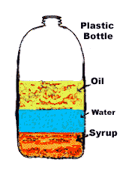
Which liquid is the least dense?
a)
oil
b)
water
c)
syrup 
d)
plastic bottle
45.
Why do objects sink or float in H2O
a)
Because their densities are higher or lower than compared to water
b)
Because their densities are using gravity to pull down
c)
Because their densities are heavier or lighter
d)
Because their mass and volumes are equal 
46.
Where can matter be found?
a)
Everywhere
b)
On Earth only
c)
In a solid and liquid only
47.
If you poured 3 liquids that do not mix how could you tell which one is the most dense?
a)
The liquid on top
b)
The liquid in the middle
c)
The liquid at the bottom