
 Worksheets
Basics of Semiconductor
Total questions: 20
Worksheet time: 12mins
The energy gap in semi conductor is approximately
1.1eV
0.3ev
0.5eV
11eV
Materials which can conduct electricity better than insulator,but not as well as conductors. This is the definition of
diode
semiconductor
conductor
insulator
superconductor
A semi conductor in an extremely pure form is known as an
Extrinsic semiconductor
P-Type semiconductor
N-Type semiconductor
Intrinsic semiconductor
The process of adding an impurity to an intrinsic semiconductor is called
Doping
Ionization
Recombination
Atomic modification
When a pentavalent impurity is added to a pure semiconductor, it becomes ………
An insulator
An intrinsic semiconductor
p-type semiconductor
n-type semiconductor
Addition of trivalent impurity to a semiconductor creates many ……..
Holes
Free electrons
Valence electrons
Bound electrons
At room temperature, an intrinsic semiconductor has ……….
Many holes only
A few free electrons and holes
Many free electrons only
No holes or free electrons
The minority carriers in P-type silicon are called _________________
Neutron
Proton
Electron
Hole
When a small amount of trivalent impurity is added to a pure semiconductor, it is known as
N-Type semiconductor
P-Type semiconductor
Intrinsic semiconductor
Insultaor
The majority carriers in n-type semiconductor
(a)
The number of electrons in the outermost orbit of silicon
4
14
3
8
Which of the following is a pentavalent impuity added while forming an extrinsic semiconductor ?
Boron
Arsenic
Indium
Gallium
These are the characteristics of Trivalent impurities except
•3 valence electrons
•produce p-type semiconductors
•producing a "hole".
Antimony, arsenic, and phosphorus are the examples
The current in a semiconductor is produced by
electron only
holes only
negative ions
both electrons and holes
Which is not one of the properties of semiconductor?
4 electrons in outermost orbit, in covalent bonding.
Valence Band and Conduction Band overlap each other.
Electron gets free leaves hole.
Semiconductor has 2 types of charge carriers.
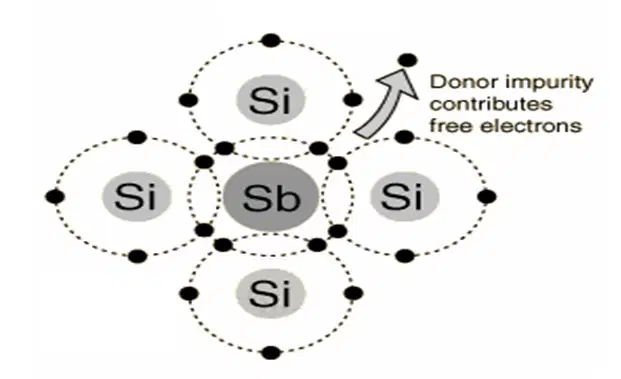
When donor impurities are added to si semiconductors as shown in figure, it forms
P-Type semiconductor
N-Type semiconductor
Conductor
Insulator
The barrier potential of silicon and germanium semiconductor
1.1v, 0.3v
0.3v,1.1v
0.3v, 0.7v
0.7v,0.3v
P-type and N-type extrinsic semiconductors are formed by adding impurities of valency?
5 and 3 respectively
5 and 4respectively
3 and 5 respectively
3 and 4 respectively
During formation of p-n junction
an electron diffuses from n to p side
a hole diffuses from p to n side
a hole diffuses from n to p side
an electron diffuses from p to n side
Let np and ne be the number density of holes and conduction electrons respectively in a semiconductor. Then,
np > ne in an intrinsic semiconductor, I < Ip + Ie
np = ne in an extrinsic semiconductor, I > Ip + Ie
np = ne in an intrinsic semiconductor, I = Ip + Ie
np > ne in an intrinsic semiconductor, I = 0( Here, Ip = current due to holes,Ie= current due to electrons, I= total current)

