
Font size
 Worksheets
Gov't EOC Review
Total questions: 50
Worksheet time: 34mins
Define separation of powers.
distribution of governmental powers among independent branches.
senators are elected by the people.
the government is sovereign over its people.
the idea of federalism plays a large role in the operation of the government on a daily basis.
What are checks and balances?
balancing the national budget
electing officials to represent the nation
making sure that Congress votes in a way that satisfies constituents.
a system for controlling government power.
Citizens vote to allow the local government to collect a tax levy. This is an example of ______________.
checks and balances
popular sovereignty
separation of powers
federalism
The president vetoes a bill passed into law by Congress. This is an example of what concept?
Popular Sovereignty
separation of powers
limited government
Checks and Balances
States are permitted to make their own laws concerning marriage, speed limits, and voting requirements. These are examples of which concept?
checks and balances
federalism
popular sovereignty
limited government
The government is not permitted to deny anyone their due process rights when they accuse someone of committing a crime. This reflects the principle of ____________________.
limited government
popular sovereignty
federalism
checks and balances
The legislative branch makes laws, the judicial branch interprets laws, and the executive branch enforces them. What concept is this?
federalism
limited government
popular sovereignty
separation of powers
The senate votes to approve (confirm) cabinet members appointed by the president. Which branch is checking the power of which other branch?
the executive branch is checking the power of the legislative
judicial checking the power of the legislative
legislative checking the power of the executive
executive checking the power judicial
Congress votes to add an amendment to the Constitution that makes something constitutional that was previously determined to be unconstitutional by the Supreme Court. Which branch is checking the power of which other branch?
legislative checking judicial
executive checking legislative
legislative checking executive
judicial checking legislative
Congress overrides a presidential veto with a 2/3 vote in both houses. Which branch is checking the power of which other branch?
executive checking legislative
judicial checking legislative
legislative checking executive
executive checking judicial
This amendment guarantees the freedom of speech, press, religion, assembly, and to petition the government.
This amendment asserts that powers not delegated to the national government or denied to the states are reserved to the states.
This amendment guarantees the right to bear arms.
This amendment prohibits excessive bail or fines and cruel or unusual punishment.
This amendment states that rights not listed in other amendments are still available to the people.
This amendment guarantees the right to a speedy and public trial in criminal cases with counsel (attorney).
This amendment guarantees the right to jury trial in civil suits when the amount being sought is $20 or more.
This amendment provides for freedom from self-incrimination (testifying against yourself) and being tried twice for the same crime if you are found not guilty (double jeopardy).
These people were in favor of adding the Bill of Rights to the Constitution.
Federalists
Antifederalists
The Bill of Rights reflects which main concept in the Constitution?
popular sovereignty
limited government
separation of powers
federalism
This group supported having a Bill of Rights added to the Constitution.
Federalist
Anti-federalist
They thought the states should have more power than a national (federal) government.
Federalist
Anti-federalist
This group was in favor of a strong central government to protect the nation.
Anti-Federalists
Patriots
Federalists
Who may have said this? A strong President is necessary to protect the country against foreign attack and make sure laws are carried out properly.
Anti-Federalist
Federalist
Who may have said this? I would like a strong central (Federal) government.
Federalist
Anti-Federalist
Who may have said this? I would like a weak central (Federal) Government.
Federalist
Anti-Federalist
Who may have said this? The President created by the Constitution is really just a king.
Federalist
Anti - Federalist
Who may have said this? The USA is too large to have a central government. People won't know their leaders and will lose control of the government.
Federalist
Anti-Federalist
Who wanted to ratify (pass) the Constitution?
Federalists
Anti-Federalists
What was the compromise the Anti-Federalists agreed to in order to ratify the Constitution?
Bill of Rights
Shay's Rebellion
Declaration of Independence
English Bill of Rights
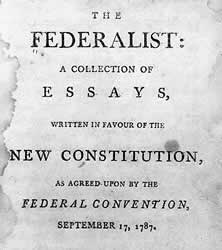
The "Federalist Papers" were written to:
Explain and convince the people into supporting the new U.S Constitution.
spark a new revolution among the American people against their government.
oppose a strong centralized government.
create a new monarchy.
Laws are made by the __________ branch.
legislative
executive
judicial
Laws are enforced by the ___________ branch.
legislative
executive
judicial
Laws are interpreted by the ____________ branch.
legislative
executive
judicial
In addition to making laws, the legislative branch also has duties including
proposing the federal budget, recognizing foreign nations, issuing executive orders
issuing writs of certiorari, establishing judicial procedures, sentencing offenders, accepting amicus curiae briefs.
conducting oversight investigations, instituting impeachment proceedings, approving treaties, passing resolutions
In addition to enforcing laws, the executive branch also has duties including
proposing the federal budget, recognizing foreign nations, issuing executive orders
issuing writs of certiorari, establishing judicial procedures, sentencing offenders, accepting amicus curiae briefs.
conducting oversight investigations, instituting impeachment proceedings, approving treaties, passing resolutions
Who is associated with the legislative branch?
the Supreme Court
the president
Congress, House of Representatives, Senate, legislature
Who is associated with the judicial branch?
Supreme Court, federal courts, the judiciary, appellate courts
the president
Congress
Define judicial review.
the Senate's ability to confirm presidential appointments.
the court's ability to interpret laws and the Constitution and to clarify their meaning.
the court's ability to impeach the president
taxing the states in order to generate revenue
What check does the Supreme Court have on Congress?
may veto laws
may disapprove treaties or appointments
may appoint judges
may declare legislative action unconstitutional
The Bill of Rights is made up of
Amendments 1-10.
Amendments 11-18.
Amendments 19-26.
To propose an amendment ______ of CONGRESS must approve.
3/4
3/5
1/4
2/3
Allows changes to be made to the Constitution.
Amendment process
Due process
Voting rights
Checks and balances
The 17th amendment allows for the direct election of senators by the people. Which constitutional concept is shown here?
popular sovereignty
limited government
federalism
separation of powers
A citizen is guaranteed rights by the first amendment such as the freedom of speech and religion. What concept is illustrated by these freedoms?
popular sovereignty
limited government
separation of powers
checks and balances
Amendment #10 reflects the concept of _____________.
popular sovereignty
limited government
federalism
separation of powers
In 1896 the Supreme Court declared in the Plessy v Ferguson that the concept of separate but equal was constitutional. But, in 1954 in the landmark case of Brown v Board of Education, the Court reversed that decision by declaring that it was now unconstitutional to segregate students by race in public schools. This is an example of how ___________________
the supreme court was wrong in its original decision
the president is too involved in the Supreme Court's decisions
the interpretation of the Constitution and its provisions can change over time
interpretation the Constitution remains the same at all times

