
 Worksheets
4.7 Oceans
Total questions: 60
Worksheet time: 43mins
An ocean is a/an __________ ecosystem.
marine
rain forest
savanna
fresh water
The word "marine" means anything that is found in, or made by, the sea.
True
False
_______________ break down dead plants and animals in the ocean, helping to release energy back into the ecosystem.
Producers
Consumers
Decomposers
___________________ get their energy by eating other organisms.
Producers
Consumers
Decomposers
Select all the Swimming Organisms below:
Sharks
Plankton
Fish
Coral
Select all the Floating Organisms below:
Sharks
Plankton
Fish
Phytoplankton

When water evaporates from the surface of the ocean, does that increase or decrease the salinity of the ocean water?
Increase the salinity
Decrease the salinity

Which Organisim in the Food web gets its energy from the Sun?
Large shark
Tuna
Small Fish
Phytoplankton
Using the Ocean Food web, which answer gives the correct order of an ocean food chain?
Large shark, Tuna, Mackeral, Small fish
Mackeral, Small Fish, Tuna, Shark
One-celled like, shrimp-like creatures, small fish, Tuna, Shark.
One-celled life, shrimp-like creatures, mackeral, tuna, shark.
Algae and other producers need a lot of sunlight to survive in the ocean. Which part of the ocean would they most likely live in?
Abyssal plain
Trench
Continental Shelf
Continental Slope
As you go deeper in the ocean, the temperature
Increases (gets warmer)
Decreases (gets colder)
Which of these increases as you go deeper in the ocean?
Temperature
Pressure
Number of plants

In this photo, who is the producer?
The plankton
the shrimp
the fish
the shark
What is the name for the group of organisms who float in the water and must have the sun to produce energy through photosynthesis? These organisms are the base of the food chain.
plankton
benthos
nekton
seaweed
What is the part of the ocean where most life is found? This is also the sloping border on the continent that is below the water.
ocean trench
continental shelf
abyssal plain
ocean current
Which of the following is an ocean current that borders the east coast of the United States?
Gulf Stream
Jett Stream
North Atlantic Current
Equatorial Current
Tides are controlled by....
Salinity
Wind and storms
The gravitational pull of the moon
The temperature of the water
About how much of the Earth is covered with ocean?
97%
55%
70%
85%
Which of the following is NOT a reason why it is difficult for most animals to live in the deep sea?
The pressure is too great.
There are too many predators swimming in the deep sea.
The temperature is too cold.
It is pitch black and they are unable to see
Ocean currents affect the following: (Choose all that apply)
Differences in temperature
The mixing of ocean water
States of matter
Plant and animal populations
The phases of the moon
Which of the following marine organisms can be classified as producers? Choose 2
correct answers.
Crabs
Phytoplankton
Sharks
Zooplankton
Seaweed
What part of ocean water do marine organisms depend on for survival?
Dissolved gases
sediments
seaweed
decaying animal matter
Choose 4 events that can impact the level of salinity in the ocean water.
Depth of the water
Evaporation
Humans swimming in the water
Melting of an iceberg
Rain water running off the land
Which organism is the producer?


Many species of ocean organisms live in coral reefs. The map shows that most coral reefs are found near the equator. What does the location of coral reefs suggest about coral organisms?
Corals need warm seawater to survive.
Corals mostly live around volcanic islands.
Ocean currents keep corals from migrating.
Most ocean waters are too deep for corals.
Ocean water is a mixture of all the following except–
gases
water
dissolved solids
vinegar
Which organisms are non-moving in the ocean?


Which organisms swim in the ocean?
Which organism floats in the ocean?
Select all that apply: Which of the following are the producers in an oceanic food web?
great white shark
algae
plankton
clownfish
The most important reason that lakes and oceans have different types of animal life is that oceans have –
Sandy shores and bottoms
Water with more salt
Large waves at the edge
A much larger surface area

Which location is likely to have the greatest water pressure, the coldest temperature, and the smallest number of living organisms?
Continental Shelf
Ocean Trench
Continental Rise
Abyssal Plain

The ocean floor–
Is always a flat bed of sand
Has mountains, plains, and ridges like land surfaces
Is covered by the same amount of water everywhere
Covers less area than the land
What causes the salinity in the ocean to decrease? Select 2 answers.
river run off
depth of water
melting of ice
evaporation
What causes the salinity in the ocean to increase? Select 2 answers.
river run off
depth of water
melting of ice
evaporation
Which is the best way to describe the continental shelf?
A flat underwater valley
A region of mountain in the deep ocean
A shallow area of sediment near the ocean shore
A region with a higher water pressure
The back and forth movements caused by the gravitational pull of the moon are called
tides
currents
waves
drifts
The salinity of the Mediterranean Sea is greater than that of the Atlantic Ocean. This means that, compared to the Atlantic Ocean, the Mediterranean Sea is —
wider
saltier
cooler
deeper

Sailors long ago would catch the current off the coast of Virginia. This current would help them get to which continent?
South America
Central America
Europe
Southern African

What do the arrows on the map represent?
size of waves
water weight
ocean currents
time between tides
What is a current?
increase in temperature
circular pattern of wind
decrease of salinity
motion of water that looks like a river undersea
What causes tides?
moon's gravity
sun's gravity
salinity
earth's gravity
Which feature of the ocean floor connects the steep walls of the continental slope to the bottom of the ocean floor?
Continental Shelf
Continental Slope
Abyssal Plains
Continental Rise
Ocean Trench

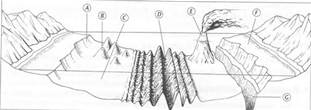
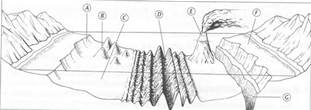
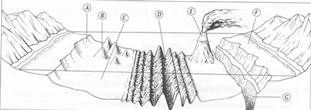
Which part of the ocean floor is labeled "D"?
Mid-Ocean Ridge
Continental Slope
Blue-Ridge Mountains
Abyssal Plain
The Abyssal Plain is known for being...
dark, flat and barren.
a very steep slope.
canyons cut into the continental slope.
submerged, flat-top, inactive volcanos.
An underwater mountain range that is an oceanic spreading center. Responsible for the creation of new ocean floor.
trench
mid-ocean ridge
abyssal plain
continental shelf
What is ocean water made of? Select all correct answers
gases
oil
water
sugar
dissolved solids
In the sea, phytoplankton use the sun's energy to make their own food. This makes them a _________.
producer
consumer
decomposer
Select all the correct answers.
Oceans ___________
are large bodies of salt water
are large bodies of fresh water
cover about 71% of Earth's surface
contain about 50% of Earth's water
In some parts of the world, tuna are being overfished. What could this cause?
The organisms that tuna eat will increase in population.
The organisms that eat tuna will increase in population.
There would be no effect.
As you swim deeper towards the ocean floor, (a) and (b) increase.
As you swim deeper towards the ocean floor, (a) and (b) decrease.
Label the parts of the ocean floor.
abyssal plain
continental rise
trench
continental slope
continental shelf
Most of the ocean floor is covered with thick layers of ______
concrete
soil and pebbles
sand, mud, and rocks
moss

Use the picture below to answer the question. Which of the following is closest to how deep great white sharks dive?
1,000 m
1,500 m
2,000 m
2,500 m

Use the picture below to answer this question: Which of the following best represents the abyssal plain?
1
2
3
4

This is an angler fish. This organism produces light from its rod-like flesh coming from its forehead. It uses this adaptation to lure its prey out of the dark. What inference can you make about where this marine organism lives?
This fish can live anywhere because it has its own light.
This fish lives near the continental shelf and gets its light from the sun.
This fish will live best on the continental slope.
This fish lives in an ocean trench because it is the deepest, darkest area of the ocean.

