
 Worksheets
Chapter 18 Review
Total questions: 83
Worksheet time: 2hrs 50mins
Label the voltaic cell correctly.
Flow of positive ions
Flow of negative ions
Flow of electrons
anode
cathode
M2+(aq) converting into M(s)
M(s) converting into M2+(aq)

Figure shows a chemical cell. What is the energy conversion that occurs in the cell?
Kinetic energy to potential energy
Reactions in voltaic (galvanic) cells are.... (2 answers)
spontaneous reactions
non-spontaneous reactions
redox reactions
non-redox reactions
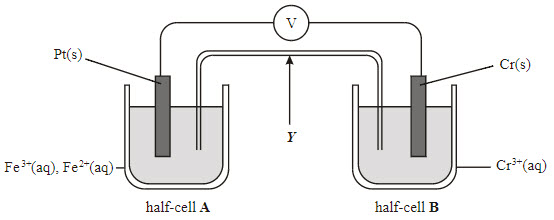
To allow flow of ions for charge neutrality

The diagram shows the set-up of the apparatus of a chemical cell. Magnesium is converted from Mg(s) to Mg2+(aq). Which of the following observations will you make?
The magnesium rod becomes thicker
The iron rod becomes thinner
Electrons flow from iron to magnesium
the green colour of iron(II) sulphate becomes paler (lighter)
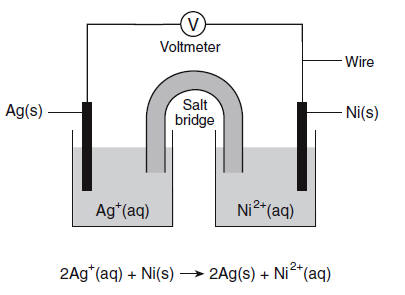
In a Galvanic Cell, the salt bridge...
completes the circuit so that electrons can flow through the wire
maintains charge balance
is soaked in an unreactive electrolyte such as KNO3
all of the above
What unit of measurement do we use to measure electrical potential?
Watts
Amps
Volts
Ohms
Which way do electrons flow in a galvanic cell? (2 answers)
Cathode to anode
Positive to negative terminal
Anode to cathode
Negative to positive terminal
Match the following keywords and definitions:
A species that accepts electrons from another species, undergoing reduction itself.
Oxidizing Agent
The potential difference between a standard hydrogen electrode (SHE) and another half-reaction
Standard Electrode Potential (E°)
The voltage measured under standard conditions for a galvanic cell. E°cell is the difference between the standard electrode potentials of the two half-reactions (cathode - anode). A positive value indicates a spontaneous reaction.
Standard Cell Potential (E°cell)
Allows for ionic flow to maintain charge neutrality within the cell while minimizing mixing of solutions.
Salt Bridge
Where oxidation occurs (electrons are lost).
Anode
Under specific conditions, the cell potential E can be considered a standard cell potential E°.
What are these conditions?
Pressure of 1atm for gases
1 mol of all species
1M aqueous for all solutions
298K
KNO3 must be used for the salt bridge
In a Galvanic Cell, the anode is...
positive
negative
In a Galvanic Cell, the cathode is...
positive
negative
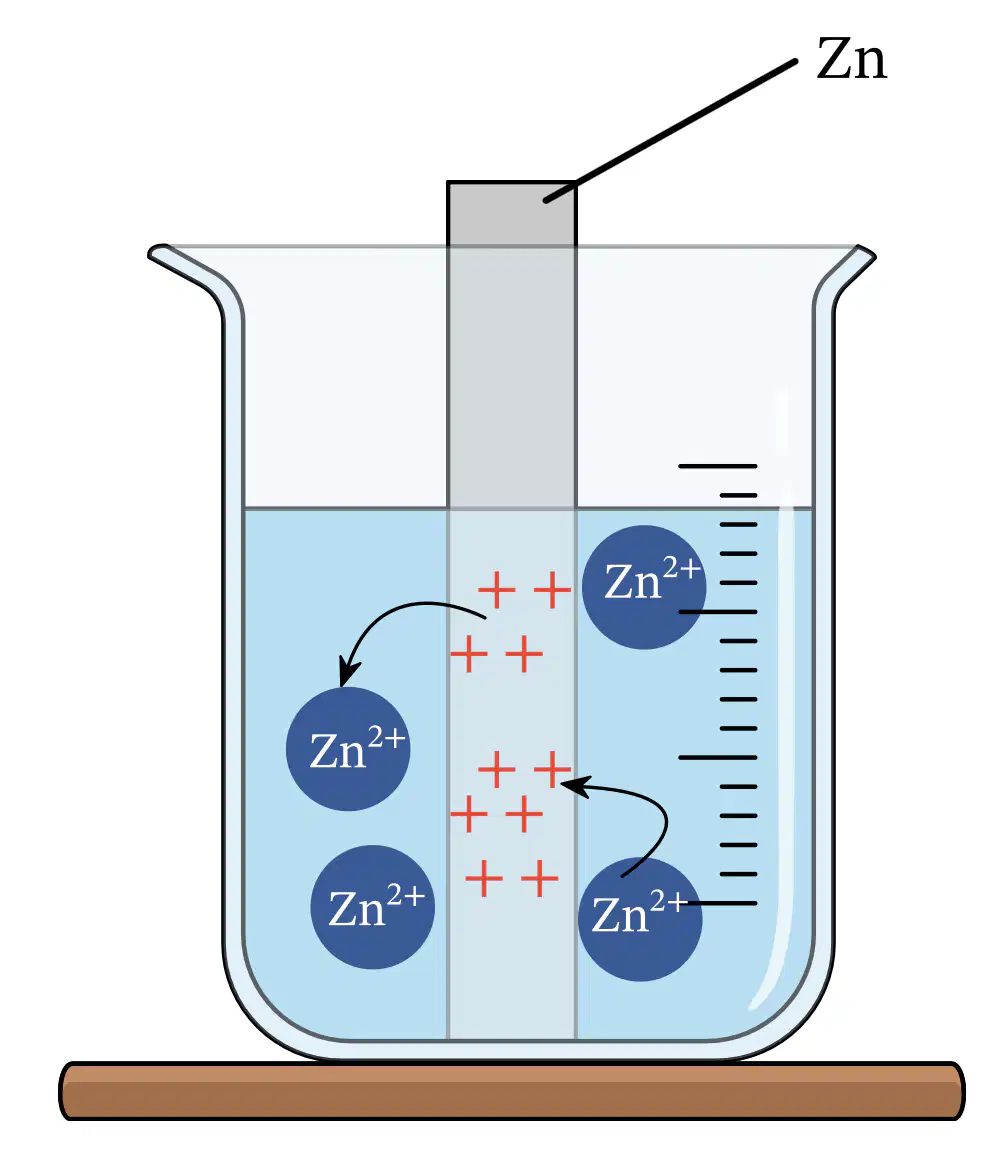
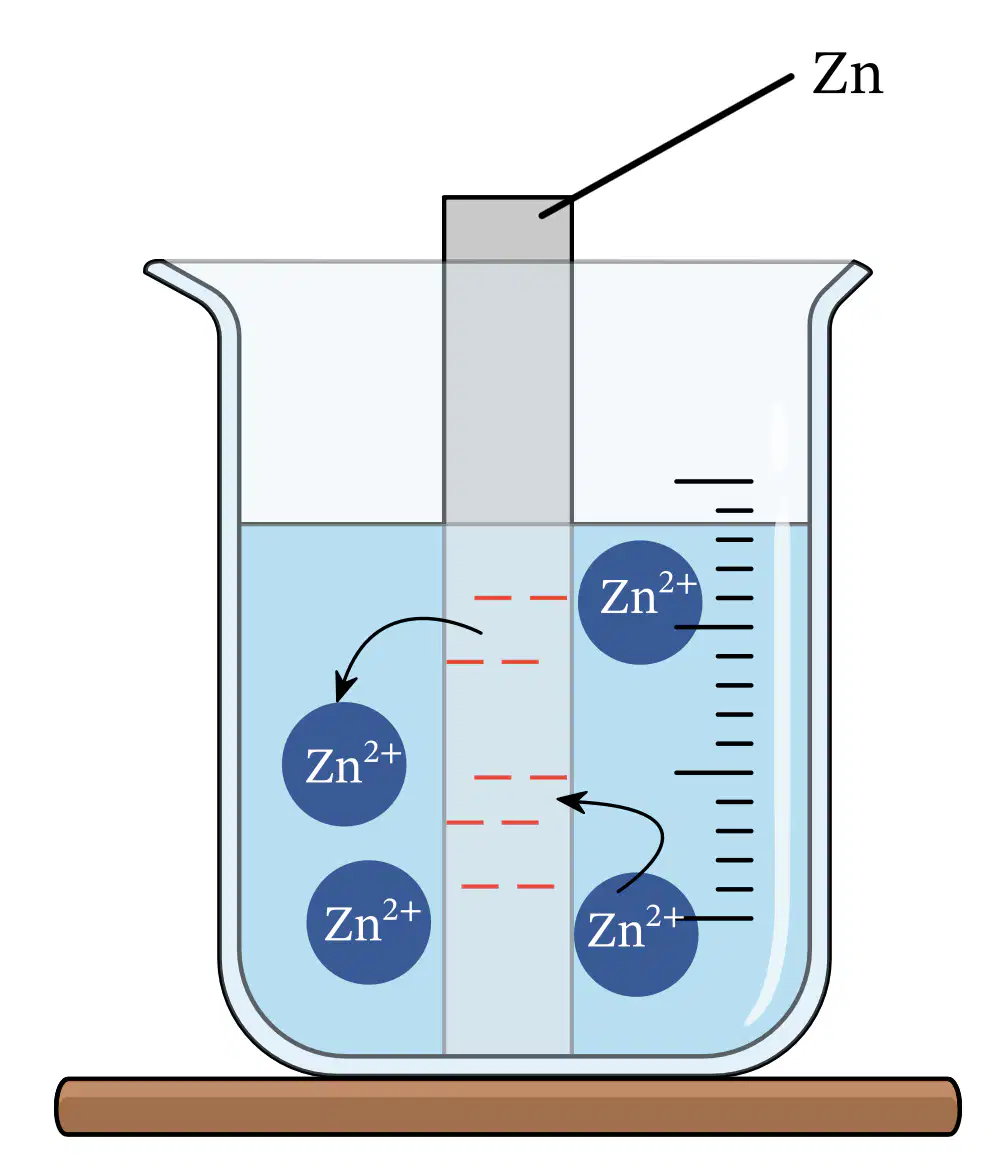
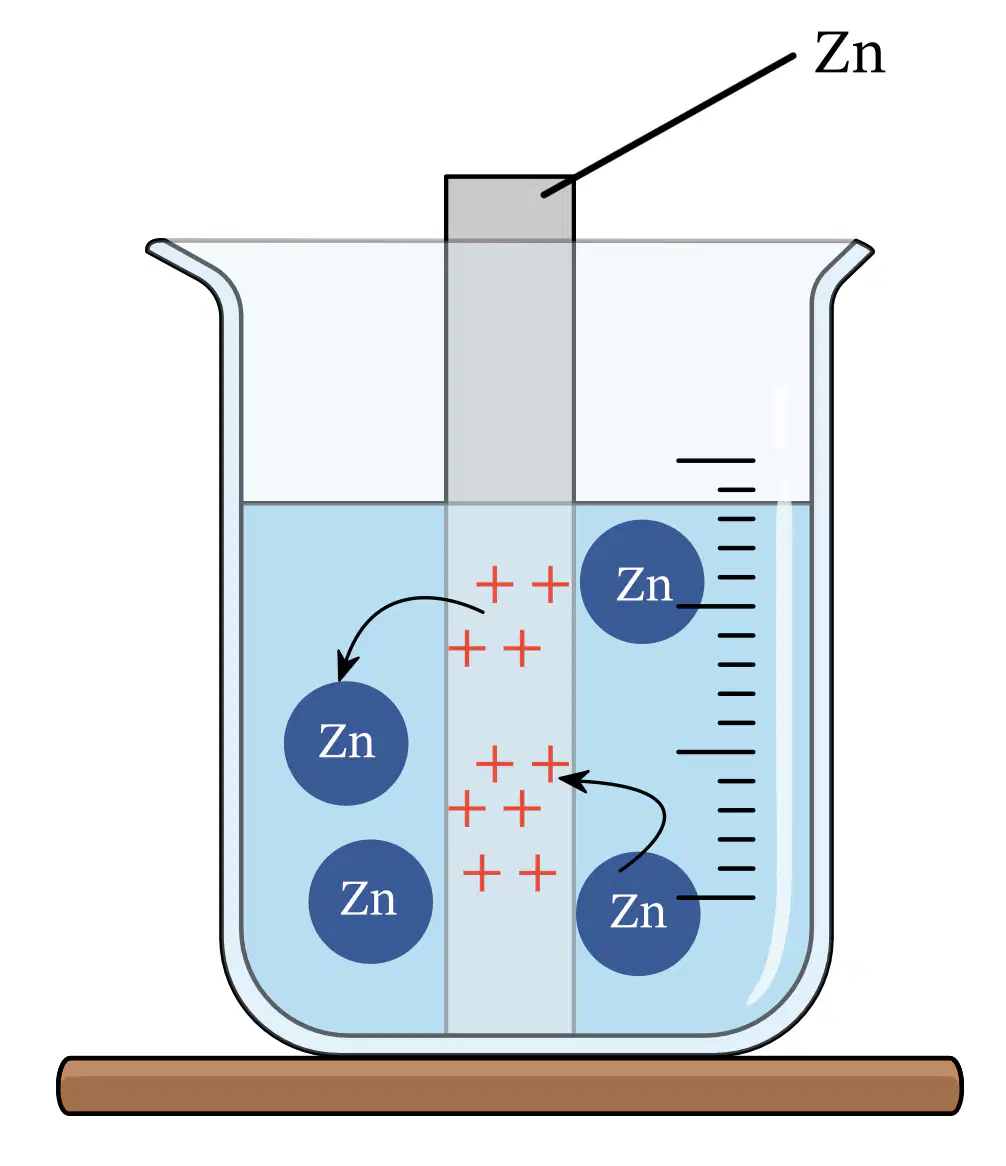
Which of the following diagrams depicts the equilibrium that exists between a piece of zinc metal in contact with an aqueous solution of zinc ions?

Ecell =
Ered - Eox
Ered + Eox
Eox - Ered
Eox + Ered
E° for a half reaction will change when you multiply the half-reaction by an integer.
Sometimes

Calculate E°cell for a Cadmium (Cd) - Zinc (Zn) cell.
1.16 V
-1.16 V
0.36 V
-0.36 V

Calculate E°cell for the following for a Cadmium (Cd) - Copper (Cu) cell.
0.74 V
-0.74 V
-0.06 V
0.06
In a redox reaction, the reducing agent... (choose two options)
is oxidised
is reduced
increases its oxidation number
decreases its oxidation number
In a Galvanic cell, the cations in the salt bridge...
flow the same way as the electrons flow in the wire
flow the opposite way to the electron flow in the wire
stay in the salt bridge
A certain galvanic cell has for its spontaneous cell reaction: Zn + HgO → ZnO + Hg
Which is the half-reaction occurring at the anode?
HgO + 2 e- → Hg + O2-
Zn2+ + 2 e- → Zn
Zn → Zn2+ + 2 e-
ZnO + 2 e- → Zn
A certain galvanic cell has for its spontaneous cell reaction: Zn + HgO → ZnO + Hg
Which is the half-reaction occurring at the cathode?
HgO + 2 e- → Hg + O2-
Hg → Hg2+ + 2 e-
Zn → Zn2+ + 2 e-
ZnO + 2 e- → Zn

Zn2+ forms Zn
Zn forms Zn2+
Br2 forms Br-
Br- forms Br2
Voltaic cells are the same as which other cells?
Galvanic
Electrolyte
Electron
Electrolytic
Choose the correct symbols for each of the uses in 'line notation' describing voltaic cells.
when separating phases (phase boundary)
use a line ' | '
when none of the species in a half cell are solid
use Platinum as an electrode
to represent the salt bridge
use a double line ' | | '
to start and end the line notation
us the electrodes
always
show the state symbols for every species
Which is the conventional way to depict a cell made from a zinc half-cell connected to a copper half-cell?
Zn2+(aq) | Zn(s) | | Cu(s) | Cu2+(aq)
Zn2+(aq) | Zn(s) | | Cu2(aq) | Cu(s)
Zn(s) | Zn2+(aq) | | Cu2+(aq) | Cu(s)
Zn(s) | Zn2+(aq) | | Cu(s) | Cu2+(aq)


What happens to the cell voltage when the salt bridge is removed?
The cell voltage drops to zero.
The cell voltage increases.
The cell voltage becomes negative.
The cell voltage is unchanged.

The diagram shows a zinc-copper voltaic cell. Which statement is not correct when the cell is operating?
The overall reaction taking place is:
Cu2+(aq) + Zn(s) → Zn2+(aq) + Cu(s)
The concentration of zinc ions in the zinc half-cell remains constant.
Electrons flow from the zinc to the copper in the external circuit
The salt-bridge allows the flow of ions between the two half-cells
What is the correct derivation for the Nernst Equation at 298K, starting from the equation below?
Ecell=Ecello−nFRTlnQ
Ecell=Ecello−nF1.00logQ
Ecell=Ecello−n0.0591logQ
Ecell=Ecello+n0.0591lnQ
Ecell=Ecello−n0.0591lnQ
What is the correct Nernst equation for the following cell:
Mg(s) | Mg2+(aq, 0.001M) | | Al3+(aq, 0.001 M) | Al (s)
Ecell=Ecello− 60.0592log[Al3+]2[Mg2+]3
Ecell=Ecello− 60.0592log [Mg2+]3[Al3+]2
Ecell=Ecello+ 30.0592log[Al3+]2[Mg2+]3
Ecell=Ecello− 30.0592log[Al3+]2[Mg2+]3
At different concentrations of ions in the two half cells, the measured current differs. Sort the statements into the correct categories.
Zn(s) + Cu2+(aq) → Zn2+(aq) + Cu(s)
E° = 1.10 V ΔG° = -212 kJ/mol K = 1.5 × 1037
Q = [Cu2+][Zn2+]
Remember that Ecell=Ecello−nFRTlnQ
Q < 1
Q = 1
Q > 1
Q = K = 1.5 x 1037
The concentration of copper ions is greater than zinc ions
The concentrations of copper and zinc ions are equal
Standard conditions
The concentration of zinc ions is greater than copper ions
The cell is at equilibrium
The cell is "dead".
lnQ < 0 i.e. negative
lnQ = 0
lnQ > 0 i.e. positive
Calculate the Ecell for the following galvanic cell.
Zn(s) | Zn2+ (aq, 1.0M) || Ag+ (aq, 1.5M) | Ag(s)
EAg+ | Ag = +1.08V and EZn2+ | Zn = -0.76V
0.32 V
0.33 V
1.84 V
1.85 V
Calculate the cell potential, Ecell of the electrochemical cell in which reaction
Pb2+ (aq) + Cd (s) → Pb (s) + Cd2+ (aq)
Given that Eocell = +0.277 V,
[Cd2+] = 0.02M, and [Pb2+] = 0.2M.
0.207 V
0.255 V
0.307 V
0.355 V
The cathode is ___________.
Zn(s)|Zn(aq)2+‖Cd(aq)2+|Cd(s).
Zn
Zn2+
Cd
Cd2+
The cathode is ___________.
Sn(s)|Sn(aq)2+‖Ag(aq)2+|Ag(s).
Sn
Sn2+
Ag
Ag2+
Which is correct to write cell notation
Anode: Zn
Cathode: Ni
Zn2+ (aq, 1M) | Zn (s) || Ni (s) | Ni2+ (aq, 1M)
Zn (s) | Zn2+ (aq, 1M) || Ni2+ (aq, 1M) | Ni (s)
Zn2+ (s, 1M) | Zn (aq) || Ni (aq) | Ni2+ (s, 1M)
Zn (aq) | Zn2+ (s, 1M) || Ni2+ (s, 1M) | Ni (aq)
Zn (s) | Zn2+ (aq, 1M) || H+ (aq, 1M) | H2 (g, 1 atm) | graphite (s)
Based on cell notation above, give the one electrolyte that can be used in the cathode.
ZnSO4 (aq)
H2 (aq)
ZnCl2 (aq)
HCl (aq)
Based on the cell notation below, give a suitable formula for X in the cell notation below?
X | H2(g, 1 atm) | H+ (aq,1M) || Ag+ (aq, 1M) || Ag (s)
Ag (s)
H (s)
Pt (s)
Zn (s)
Based on cell notation, write overall equation:
Al(s) | Al3+(aq, 1M) || Pb2+(aq, 1M) | Pb(s)
Pb(s) + Al3+(aq) ----------> Pb2+(aq) + Al(s)
Pb2+(aq) + Al(s) ---------->Pb(s) + Al3+(aq)
3Pb(s) + 2Al3+(aq) ----------> 3Pb2+(aq) + 2Al(s)
3Pb2+(aq) + 2Al(s) ---------->3Pb(s) + 2Al3+(aq)
Which of the cell notation is CORRECT for this redox equation:
2Ag+(aq) + Cu(s) --> Cu2+(aq) + 2Ag(s)
Cu(s) │ Cu2+(aq, 1M) ║ 2Ag+(aq, 1M) │ 2Ag(s)
Cu(s) │ Cu2+(aq, 1M) ║ Ag+(aq, 1M) │ Ag(s)
Ag(s) │ Ag+(aq, 1M) ║ Cu2+(aq, 1M) │ Cu(s)
2Ag(s) │ 2Ag+(aq, 1M) ║ Cu2+(aq, 1M) │ Cu(s)
How can the cell potential, Ecell be increased based on the Nernst equation:
Ecell=Ecello− n0.0592log [Ni2+][Zn2+]
Increase temperature
Decrease concentration Ni2+
Increase concentration Ni2+
Choose Eocell anode and cathode the positive value
Calculate the cell potential, Ecell of the electrochemical cell in with reaction
Pb2+ + Cd → Pb + Cd2+
Given that Eocell = 0.277 V
[Cd2+] = 0.02M, and [Pb2+] = 0.2M
Ecell= Ecello−n0.0592logQ
0.207 V
0.255 V
0.307 V
0.355 V
Calculate the concentration of silver ions Ag+ :
Eo(Ag+/Ag) = 0.8V
Eo(Cu2+/Cu) = 0.34V
Cell potential, Ecell (at 25oC) = 0.422V,
Given [Cu2+] = 0.1M
(give your answer to 2decimal places)
Ecell = Ecello−n0.591log Q
(a)
Standard electrode potential of a half-cell is measured with reference to
standard hydrogen electrode with 1.00M H2SO4 solution
standard oxygen electrode with 1.00M H2SO4 solution
standard chlorine electrode with 1.00M H2SO4 solution
d) standard hydrogen electrode with 1.00 M HCl solution
What is the correct derivation for the Nernst Equation, starting from the equation below?
Ecell=Ecello−nFRTlnQ
Ecell=Ecello−nF1.00logQ
Ecell=Ecello−n0.0591logQ
Ecell=Ecello+n0.0591lnQ
Ecell=Ecello−n0.0591lnQ
What phase must a compound be in order for electrolysis to work? (choose 2 of 4)
molten
solid
aqueous
gaseous
An example for weak electrolyte is:
HCl
NaOH
Acetic acid
H2SO4
6. Why is sodium chloride not able to conduct electricity in a solid state?
Ion move freely
Solid sodium chloride contains sodium ions
Sodium ions and chloride ions are held together by the strong electrostatics force caused them not to move freely
Sodium ions receive electrons to form a metal and chloride ions lose electrons to form chlorine gas
Why must electrolyte must be in the liquid or aqueous state?
So the ions can move
So that ions does not get hot
So the elements can move
So the ions can be attracted
What are the ions present in molten lead(II) bromide?
PbBr2
Pb and Br
Pb2+ and Br-
Pb2+ and Br2-
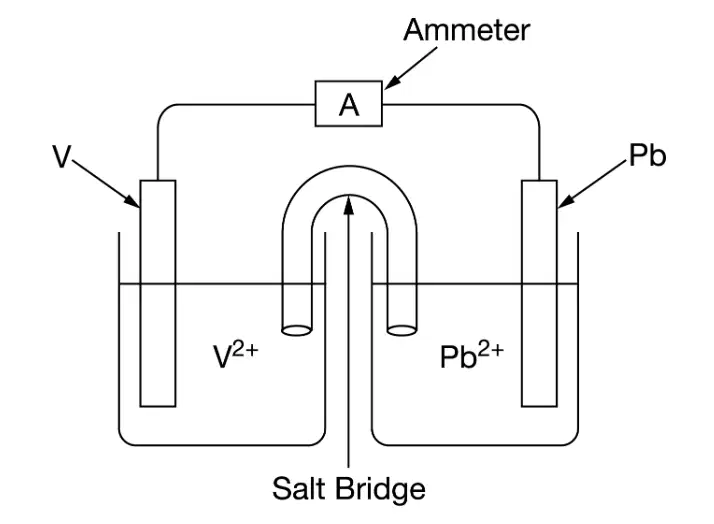
V2+ + 2e- --> V . Eo = -1.18V
Pb2+ + 2e- --> Pb . Eo = -0.13V
Which of the following mathematical relationships would be most useful for determining the change in mass of an electrode after 1.0 minute of the cell's operation without having to use a balance?
Ecello =Ecello−nFRTlnQ
I=tq
ΔG=−nFEo
ΔG=ΔH−TΔS
Which factors affect amount of metal formed during electrolysis? (choose more than one)
Charge on the metal ion
Current
Time
Volume of electrolyte
Which equation allows you to calculate the mass of a metal that will deposit on an electrode?
m = MM⋅n⋅FI⋅t
m = MM⋅I⋅tn⋅F
m = n⋅FMM⋅I⋅t
m = (MM⋅I⋅t)(nF)
The anode is where oxidation occurs in...
A Galvanic Cell
A Electrolytic Cell
Both Galvanic and Electrolytic cells
The method of coating metals by immersing the metals in a solution and then passing an electric current through the liquid is called ________
Electrolysis
Electrospading
Electropalting
Electroplation
m=n⋅FMM⋅I⋅t
What are the units of the following:
mass = (a) moles = (b) times = (c) Faraday = (d) current = (e)
What is the name given to the solution that is being electrolyzed?
Electrolyze
Solvent
Which of the following is TRUE about the particles present in solid and molten sodium chloride?
both solid and molten sodium chloride contain ions
solid sodium chloride contains atoms while molten sodium chloride contains ions
solid sodium chloride contains molecules while molten sodium chloride contains ions
solid sodium chloride contains atoms while molten sodium chloride contains molecules
Why must electrolytes must be in the liquid (molten) or aqueous state?
So the ions can move
So that ions does not get hot
So the elements can move
So the ions can be attracted
Which of the following is NOT an electrolyte?
molten glucose (C6H12O6)
aqueous ammonia (NH3)
molten lead(II) bromide
molten potassium iodide
Glucose (C6H12O6) does not conduct electricity because it...
contains freely moving electrons
has very low melting points
does not contain ions
contains ionic compounds which can dissolve in water
Which one of the following statements is true for both galvanic cells and electrolytic cells?
Reduction occurs at the negative electrode in both cells.
Reduction occurs at the cathode in both cells.
Anions migrate to the cathode in both cells.
The anode is positive in both cells.
What does the Cathode (-) do to ions in electrolytic cells?
Give electrons to the positive ions to turn them into atoms
Take electrons from the positive ions
Turn ions back into atoms by removing electrons
What substances are produced at positive/negative electrodes during the electrolysis of molten NaCI?
Anode: Na+
Cathode: Cl2
Anode: Cl-
Cathode: Na+
Anode: Na
Cathode: Cl2
Anode: Cl2
Cathode: Na
What do you expect to observe at the positive and negative electrodes during electrolysis of molten NaCI?
Anode: pH increases
Cathode: pH decreases
Anode: metallic substance forms
Cathode: greenish bubbles form
Anode: bubbles form
Cathode: bubbles form
Anode: greenish bubbles form
Cathode: metallic substance forms
Complete the answers for MOLTEN calcium bromide:
Cation: (a) Anion: (b) Product at the cathode: (c) Product at the anode: (d)

A spoon is electroplated with chromium using chromium(III) nitrate. Which statement is correct?
Positive electrode increases in mass
Concentration of Cr3+ ions in solution decreases
Reduction occurs at the anode
Reaction at the cathode is Cr3+ + 3e– → Cr

What happens at the anode? (two answers)
Cations are attracted, and are oxidised
Anions are attracted, and are oxidised
If there are competing species;
the most negative Eo gets oxidised
If there are competing species;
the most positive Eo gets oxidised

The diagram shows the electrolysis of copper(II) chloride solution using carbon as electrodes.
Which of the following is the correct half-equation representing the reaction at anode?
Cl2(g) + 2e- → 2Cl-(aq) (E° = 1.36 V)
O2(g) + 4H+(aq) + 4e- → 2H2O(l) (E° = 1.23 V)
2H2O(l) → O2(g) + 4H+(aq) + 4e-
2Cl- → Cl2 + 2e-
Cu → Cu2+ + 2e-
Cu2+ + 2e- → Cu
Molten X is electrolysed using carbon electrodes. After 10 minutes, a brown solid is deposited on the cathode and a brown gas is released at the anode. What is molten X?
Lead(II) chloride
Lead(II) bromide
Copper(II) chloride
Copper(II) bromide
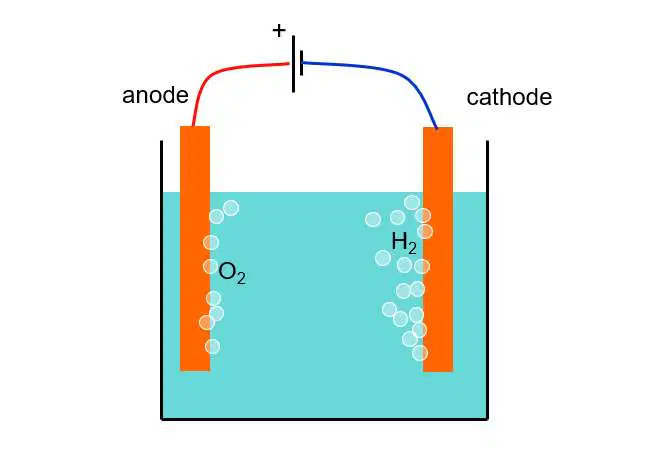
What happens during the electrolysis of water?
bubbles of hydrogen is produced
bubbles of oxygen is produced
2H2O(l) + 2e- → H2(g) + 2OH-(aq) (E° = -0.83 V)
O2(g) + 4H+(aq) + 4e- → 2H2O(l) (E° = 1.23 V)
pH around this electrode decreases
pH around this electrode increases
Aqueous zinc chloride is electrolysed using platinum electrodes. What are the products expected at each electrode based purely on Eo values?
Zn2+(aq) + 2e− → Zn(s) (E° = -0.76 V)
2H2O(l) + 2e- → H2 (g) + 2OH-(aq) (E° = -0.83 V)
Cl2(g) + 2e- → 2Cl-(aq) (E° = 1.36 V)
O2(g) + 4H+(aq) + 4e- → 2H2O(l) (E° = 1.23 V)
cathode: hydrogen
anode: chlorine
cathode: oxygen
anode: hydrogen
cathode: zinc
anode: oxygen
cathode: zinc
anode: water

