
 Worksheets
Chemistry Cycle 2 Review
Total questions: 85
Worksheet time: 2hrs 30mins
Name
Class
Date
1.
J.J. Thomson discoverd what?
a)
neutron
b)
proton
c)
electron
d)
nucleus
2.
Bohr's planetary model involved the electrons residing in ____________.
a)
clouds
b)
orbitals
c)
nucleus
3.
Modern atomic theory involves the electrons residing in ____________.
a)
clouds
b)
orbitals
c)
nucleus
4.
Rutherford's model of the atom introduced the _________.
a)
electron
b)
neutron
c)
orbitals
d)
nucleus
5.
Rutherford described the nucleus as all of the following except:
a)
small
b)
dense
c)
neutral
d)
positive
6.
The Plum Pudding Model belongs to which scientist?
a)
Rutherford
b)
Dalton
c)
Thomson
d)
Dalton
7.
J.J. Thomson used the cathode ray experiment to prove the existence of which subatomic particle?
a)
electron
b)
neutron
c)
nucleus
d)
proton
8.
This man was the first to say that everything in the universe is made up of tiny particles called atoms?
a)
Democritus
b)
Dalton
c)
Copernicus
9.
Rutherford used the gold foil experiment to prove the existence of what?
a)
electron
b)
neutron
c)
nucleus
d)
atoms
10.
This man said that atoms of the same element are identical?
a)
Democritus
b)
Dalton
c)
Thomson
d)
Rutherford
11.
In the modern periodic table elements are arranged by:
a)
atomic mass
b)
atomic number
c)
valence electrons
d)
number of isotopes
12.
Each column in the periodic table is called a
a)
period
b)
group
c)
cluster
d)
unit
13.
The atomic number tells you what?
a)
number of electrons
b)
number of protons
c)
number of neutrons
d)
both electrons and protons in an atom.
14.
Which group of the periodic table is composed of inert (not reactive) gases?
a)
alkali metals
b)
alkaline earth metals
c)
halogens
d)
noble gases
15.
Elements which are shiny, conduct electricity and heat are called
a)
metal
b)
nonmetal
c)
metalloid
d)
nonexistent
16.
Which element is not a metal?
a)
H
b)
Re
c)
Al
d)
B
17.

The atoms along the staircase are called
a)
metals
b)
nonmetals
c)
metalloids
d)
noble gases
18.
Which is a halogen?
a)
Helium
b)
Chlorine
c)
Oxygen
d)
Neptune
19.
Which is an alkali metal?
a)
Magnesium
b)
Iron
c)
Sodium
d)
Europium
20.
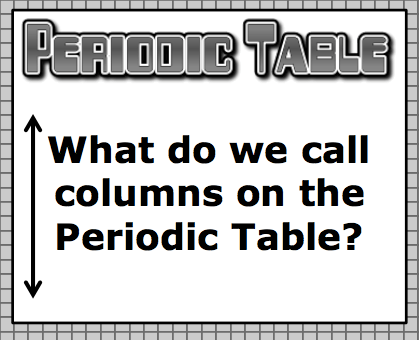
a)
Periods
b)
Groups
21.
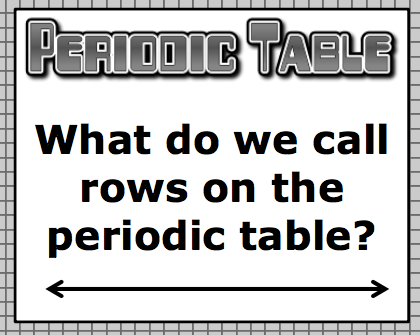
a)
Periods
b)
Groups
22.

a)
energy levels
b)
valence electrons
c)
protons
d)
neutrons
23.
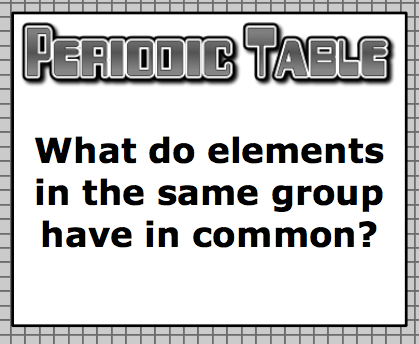
a)
energy levels
b)
valence electrons
c)
protons
d)
neutrons
24.
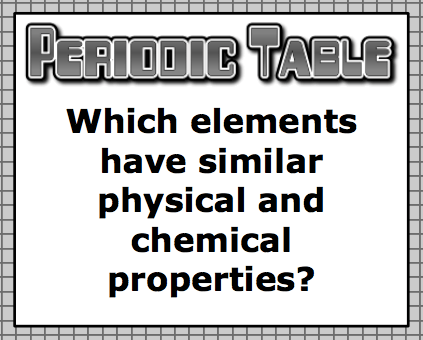
a)
Same group
b)
Same period
25.

a)
Metals
b)
Nonmetals
26.

a)
Metals
b)
Nonmetals
27.
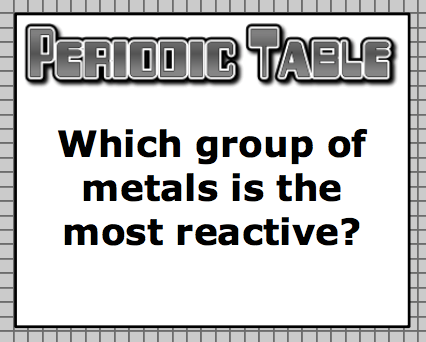
a)
Group 1
b)
Group 17
c)
Group 18
d)
Group 2
28.
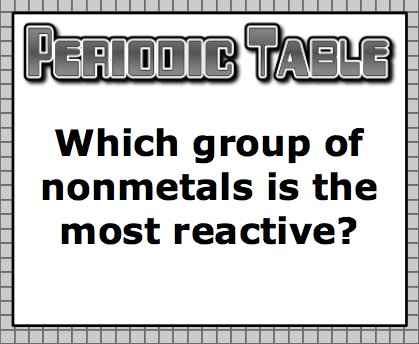
a)
Group 1
b)
Group 17
c)
Group 18
d)
Group 2
29.
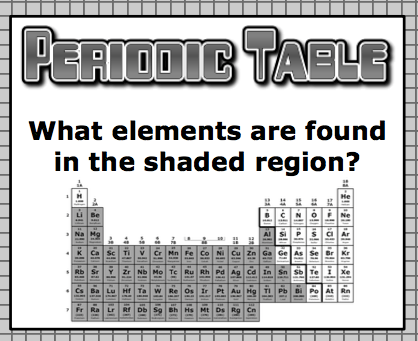
a)
Metals
b)
Nonmetals
c)
Metalloids
30.
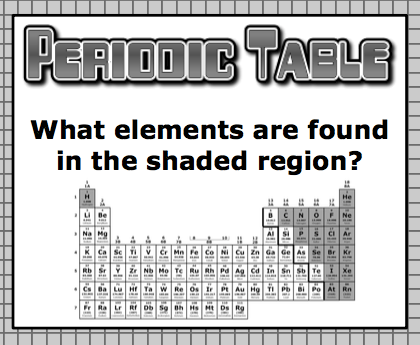
a)
Metals
b)
Nonmetals
c)
Metalloids
31.
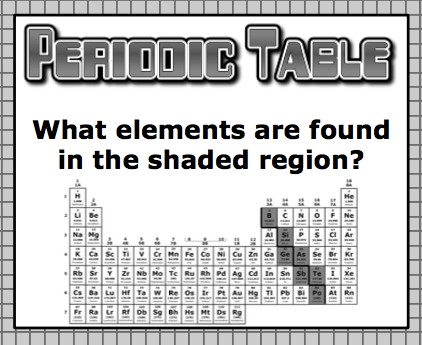
a)
Metals
b)
Nonmetals
c)
Metalloids
32.
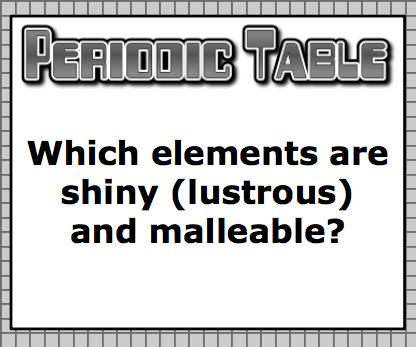
a)
Metals
b)
Nonmetals
c)
Metalloids
33.
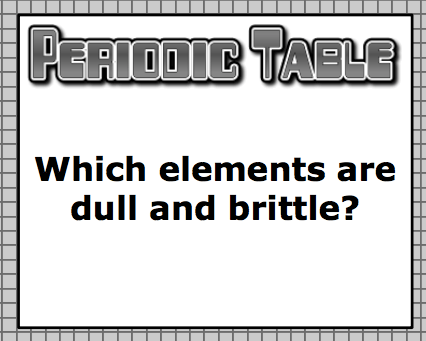
a)
Metals
b)
Nonmetals
c)
Metalloids
34.
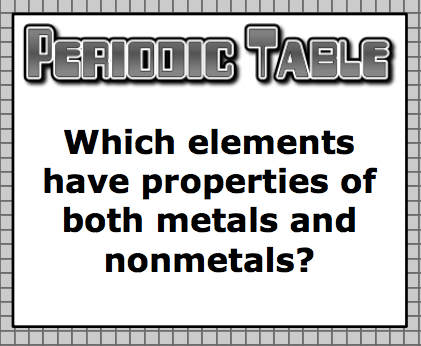
a)
Metals
b)
Nonmetals
c)
Metalloids
35.
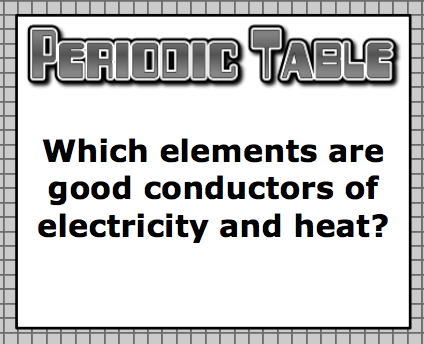
a)
Metals
b)
Nonmetals
c)
Metalloids
36.
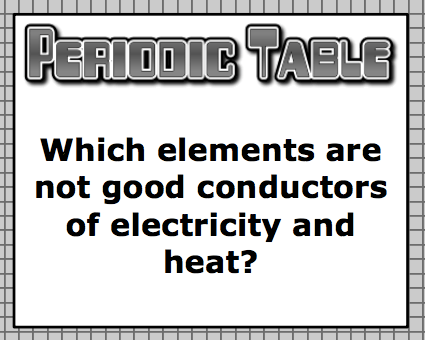
a)
Metals
b)
Nonmetals
c)
Metalloids
37.
What type of ion will Iodine (I) form?
a)
1-
b)
2-
c)
1+
d)
2+
38.
What type of ion will Oxygen (O) form?
a)
1-
b)
2-
c)
1+
d)
2+
39.
What type of ion will Lithium (Li) form?
a)
1-
b)
2-
c)
1+
d)
2+
40.
What is the symbol for the ion that has 17 protons and 18 electrons?
a)
Cl+
b)
Ar+
c)
Ar-
d)
Cl-
41.
What is the symbol for the ion that has 11 protons and 10 electrons?
a)
Na+
b)
Ne+
c)
Ne-
d)
Na-
42.
What is the symbol for the ion that has 13 protons and 10 electrons?
a)
Al3+
b)
Ne3+
c)
Ne3-
d)
Al3-
43.

What is the most stable configuration for electrons in the outer energy level? (think octet)
a)
8
b)
4
c)
5
d)
1
44.

Isotopes are atoms that have the same number of ________ but differing number of __________
a)
protons, electrons
b)
neutrons, protons
c)
protons, neutrons
d)
electrons, protons
45.

Which combination of protons, neutrons, and electrons is correct for the isotope of copper, Cu-63?
a)
29 protons, 34 neutrons, 29 electrons
b)
29 protons, 29 neutrons, 63 electrons
c)
63 protons, 29 neutrons, 63 electrons
d)
34 protons, 29 neutrons, 34 electrons
46.

Which atom has the largest number of neutrons?
a)
P-30
b)
Cl-37
c)
K-39
d)
Ar-40
47.
How many protons does Pb-209 have?
a)
127
b)
209
c)
82
d)
291
48.
How many neutrons would V-49 have?
a)
26
b)
49
c)
23
d)
50.94
49.
Which of the following could have 14 neutrons?
a)
Al-27
b)
Si-29
c)
Mg-25
d)
Na-22
50.
Which of the following could have 82 neutrons?
a)
W-182
b)
Ta-181
c)
Cs-132
d)
Ba-138
51.
What is the mass number of an atom of gold with 117 neutrons?
a)
117
b)
196
c)
196.97
d)
197
52.

When Magnesium loses 2 electrons what is its charge?
a)
- 10
b)
+ 2
c)
- 2
d)
+ 10
53.

Which subatomic particle can change without changing the identity of the atom, but does change its charge?
a)
proton
b)
electron
c)
neutron
d)
quarks
54.
Which particle has a positive charge?
a)
electron
b)
orbital
c)
proton
d)
neutron
55.
Choose the particle that has no charge.
a)
nucleus
b)
neutron
c)
proton
d)
electron
56.
This particle determines what element you have - the elements identity.
a)
electron
b)
proton
c)
neutron
d)
valence shell
57.
What is the mass of a proton and a neutron?
a)
1amu
b)
2grams
c)
13amu
d)
10cm
58.

The mass of one proton is equal to the mass of one...
a)
neutron
b)
electron
59.

The mass of one proton is greater than the mass of one...
a)
neutron
b)
electron
60.

Which letter represents a proton?
a)
A
b)
B
c)
C
d)
D
61.
Which letter represents a neutron?
a)
A
b)
B
c)
C
d)
D
62.
Which letter represents an electron?
a)
A
b)
B
c)
C
d)
D
63.
Which letter represents the nucleus?
a)
A
b)
B
c)
D
d)
E
64.
What is an atom mostly made up of?
a)
protons
b)
electrons
c)
empty space
d)
neutrons
65.

What is the element name of the atom pictured?
a)
Fluorine
b)
Neon
c)
Argon
d)
Potassium
66.

What is the number of protons that the element in this image contain?
a)
14
b)
7
c)
15
d)
18
67.

Calculate the average atomic mass of silver.
a)
106.38649amu
b)
111.91896amu
c)
107.8677amu
d)
121
68.

What do these isotopes of carbon all have in common?
a)
neutrons & mass number
b)
atomic number and neutrons
c)
atomic number and electrons
d)
protons, atomic number, and mass number
69.
An element has two naturally occurring isotopes. One is 10.013 amu and is 19.9% abundant. The other is 11.01 amu and is 80.1% abundant. What is the average atomic mass? What element is it?
a)
9.012, Beryllium
b)
12.011, Carbon
c)
6.941, Lithium
d)
10.812, Boron
70.
Nitrogen has three occurring isotopes: Nitrogen-13, Nitrogen-14, Nitrogen-15. Which isotope is the most abundant?
a)
Nitrogen-13
b)
Nitrogen-14
c)
Nitrogen-15
d)
Based on the information given, it cannot be determined
71.
Calculate the average atomic mass of silver.
a)
106.38649amu
b)
111.91896amu
c)
107.8677amu
d)
121
72.

Calculate the average atomic mass of silver.
a)
106.38649amu
b)
111.91896amu
c)
107.8677amu
d)
121
73.
Blue visible light has less energy than red visible light.
a)
True
b)
False
74.
Blue visible light has a shorter wavelength than red visible light.
a)
True
b)
False
75.
Every element has its own unique atomic spectra.
a)
True
b)
False
76.
The wavelength of light is related to which of the following properties?
a)
Color
b)
Frequency
c)
Color AND frequency
d)
Neither color NOR frequency
77.
What is a photon?
a)
When radiation burst through electric waves
b)
The emission of electrons from a metal caused by light striking the metal
c)
The rate at which a waves energy flows through a given unit of area.
d)
packets of electromagnetic energy
78.
A wave with a large wavelength will have a ______ frequency and _____ energy
a)
high, low
b)
high, high
c)
low, high
d)
low, low
79.
All electromagnetic waves have the same...
a)
frequency
b)
speed
c)
wavelength
d)
energy
80.

What is the number of wave cycles that pass a given point per unit of time
a)
crest
b)
wavelength
c)
frequency
d)
amplitude
81.

The blue section of the wave is measuring the _________________.
a)
wavelength
b)
crest
c)
trough
d)
frequency
82.

What are lines of colored light obtained by passing the light emitted by an element through a prism called?
a)
spectrum
b)
atomic emission spectrum
c)
energy level
d)
quantum of energy
83.
What atom matches this ground state electron configuration?
1s22s22p63s23p64s23d10
1s22s22p63s23p64s23d10
a)
Zinc
b)
Copper
c)
Nickel
d)
Germanium
84.
What electron configuration matches an oxygen atom in the ground state?
a)
1s22s22p63s2, 3p64s23d104p5
b)
1s22s22p4
c)
1s22s22p6
d)
1s22s22p63s23p64s23d1
85.

Which is associated with the most energy?
a)
2p
b)
2s
c)
3p
d)
1s
100 %

