wayground logo

Free Printable Worksheets

Font size

S
M
L
XL
Worksheets

Chemistry A tri 2 Final Exam Review

Total questions: 86

Worksheet time: 2hrs 40mins

Name
Class
Date
1.
How many significant figures: 153.0 mL
a)
1
b)
2
c)
3
d)
4
2.
How many significant figures: 1000 mL
a)
1
b)
2
c)
3
d)
4
3.
How many significant figures: 0.010 L
a)
1
b)
2
c)
3
d)
4
4.
Calculate 5.50 cm + 5.5 cm and give your answer with the correct number of significant figures.
a)
11 cm
b)
11.0 cm
c)
11.00 cm
d)
11.000 cm
5.

What is the correct answer according to significant figure rules


1102.45 sec - 0.0057 sec

a)

1102.4443 sec

b)

1100 sec

c)

1102.44 sec

d)

1102.45 sec

6.

What is the correct answer according to significant figure rules


1.5 mL * 2.67 mL / 4 mL =

a)

1.00125 mL

b)

1.00 mL

c)

1.0 mL

d)

1 mL

7.

What is the volume of liquid in the graduated cylinder?

a)

55 mL

b)

44.80 mL

c)

44.8 mL

d)

45 mL

8.
Convert 8 kilometers to meters
a)
800 m
b)
80,000 m
c)
8,000 m
d)
.008 m
9.
Is this device used to make accurate volume measurements?
a)
Yes, erlenmeyer flasks are the best
b)
No, graduated cylinders are better
10.

Convert: 175 K to °C:

a)

-98 °C

b)

79 K

c)

230.9 °C

d)

-48.2 °C

11.
If a glass of water warms to 78 degrees celsius, what is it's temperature in Kelvin?
(Kelvin = C + 273)
a)
-195
b)
78
c)
350
d)
351
12.

Convert 3.5 gallons into cups. (1gal = 16cups)

a)

56 cups

b)

0.21875 cups

c)

19.5 cups

d)

48 cups

13.
You know 1000 mg = 1 g.  Convert 2.5 grams into milligrams.
a)
25 mg
b)
25,000 mg
c)
250 mg
d)
2500 mg
14.
Frank has a paper clip. It has a mass of 9g and a volume of 3cm3. What is its density?
a)
3 g/cm3
b)
1/3 g/cm3
c)
27 g/cm3
d)
39 g/cm3
15.
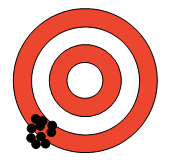
This bullseye demonstrates...
a)
High Accuracy & High Precision
b)
High Accuracy & Low Precision
c)
Low Accuracy & High Precision
d)
Low Accuracy & Low Precision
16.

What is the volume of 150.0 grams of lead if it has a density of 11.3 g/cm3?

a)

13.3 g

b)

13.3 cm3

c)

.075 g

d)

1695 cm3

17.
Calculate the mass of a substance which has a volume of 35.0 cm3 and a density of 0.50 g/cm3.(All calculations should have the correct sig figs)
a)
17.5 g
b)
0.014 g
c)
18 g 
d)
70. g
18.

Matter is anything that has:

a)

mass

b)

volume

c)

mass and volume

d)

substance

19.
What term describes a solid changing to a gas?
a)
Deposition
b)
Sublimation
c)
Evaporation
d)
Freezing
20.
Particles (molecules) in a ______________________ have more energy than the other states of matter.
a)
gas
b)
solid
c)
liquid
21.
a)
It remains the same.
b)
It changes greatly.
c)
It changes minimally.
d)
Unable to tell.
22.
A substance that contains only one type of atom is a(n)
a)
compound
b)
element
c)
heterogeneous mixture
d)
homogeneous mixture
23.
Which of these is a pure substance?
a)
bread
b)
table salt
c)
garden soil
d)
sea water
24.

A _______ _________ is what we call when the composition is not uniform throughout.

a)

homogeneous mixture

b)

heterogeneous mixture

25.
Which of the following are pure substances?
a)
solutions
b)
compounds
c)
homogeneous mixtures
d)
colloids
26.
Two classifications of a pure substance are
a)
homogeneous and heterogeneous
b)
atoms and elements
c)
elements and compounds
d)
solutions and colloids
27.

Which of the following is matched incorrectly.

a)

Air: compound

b)

Steel alloy: homogeneous mixture

c)

Glucose (C6H12O6): compound

d)

Cookies & Cream: heterogenous mixture

28.

What is the atomic number?

a)

the number of protons in the nucleus

b)

the number of protons and neutrons in the nucleus

c)

the number of neutrons in the nucleus

d)

the number of protons in the energy levels

29.

What is the mass number?

a)

the number of protons in the nucleus

b)

the number of protons and neutrons in the nucleus

c)

the number of neutrons in the nucleus

d)

the number of protons and electrons in the atom
30.

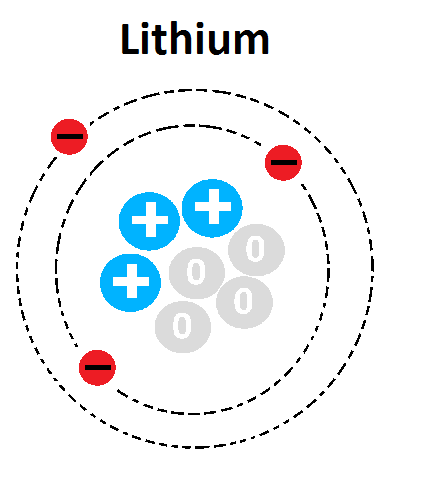
What is the mass number of this atom?

a)

1

b)

3

c)

4

d)

7

31.
In order for an atom to be neutral what has to be true?
a)
The atom has more protons than neutrons
b)
The atom has more neutrons than protons
c)
The atom has the same number of protons and neutrons
d)
The atom has the same number of protons and electrons
32.

What does the 6 represent?

a)

Atomic mass

b)

atomic number

c)

chemical symbol

d)

element name

33.
Which subatomic particles contribute the most to the mass of an atom?
a)
Protons, Neutrons, Electrons
b)
Protons only
c)
Protons and Electrons
d)
Protons and Neutrons
34.

An atom has 10 protons, 15 neutrons and 10 electrons what is its mass number.

a)

20

b)

10

c)

35

d)

25

35.
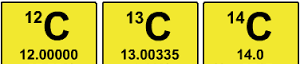
What do these isotopes of carbon all have in common?
a)
neutrons & mass number
b)
atomic number and neutrons
c)
atomic number and electrons
d)
protons, atomic number, and mass number
36.
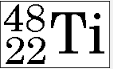
How many protons does this isotope of titanium have?
a)
48
b)
22
c)
26
d)
70
37.
What quantities vary between isotopes of an element?
a)
protons, electrons, and atomic mass
b)
protons, electrons, and atomic number
c)
neutrons and electrons
d)
neutrons and atomic mass
38.
24.1% of all the isotopes of a an element have a mass of 75.23 amu, 48.7% have a mass of 74.61 amu, and 27.2% have a mass of 75.20 amu.
What is the average mass of this element?
a)
74.92 amu
b)
24.97 amu
c)
75.01 amu
d)
74.51 amu
39.

What subatomic particle is responsible for the spectral lines seen in emission spectra diagrams?

a)

electrons

b)

protons

c)

neutrons

40.

In order to go from ground state to an excited state, an electron must

a)

emit energy

b)

absorb energy

c)

wiggle

41.

When an electron returns to ground state from an excited state, the atom will

a)

emit energy

b)

absorb energy

c)

rotate

d)

wiggle

42.
A certain photon of light has a wavelength of 4.22x10⁻⁷nm. What is the frequency? (v=c/λ)
a)
7.11x10¹⁴ Hz
b)
7.11Hz
c)
1.41x10⁻¹⁵
d)
-1.41x10¹⁵
43.
A wave with a large wavelength will have a ______ frequency and _____ energy
a)
high, low
b)
high, high
c)
low, high
d)
low, low
44.
Select the correct order of waves on the EMS 
a)
Radio, Micro, Infra, Visible, Ultra, X-ray, Gamma
b)
Gamma, X-ray, Ultra, Vis, Infra, Micro, Radio
c)
Vis, Micro, Infra, Ultra, X-ray, Gamma, Radio
d)
Micro, Radio, Vis, Infra, Ultra, X-ray, Gamma
45.
Which has the LONGEST wavelength and, therefore, the lowest frequency/energy
a)
Gamma Rays
b)
Radio Waves
c)
Visible Light
d)
Infrared rays
46.
What is the energy of a quantum of light with a frequency of 7.39x10¹⁴Hz.(E=Hv)
a)
4.88x10¹⁹
b)
4.88x10⁻¹⁹
c)
2.22x10²³
d)
2.22x10⁻²³
47.
Certain blue lights have a frequencey of 6.91x10¹⁴Hz. What is the wavelength? (λ=c/v)
a)
4.34x10²¹
b)
4.34x10⁻²¹
c)
4.34x10⁻⁷
d)
2.07x10²³
48.
The energy for a quantum of light is 2.84x10⁻¹⁹J. What is the wavelength. (λ=hc/E)
a)
6.97x10-45m
b)
6.97x1045m
c)
6.97x10⁻⁷m
d)
6.97x10⁷m
49.

The principle quantum number, n, represents the:

a)

spin value

b)

suborbital value

c)

energy level

d)

magnetic value

50.

How many electrons total are found in the f orbital?

a)

2

b)

6

c)

10

d)

14

51.

Which of the following is NOT a possible pair of quantum numbers?

a)

2p

b)

2d

c)

4p

d)

4f

52.

orbital sublevels, or l, implies:

a)

orbital color

b)

electron spin

c)

orbital shape

d)

energy level

53.
What atom matches this electron configuration?
1s22s22p63s23p64s23d10
a)
Zinc
b)
Copper
c)
Nickel
d)
Germanium
54.

How many electrons can the d sublevel (the d orbitals) hold?

a)

14

b)

10

c)

2

d)

6

55.

Choose the correct shortcut configuration for iodine.

a)

[Ar]4s24d104p5

b)

[Kr]5s24d105p5

c)

[Xe]5s25d105p5

d)

none of the above

56.

What is incorrect about this orbital diagram?

a)

Both arrows in the 2p box should be pointing up

b)

There is nothing incorrect with this diagram

c)

In the 2p box there should only be 1 electron in the first 2p box and one in the 2nd 2p box pointing in the same direction.

d)

All the arrows should be pointing up.

57.

What is the shorthand configuration for Lead?

a)

[Xe]6s24f145d106p2

b)

[Xe]6s25d106p2

c)

[Rn]6s25d106p2

d)

[Rn]6s24f145d106p2

58.
Electrons occupy orbitals of lowest energy first is part of what electron configuration rule?
a)
Hund’s Rule
b)
Aufbau Principle
c)
Pauli Exclusion Principle
59.
Which guideline, Hund’s rule or the Pauli exclusion principle, is violated in the following orbital diagrams?
a)
Aufbau's
b)
Hund's
c)
Pauli exclusive
60.
Which guideline, Hund’s rule or the Pauli exclusion principle, is violated in the following orbital diagrams?
a)
Hund's
b)
Aufbau's
c)
Pauli's Exclusive
61.
Ionization energy is the...
a)
energy needed to remove the outermost electron.
b)
ability of an atom to attract electrons from another atom.
62.
Which element has the smaller atomic radius: potassium (K) or bromine (Br)?
a)
potassium (K)
b)
bromine (Br)
63.
Which element has the greatest ionization energy: Aluminum (Al)    or    Chlorine (Cl)?
a)
Aluminum (Al)
b)
Chlorine (Cl)
64.
What is an ion?
a)
A Charged Atom
b)
A Large Atom
c)
A Small Atom
d)
A Cute Atom
65.
Why are ions formed?
a)
To make our lives difficult
b)
Because atoms want 8 valence electrons
c)
Because atoms have the same number of protons and electrons
d)
Because atoms gained neutrons
66.
An atom becomes _________ when it gains electrons.
a)
Positive
b)
Negative
c)
Neutral
d)
Invinsible
67.

What is the charge of a sodium ion?

a)

+2

b)

+1

c)

-1

d)

-2

68.
Group 17 always has ions with a charge of 
a)
+1
b)
+2
c)
-1
d)
-2
69.
What charge will an Oxygen ion have? 
a)
+1
b)
-1
c)
+2
d)
-2
70.
If an element has 3 valence electrons, what charge will likely form on its ion ?
a)
+3
b)
+5
c)
-3
d)
-5
71.
Which of the following has a -3 charge?
a)
Boron
b)
Fluorine
c)
Nitrogen
d)
Neon
72.
Elements on the LEFT side of the periodic table will most likely form:
a)
Positive ions
b)
Negative ions
c)
Neutral Ions
d)
None of these
73.
Cations are...
a)
Positive
b)
Negative
c)
Neutral
d)
Purring
74.
Anions are...
a)
Positive
b)
Negative
c)
Neutral
d)
Crying
75.
An atom becomes _______ when it loses electrons.
a)
Positive
b)
Negative
c)
Neutral
d)
Invinsible
76.
Mg2+ and Cl- create...
a)
Mg2Cl
b)
MgCl2
c)
Mg2Cl2
d)
MgCl
77.
Ca2+ and N3- create...
a)
Ca2N3
b)
Ca3N2
c)
CaN3
d)
Ca2N
78.
Fe +2  and  SO4 -2
a)
FeSO4
b)
Fe4(SO4)2
c)
FeSO2
d)
correct answer is not given
79.

Valence electrons are found

a)

in the innermost energy level of an atom

b)

in the middle energy levels of an atom

c)

in the outermost energy levels of an atom

80.

Why do all bonds form?

a)

so the number of protons equals the number of electrons

b)

so an atom can become unstable

c)

to fill the outermost energy level

81.
How are ionic bonds formed?
a)
Transfer of electrons
b)
Sharing of electrons
82.
Ionic bonds are between...
a)
Metal and Non-metal
b)
Non-metal and Non-metal
c)
Metal and Metal
83.
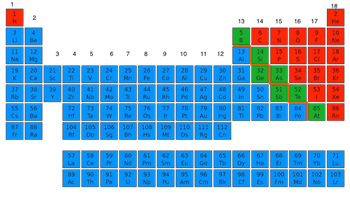
Where are the nonmetals located on the periodic table? 
a)
Blue
b)
Red
c)
Green
84.
Where are metals located on the periodic table?
a)
Blue
b)
Green
c)
Red
85.
What two types of atoms make a covalent bond?
a)
2 Nonmetals
b)
1 Nonmetal and 1 Metal
c)
2 Metals
d)
2 Noble Gases
86.
How are covalent bonds explained?
a)
When one atom takes the other atom's electron
b)
When the atom shares an electron with an another atom
c)
When the two nucleus merge
d)
When the neutrons leave the nucleus