
 Worksheets
Chem01.1 Alchemy and Scientific Method
Total questions: 89
Worksheet time: 46mins
The science of chemistry is:
the study of matter and its changes
the study of living organisms
the study of celestial bodies
the study of Earth's physical structure
What is chemistry? Chemistry is a science that deals with the composition, structure, and properties of substances and with the ________ that they undergo.
transformations
colors
weights
temperatures
Which of the following statements is true about chemistry?
Chemistry is a science of precise measurement, but before that, there was alchemy.
Chemistry is only about mixing substances.
Chemistry does not involve measurement.
Chemistry is unrelated to alchemy.
According to Merriam-Webster, what was the main aim of alchemy?
To create new elements
To achieve the transmutation of base metals into gold, discover a universal cure for disease, and find a means to indefinitely prolong life
To invent new machines
To study astronomy
The areas of alchemy described as aiming to achieve the transmutation of metals, cure disease, and prolong life were often referred to as _______ alchemy.
mystical
mechanical
botanical
elemental
Practical alchemy developed which of the following for fabrics?
Metals
Dyes
Glass
Gold
Alchemy only focused on mystical goals and did not have any practical applications.
True
False
Practical alchemy involved alloying and working with _______ and uses for _______.
metals, glass
plants, water
stones, fire
gases, wood
Practical alchemy was considered important compared to mystical alchemy because:
it focused on real-world applications and material transformations.
it was based on spiritual beliefs and symbolism.
it ignored scientific experimentation.
it only dealt with philosophical concepts.
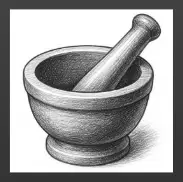
Which of the following tools were developed by alchemists and are still used by scientists today?
Mortar and pestle
Beakers
Tongs
Crucibles
All of the above
By employing tools such as the mortar and pestle, alchemists developed habits of __________ and trial-and-error that gradually transformed alchemy into an early science.
experimentation
improvisation
meditation
celebration
Alchemy was able to explain the changes observed in chemical reactions because it had the concept of atoms and molecules.
True
False
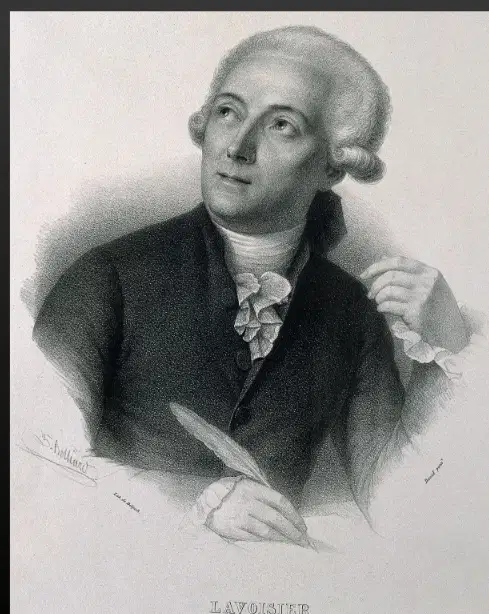
In the late 1700s, Antoine Lavoisier was a ________ who helped transform chemistry from a science of observation into a science of measurement.
Frenchman
German
Italian
Englishman
Antoine Lavoisier helped bring which major change to the field of chemistry in the late 1700s?
He established the law of conservation of mass.
He discovered the electron.
He invented the periodic table.
He developed the theory of relativity.
Antoine Lavoisier helped transform chemistry from a science of measurement into a science of observation.
True
False
According to the Phlogiston Theory, what must substances contain in order to burn?
Oxygen
Phlogiston
Ash
Water
Based on the Phlogiston Theory, what is left behind after wood burns?
Ash
Charcoal
Smoke
Water
When wood (phlogiston rich) burns, what is released into the air according to the Phlogiston Theory?
Phlogiston
Oxygen
Carbon dioxide
Nitrogen
The main idea of the Phlogiston Theory is:
That substances contain a fire-like element called phlogiston that is released during combustion.
That all matter is made up of atoms and molecules.
That combustion is caused by the absorption of oxygen from the air.
That heat is a form of energy that flows from hot to cold objects.
According to phlogiston theory, what did a metal like magnesium consist of?
Only magnesium
Phlogiston and calx
Only calx
Only phlogiston
According to phlogiston theory, calx was the '_____' metal left behind after combustion.
true
false
pure
impure
What is left behind after all the phlogiston has been released from the metal during combustion according to phlogiston theory?
Phlogiston
Calx
Dephlogisticated air
Water
According to the Phlogiston Theory, what happens when a candle is placed under a bell jar and burned?
The air fills with oxygen
The air fills with phlogiston until it becomes saturated and the candle stops burning
The candle burns indefinitely
The air becomes colder
According to the Phlogiston Theory, when the air under the bell jar becomes _______ with phlogiston, the candle stops burning.
saturated
diluted
evaporated
infused
What is the reason the candle stops burning under the bell jar according to the Phlogiston Theory?
Lack of oxygen
Air becomes saturated with phlogiston
The candle melts completely
The jar breaks
Which metal did Lavoisier work with to test the phlogiston theory?
tin
iron
copper
lead
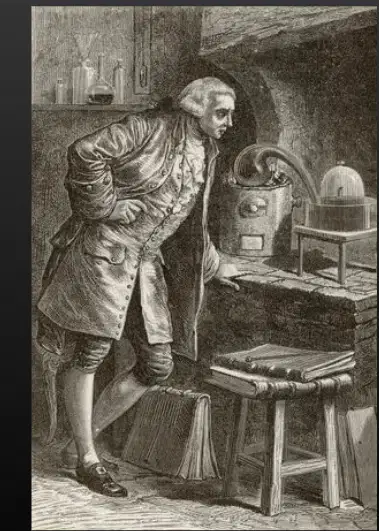
What did Lavoisier do after measuring the mass of the tin metal sample?
He placed it inside a closed vessel and heated it, then weighed it again.
He dissolved the tin in acid and measured the gas released.
He hammered the tin into a thin sheet and measured its thickness.
He mixed the tin with another metal to form an alloy.
The gas required was:
Oxygen
Nitrogen
Carbon dioxide
Hydrogen
What gas did Joseph Priestley release by heating mercury(II) oxide?
Oxygen
Hydrogen
Nitrogen
Carbon dioxide
Who determined that the gas released from heating mercury(II) oxide should be called 'oxygène'?
Joseph Priestley
Antoine Lavoisier
Isaac Newton
John Dalton
Lavoisier thought the gas released from heating mercury(II) oxide was essential to forming _____
acids
bases
salts
metals
Lavoisier recognized that the gas released from heating mercury(II) oxide was a new element needed for respiration and combustion.
True
False
What happened when Lavoisier heated mercury in a sealed container until it became mercury(II) oxide and then heated the mercury(II) oxide?
The mass increased
The mass decreased
The same mass was released
No gas was released
According to Lavoisier's bold claims, what was identified as a new element?
Hydrogen
Oxygen
Nitrogen
Phlogiston
According to Lavoisier, phlogiston did not exist.
True
False
What did Lavoisier claim was needed for combustion?
Oxygen
Hydrogen
Nitrogen
Carbon Dioxide
For what reasons is Antoine Lavoisier often referred to as the 'father of modern chemistry'?
Because he identified oxygen as a new element, disproved the existence of phlogiston, stated the law of conservation of mass, recognized and named hydrogen and oxygen, and helped create the metric system.
Because he discovered the electron and developed the periodic table.
Because he invented the microscope and discovered bacteria.
Because he was the first to propose the atomic theory of matter.
Which of the following did Lavoisier help create?
The periodic table
The metric system
The atomic theory
The electron model
Who stated the first version of the law of conservation of mass?
Antoine Lavoisier
Isaac Newton
John Dalton
Dmitri Mendeleev
The scientific method is:
a systematic process used to investigate observations and answer questions
a random guess made without evidence
a set of rules for memorizing facts
an opinion formed without testing
What is the first step of the scientific method? The first step of the scientific method is to ________ using your five senses as needed to describe things either quantitatively or qualitatively.
make observations
form a hypothesis
conduct an experiment
analyze data
What is a quantitative observation?
An observation involving the measurement of quantity or amount, essentially anything involving a number.
An observation based on qualities or characteristics that cannot be measured.
An observation that does not involve numbers or measurements.
An observation based on opinions.
Which of the following is an example of a quantitative observation? Choose the correct answer.
The apple is red.
The mass of the object is 5 kg.
The flower smells sweet.
The music is loud.
The measurement of how heavy an object is refers to its _______.
weight
length
volume
temperature
The measurement of how hot or cold something is refers to its _______.
temperature
volume
weight
length
The measurement of how long something is refers to its _______.
length
weight
temperature
volume
The measurement of the amount of space an object occupies is called its _______.
volume
mass
weight
density
What is a qualitative observation?
An observation involving numbers or quantities
An observation involving the quality or kind, describing something without involving numbers or quantities
An observation involving measurements only
An observation involving experiments only
Which of the following is an example of a qualitative observation?
The mass of a rock is 5 grams
The temperature is 20°C
The rock is shiny and smooth
The length of the stick is 10 cm
A qualitative observation describes something but does not involve ______ or quantities.
numbers
colors
shapes
textures
A good scientific question is _______, measurable, and leads to the setup of an experiment.
specific
random
vague
broad
Which of the following is a characteristic of a good scientific question?
It is vague
It is measurable
It is unrelated to experiments
It is opinion-based
A good scientific question leads to the setup of an experiment.
True
False
What is a hypothesis?
A random guess
An educated guess that is testable and predictable
A proven fact
A summary of results
A hypothesis is usually written in the format of
If... then... because...
What... when... how...
Why... who... where...
Since... therefore... thus...
Which of the following must a hypothesis be?
Falsifiable and measurable
Always true
Unchangeable
Not testable
Chemical Safety: According to the instructions, how should you dispose of chemicals in the lab?
Put all chemicals down the sink
Dispose of chemicals as instructed by your teacher
Throw all chemicals in the trash
Mix chemicals together before disposal
Chemical Safety: True or False: All chemicals can be put down the sink.
True
False
How long should the eyewash station be used continuously when you get something in your eye?
15-20 minutes
1-2 minutes
30-45 seconds
5 minutes
What is the fire extinguisher used for in the classroom?
Cleaning spills
Open flames
First aid
Eye injuries
What does the 'P' in the fire extinguisher acronym PASS stand for?
Pull the pin
Press the handle
Point at the fire
Push the lever
What does the 'A' in the fire extinguisher acronym PASS stand for?
Aim at the base of the fire
Activate the alarm
Apply pressure to the handle
Alert the authorities
What does the 'S' in the fire extinguisher acronym PASS stand for (first S)?
Squeeze the trigger
Sweep the area
Stop the fire
Shut the valve
What does the 'S' in the fire extinguisher acronym PASS stand for (second S)?
Sweep back and forth
Stop immediately
Shout for help
Stand clear
What does PPE stand for?
Personal Protective Equipment
Public Policy Education
Professional Performance Evaluation
Primary Power Equipment
Which of the following is an example of PPE?
Fire extinguisher
Goggles
Eyewash station
Safety shower
Which of the following is NOT considered PPE?
Gloves
Lab aprons
Fire blankets
Goggles
PPE is different from classroom safety equipment.
True
False
Which list contains examples of classroom safety equipment?
Fire extinguishers, fire blankets, eyewash stations, safety showers
Chalkboards, desks, projectors, computers
Textbooks, notebooks, pens, pencils
Posters, bulletin boards, wall clocks, maps
Goggles need to be worn when you are working with which of the following?
Chemicals
Heat
Glassware
All of the above
According to Merriam-Webster, a chemical is “a substance obtained by a ________ process or producing a chemical effect.”
chemical
physical
mechanical
biological
When working with heat in the laboratory, you should always remember to:
Use heat-resistant gloves and handle equipment carefully.
Leave flammable materials near the heat source.
Ignore safety instructions and procedures.
Touch hot equipment with bare hands.
If glass breaks in the laboratory, you should:
Tell your teacher immediately and do not touch the glass.
Pick up the glass with your hands.
Ignore it and continue working.
Sweep it up with your bare hands.
Aprons/lab coats are used when there is a risk of ______. Same with gloves.
spill
noise
light
heat
Long hair should be tied back in the lab, especially when working with ______ and open flames.
heat
water
paper
glass
Experiments should be which of the following?
Complicated, secret, and unique
Clear, honest, and reproducible
Vague, biased, and unrepeatable
Fast, easy, and expensive
Validation means that when others do what you did, they get the (a) result each time.
According to the Scientific Method Step 8, which of the following is NOT a way to share results?
Lab reports
Peer review
Presentations
Private diary
Experiments should be clear, honest and _________.
reproducible
expensive
subjective
invisible
What should you do when analyzing data in science?
Ignore trends and patterns
Interpret trends, patterns, and anomalies in data and perform statistical analysis, such as percent error
Only look at the data that supports your hypothesis
Avoid statistical analysis
You should avoid ________, which means only using data that supports your hypothesis but ignoring other data.
confirmation bias
random sampling
peer review
double-blind study
Being open to being wrong is an important part of science.
True
False
Measurements should be reported to the appropriate number of ________ figures.
significant
decimal
whole
approximate
The independent variable should go along which axis when recording data into charts?
y-axis
z-axis
x-axis
none of the above
When graphing data, time is almost always on the (a) if measured.
What is the independent variable in a controlled experiment? (sometimes called a manipulated variable)
The independent variable is the one factor changed during various trials of the experiment.
The independent variable is the result measured at the end of the experiment.
The independent variable is the factor that remains constant throughout the experiment.
The independent variable is the equipment used to conduct the experiment.
What is the dependent variable in a controlled experiment?
The dependent variable is measured and changes as a result of the variation of the independent variable.
The dependent variable is the factor that is purposely changed by the experimenter.
The dependent variable is always kept constant throughout the experiment.
The dependent variable is the equipment used to measure results.
All variables, other than the independent variable, in the experiment must be kept ______ or ______.
constant, controlled
random, variable
open, flexible
hidden, secret
The control is the standard for ______, which allows for a baseline comparison.
comparison
measurement
observation
calculation

