wayground logo

Free Printable Worksheets

Font size

S
M
L
XL
Worksheets

CP_SPRING FINAL STUDY GUIDE QUESTIONS

Total questions: 94

Worksheet time: 49mins

Name
Class
Date
1.
How many electrons is each element trying to reach?
a)
3
b)
5
c)
7
d)
8
2.
How many valence electrons can you find in group 17?
a)
2
b)
3
c)
5
d)
7
3.
Which image contains the correct electron dot diagram for Lithium?
a)
A
b)
B
c)
C
d)
D
4.
Which Lewis electron-dot diagram represents a fluoride ion?
a)
1
b)
2
c)
3
d)
4
5.
What particle determines the element's charge?
a)
Protons
b)
Neutrons
c)
Electrons
6.
What particles determines the atomic number?
a)
Protons
b)
Neutrons
c)
Electrons
7.
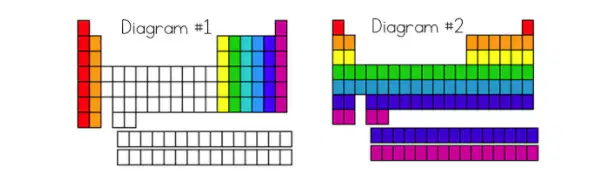
Diagram #1 is showing the _____ of a Periodic Table and Diagram #2 is showing the _____ of the Periodic Table.
a)
periods, groups
b)
groups, families
c)
groups, periods
d)
periods, families
8.
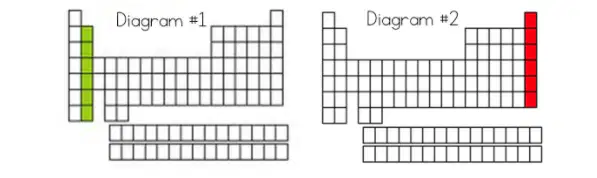
Diagram #1 is highlighted the _____. Diagram #2 is highlighted the _____.
a)
Alkaline earth metals, noble gases
b)
alkali metals, noble gases
c)
transition metals, halogens
d)
metalloids, noble gases
9.
To what group and period does the element Phosphorus belong?
a)
group 5, period 3
b)
group 3, period 5
c)
group 3, period 15
d)
group 15, period 3
10.
What are isotopes?
a)
very rare elements
b)
another name for the sub-atomic particles of atoms
c)
atoms that are next to each other on the Periodic Table
d)
atoms that have the same number of protons but different numbers of neutrons
11.
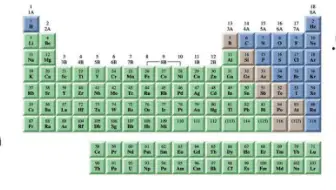
The largest colored section of the Periodic Table diagram are which type of elements?
a)
metals
b)
non-metals
c)
metalloids
d)
elements that are solid at room temperature
12.
The period that an element is in on the Periodic Table can tell you how many ____ the element's atom have.
a)
energy levels (electron shells)
b)
valence electrons
c)
protons
d)
isotopes
13.
What is a cation?
a)
An atom that has lost a valence electron
b)
An atom that has gained a valence electron
14.
What is an anion?
a)
An atom that has lost a valence electron
b)
An atom that has gained a valence electron
15.
How many grams are in 15 mg?
a)
15 g
b)
7.1 g
c)
2.05 g
d)
0.015 g
16.
Put the number in Standard Notation: 1.0 x 10^-5
a)
0.0002
b)
0.00001
c)
0.0065
d)
0.01
17.
Put the number in scientific notation: 679.05
a)
6.7905 x 10^2
b)
7.89 x 10^1
c)
90.0 x 10^6
d)
1.00 x 10^7
18.
Determine the amount of significant figures in the number below: 23.89
a)
2 sig fig
b)
3 sig fig
c)
4 sig fig
d)
5 sig fig
19.
Determine the amount of significant figures in the number below: 4.0
a)
2 sig fig
b)
3 sig fig
c)
4 sig fig
d)
5 sig fig
20.
Matter that has a definite volume and shape is called a __________.
a)
Solid
b)
Liquid
c)
Gas
d)
Plasma
21.
If matter has a definite volume, but no definite shape it is called a _____________.
a)
Solid
b)
Liquid
c)
Gas
d)
Plasma
22.
When matter does not have a definite shape or volume it is called a ___________.
a)
Solid
b)
Liquid
c)
Gas
d)
Plasma
23.
When you add heat to matter, its particle motion _____________.
a)
stays the same
b)
decreases
c)
increases
d)
stops
24.
When you remove heat, its particle motion _______________.
a)
stays the same
b)
decreases
c)
increases
d)
stops
25.
The phase change when a liquid becomes a gas its called __________________.
a)
sublimation
b)
vaporization
c)
condensation
d)
deposition
26.
The phase change when a gas becomes a liquid its called __________________.
a)
sublimation
b)
vaporization
c)
condensation
d)
deposition
27.
A rectangular block of lead (Pb) measures 20.0 mm x 30.0 mm x 45.0 mm. If the density of lead is 11.34 g/cm3, calculate the mass of the block.
a)
100 g
b)
3.87 g
c)
306 g
d)
189.0 g
28.
Find the volume that 35.2 g of carbon tetrachloride will occupy if it has a density of 1.60 g/mL
a)
0.3 mL
b)
15 mL
c)
22 mL
d)
32 mL
29.
In which model are atoms are imagined as the solar system?
a)
Dalton
b)
Thomson
c)
Rutherford
d)
Bohr
e)
Cloud Model
30.
Carbon dioxide is a(n)
a)
element
b)
compound
c)
homogeneous mixture
d)
heterogeneous mixture
31.
What type of mixture is coffee?
a)
Homogeneous mixture
b)
Heterogeneous mixture
c)
Element
d)
Compound
32.
Is mercury an element, compound, or mixture?
a)
Elements
b)
Homogeneous mixture
c)
Compounds
d)
Heterogeneous mixture
33.
Vegetable soup is a(n)
a)
element
b)
compound
c)
homogeneous mixture
d)
heterogeneous mixture
34.
What is the correct chemical formula for cesium phosphide?
a)
CeP3
b)
KP3
c)
Cs3P
d)
PCs
35.
What is the correct chemical formula for aluminum carbonate?
a)
AlCO3
b)
HCl
c)
Al2(CO3)3
d)
KI
36.
What is the correct chemical formula for disulfur tetraiodide.
a)
Fe2S3
b)
S2I4
c)
NO3
d)
IrS
37.
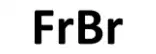
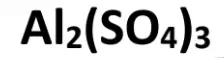
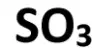
What is the correct name for the compound below?
a)
Bromine
b)
Francium bromide
c)
Lithium chloride
d)
Xenon
38.
What is the correct name for the compound below?
a)
Potassium carbonate
b)
Aluminum sulfate
c)
Dinitrogen tetrafluoride
d)
Argon sulfide
39.
What is the correct name for the compound below?
a)
Dicarbon monohydride
b)
Sulfur trioxide
c)
Mononitrogen tetrahydride
d)
Francium sulfide
40.
What is the correct name for the compound: LiCl
a)
Potassium fluoride
b)
Lithium chloride
c)
Boron bromide
d)
Magnesium iodide
41.
What is the correct chemical formula for magnesium fluoride?
a)
LiCl
b)
FrMg
c)
MgF2
d)
RhBr
42.
Indicate the type of reaction in the image below.
a)
Decomposition
b)
Synthesis
c)
Single Replacement
d)
Double Replacement
43.
Determine whether the equation below is balanced or not balanced?
a)
Balanced
b)
Not Balanced
44.
What type of chemical reaction is in the image below?
a)
Synthesis
b)
Decomposition
c)
Single replacement
d)
Double replacement
e)
Combustion
45.
What type of chemical reaction is in the image below?
a)
Synthesis
b)
Decomposition
c)
Single replacement
d)
Double replacement
e)
Combustion
46.
What type of chemical reaction is in the image below?
a)
Synthesis
b)
Decomposition
c)
Single replacement
d)
Double replacement
e)
Combustion
47.
What type of chemical reaction is in the image below?
a)
Synthesis
b)
Decomposition
c)
Single replacement
d)
Double replacement
e)
Combustion
48.
Write the empirical formula for the substance below: P4H10
a)
PH2
b)
P2H5
c)
P10H7
d)
PH
49.
A radioactive nucleus:
a)
Spontaneously emits a particle then changes to another element
b)
Spontaneously emits a particle but remains the same element
c)
Never emits a particle
d)
Never changes element
50.
This nuclear process involves energy being produced when two atoms combine.
a)
Nuclear Fusion
b)
Nuclear Fission
51.
This nuclear process involves energy being released when a giant atom splits.
a)
Nuclear Fusion
b)
Nuclear Fission
52.
__________ is the transfer of energy between two objects due to temperature differences
a)
Enthalpy
b)
Temperature
c)
Heat
d)
Specific Heat
53.
_______________ is a measurement proportional to the average kinetic energy of molecules in a sample.
a)
Enthalpy
b)
Temperature
c)
Heat
d)
Specific Heat
54.
Match the law of thermodynamics on the right to the statement on the left that is explained by the law: When a hot piece of metal is placed in cold water, the metal cools, the water heats up, and there is no loss of energy.
a)
First Law of Thermodynamics
b)
Second Law of Thermodynamics
c)
Third Law of Thermodynamics
55.
Match the law of thermodynamics on the right to the statement on the left that is explained by the law: If a hot piece of metal is placed in cold water, the water does not get colder and the metaldoes not get hotter.
a)
First Law of Thermodynamics
b)
Second Law of Thermodynamics
c)
Third Law of Thermodynamics
56.
Acids taste _________________ and bases taste __________________,
a)
bitter, sour
b)
sweet, meaty
c)
sour, bitter
d)
sour, sweet
57.
Name the following compound: H2SO4
a)
Phosphoric Acid
b)
Hydrofluoric acid
c)
Sulfuric Acid
d)
Carbonic Acid
58.
Write the chemical formula for the following compound: hydrophosphoric acid
a)
H2S
b)
H2O
c)
H3P
d)
H2SO4
59.
In the reaction below, select the correct chemical compound that is the acid.
a)
NH3
b)
H2O
c)
NH4 +
d)
OH -
60.
In the reaction below, select the correct chemical compound that is the base.
a)
NH3
b)
H2O
c)
NH4 +
d)
OH -
61.
In the reaction below, select the correct chemical compound that is the conjugate acid.
a)
NH3
b)
H2O
c)
NH4 +
d)
OH -
62.
In the reaction below, select the correct chemical compound that is the conjugate base.
a)
NH3
b)
H2O
c)
NH4 +
d)
OH -
63.
Find the pH and pOH for a solution of [H+] = 0.01 M
a)
pH = 2 pOH = 13
b)
pH = 4 pOH = 7
c)
pH = 2 pOH = 12
d)
pH = 1 pOH = 13
64.
A solution is composed of what two parts?
a)
Solvent
b)
Solute
c)
Solibility
d)
Both A & B
65.
What is the molarity of a solution that contains 0.01 mol NaCl and 5 L of H2O? (Round to 4 sig figs)
a)
0.08 M
b)
1.3 M
c)
0.002 M
d)
0.5 M
66.
EXTRA CREDIT: What is the name of H30+ ?
4 lines
67.
EXTRA CREDIT: What type of reaction is this: Acid + Base --> Water + Salt?
4 lines
68.

Convert 25 g of H20 to moles of H20

4 lines
69.
What atom matches this electron configuration?
1s22s22p63s23p64s23d10
a)
Zinc
b)
Copper
c)
Nickel
d)
Germanium
70.
How many electrons does Si contain? (click to see image)
a)
14
b)
28
c)
2
d)
4
71.
How many electrons can the first energy level hold?
a)
1
b)
2
c)
8
d)
0
72.
There are 4 different types of subshells s,p,d,f
a)
true
b)
false
73.

___________ states that no two electrons can occupy the same energy level, sublevel, and orbital and have the same spin.

a)

Aufbau Principle

b)

Hund's Rule

c)

Pauli Exclusion Principle

d)

Kinetic Molecular Theory

74.

___________ states that electrons must fill an entire sublevel before filling a new energy level.

a)

Aufbau Principle

b)

Hund's Rule

c)

Pauli Exclusion Principle

d)

Kinetic Molecular Theory

75.

___________ states that all orbitals must be occupied with one electron before any orbital can be doubly occupied. Also all singly occupied orbitals must have electrons with the same spin.

a)

Aufbau Principle

b)

Hund's Rule

c)

Pauli Exclusion Principle

d)

Kinetic Molecular Theory

76.

If 22.5 L of nitrogen at 748 mm Hg are compressed to 725 mm Hg at constant temperature, what is the new volume?

a)

23.2

b)

21.8

c)

0.0431

d)

0.0459

77.

Calculate the new temperature when 6.00 L at 20.0 °C is compressed to 4.00 L.

a)

195

b)

0.00512

c)

440

d)

0.00228

78.

A sealed container has a pressure of 1.5 atm at 25°C. If the temperature is raised to 125°C, what will be the new pressure?

a)

2

b)

1.12

c)

7.5

d)

0.3

79.

A gas balloon has a volume of 106.0 liters when the temperature is 45.0°C and the pressure is 740.0 mm of mercury. What will its volume be at 20.0°C and 780.0 mm of mercury pressure?

a)

92.7

b)

44.7

c)

103

d)

109

80.

Using the ideal gas law, solve for the pressure if 7.5 moles hydrogen gas in found in a 2.5 L rigid container with a temperature of 300 K. (remember R = 0.0821)

Round your answer to two decimal places.

a)

52.98 atm

b)

73.89 atm

c)

41.03 atm

d)

22.47 atm

81.

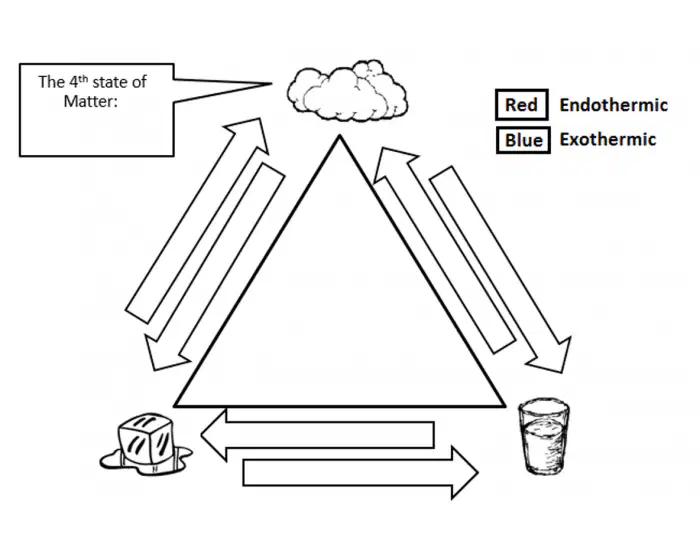
Select all of the terms that apply to the solid to liquid phase changes.

a)

Freezing

b)

Melting

c)

Condensation

d)

Vaporization

82.

Select all of the terms that apply to the liquid to gas phase changes.

a)

Freezing

b)

Melting

c)

Condensation

d)

Vaporization

83.

Select all of the terms that apply to the solid to gas phase changes.

a)

Sublimation

b)

Deposition

c)

Condensation

d)

Vaporization

84.
 A lone pair is defined as
a)
A pair of bonding electrons
b)
One non-bonding electron
c)
A pair of non-bonding electrons
d)
A pair of electrons on the central atom
85.
What molecular shape is the structure shown here? (BCl3)
a)
linear
b)
trigonal planar
c)
tetrahedral
d)
trigonal pyramidal
86.
Choose the correct shape for this molecule:
a)
linear
b)
Trigonal pyramidal
c)
Bent
d)
Tetrahedral
87.
*
a)
trigonal pyramid
b)
linear
c)
bent
d)
angular
88.

_________ ___________ is a system that is isolated from the rest of the universe.

a)

Open System

b)

Closed System

89.

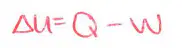
A total of 56 J of work is done on a compressed gas. If the internal energy of the gas increases by 425 J.

What is the total amount of energy transferred to heat?

a)

786 J

b)

481 J

c)

568 J

d)

375 J

90.

In a mountain cabin (high altitude), heat is added to an open pot of water boiling at 90 C. The expanding steam coming up from the pot of boiling water does 45 kJ of work, and the internal energy of the system increases by 675 kJ.

How much energy was transferred to the system as heat?

a)

2056 kJ

b)

685 kJ

c)

720 kJ

d)

894 kJ

91.

An engine absorbs 910 J of energy per cycle. The engine does 400 J of work during each cycle, and gives off 475 J as heat.

What is the engine's efficiency (as a percentage)?

a)

48%

b)

23%

c)

15%

d)

52%

92.

_______________ is the type of heat transfer through empty space by invisible electromagnetic rays.

a)

Conduction

b)

Convection

c)

Radiation

93.

_______________ is the type of heat transfer in a fluid (liquid or gas) caused when hotter, less dense fluids rise and cooler, more dense fluids sink.

a)

Conduction

b)

Convection

c)

Radiation

94.

_______________ is the type of heat transfer with solid material through direct contact. (ex: you sitting in chair)

a)

Conduction

b)

Convection

c)

Radiation