
 Worksheets
Chemistry II Unit 5 Review
Total questions: 90
Worksheet time: 3hrs 37mins
As temperature rises ___________.
an atom's kinetic energy decreases
an atom's kinetic energy increases
an atom's kinetic energy stays the same
The more energy that particles have, the ___ they move.
faster
slower
Charles' Law States...
As Volume goes up temperature goes up
As Pressure goes down volume goes down
As Pressure goes up volume goes down
As Pressure goes up temperature goes up
Gas molecules are said to move
with a set destination
in random motion
in attractive motion
in a liquefiable motion
Boyle's law : The pressure and volume of a gas show a _____ relationship.
Inverse
Direct
Boyle's PV law : When _______ is held constant, the pressure and volume of a gas are ________ proportional
temperature, equally
temperature, inversely
mass, equally
mass, inversely

Gas has no definite volume
Fales
True

Which of the following can be considered a quality that gases display?
Spread out to fill all available space
Can be compressed
Take the shape of their container
All of these

When Temperature of a gas increases, the Volume will ____________________
Increase
Decrease
Stay the Same

When Temperature of a gas increases, the Pressure will ____________________
Increase
Decrease
Stay the Same

When Volume of a gas increases, the Pressure will ______________
Increase
Decrease
Stay the Same

What is the Standard for Temperature and Pressure?
273 K and 1 atm
273 C and 1 kPa
273 F and 1 mmHg
273 K and 1 Torr
What does the unit atmosphere, atm, measure?
Pressure
Temperature
Volume
Moles
The pressure on a tank containing 0.3 moles of oxygen is 4.5 atm, and the temperature is 150 K. What is the volume of the gas?
(R = 0.0821)
0.821 L
8.21 L
82.1 L
821 L
If you have 40 L of a gas at 6 atm, and 275K, how many moles will you have?
(R = 0.0821)
10.6 mol
0.1 mol
150.5 mol
81.2
A sealed flask contains 1 mole of hydrogen and 3 moles of nitrogen at 20° C. If the total pressure is 400 torr, the partial pressure of the hydrogen is
100 torr
200 torr
300 torr
400 torr
What does the unit Liters, L, measure?
Volume
Pressure
Temperature
Moles
8 L of Helium gas are stored under a pressure of 3.3 atm. If there are 9.4 moles of Helium, what is the temperature of this sample of gas?
(R = 0.0821)
34.2 K
100 K
273 K
20.4 K
Which of the following changes would cause a decrease in the Volume of a gas?
SELECT ALL THAT APPLY!!!
Lowering the Temperature
Increasing the Pressure
Increasing the Temperature
Lowering the Pressure

Gas particles are in constant motion. They travel in straight lines, and they constantly bounce off the walls of any container that holds them.
What does this constant bombardment of particles against the walls of the container create?
Pressure
Density
Temperature
Magnetism
A rubber tire holds 2.3 moles of CO2 at a temperature of 273 K. The volume of the tire is 8 L. What is the Pressure?
(R = 0.0821)
6.4 atm
412.4 atm
43.5 atm
3.1 atm

Which of the following set of conditions would allow a gas to behave ideally?
(HINT: Remember that gases like to spread far apart! Which conditions would allow the molecules to easily spread apart?)
High Temperature, Low Pressure
High Temperature, High Pressure
Low Temperature, High Pressure
Low Temperature, Low Pressure
A student measures the pressure and volume of an empty water bottle to be 1.4 atm and 2.3 L. She then decreases the pressure to 0.65 atm. What is the new volume?
2.1 L
5.0 L
8.2 L
3.9 L
What is the pressure of a car tire that had an initial pressure of 1.8 atm but was heated from 38°C to 123°C?
0.9 atm
2.1 atm
1.6 atm
3.4 atm
Three gases are mixed together in a container with a total pressure of 4.8 atm. If two of the gases have pressures of 1.2 atm and 1.5 atm, what is the pressure of the third gas?
2.5 atm
1.8 atm
2.1 atm
1.3 atm
If a hairspray can is heated, what can be expected of the pressure of the gas inside the can?
The pressure will increase
The pressure will decrease
The pressure will remain constant
The pressure will equalize
A sample of gas with a volume of 30.0 mL at 25.0oC is heated to 50.0oC. What is the new volume of the gas?
60.0 mL
15.0 mL
27.5 mL
32.5 mL
1. Which of the following correctly describes effusion?
The movement of a gas into an area of higher pressure, always
a. The movement of a gas into a vacuum (lower pressure area)
a. The mixing of gases
a. None of the above
Which of the following correctly describes diffusion?
The movement of gases into an area of higher pressure, always
The movement of gases into a vacuum
a. The mixing of gases
a. Both (a) and (b)
Which will travel faster: oxygen gas or helium gas?
O2
He
Which travels faster? CO2 or Ar?
CO2
Ar
Usuing Graham's Law: If you had 2 identical balloons filled with Nitrogen gas (N2) and Helium gas (He), which balloon will deflate the fastest?
Helium balloon
nitrogen balloon
they will both deflate at the same rate
the balloons will both pop
a hypothetical gas that perfectly fits all the assumptions of the kinetic-molecular theory
Real Gas
Ideal Gas
Standard Gas
Universal Gas
1050 mmHg to atm
1.38
10.4
798,000
139.79
250 C to K
-23
17
487
523
Movement of molecules from an area of higher concentration to an area of lower concentration.
Effusion
Diffusion
Ideal Gas
Kinetic Molecular Theory
Standard Temperature and Pressure
1 atm 0 K
1 atm 273 C
760 mmHg 273 C
760 mmHg 273 K
2.3 atm to kPa
0.023
233
44
1748
A process by which gas particles pass through a tiny opening
Diffusion
Effusion
Kinetic Molecular
Elastic
Theory that all gases are composed of particles moving constantly in random directions
Diffusion
Effusion
Kinetic Molecular
Elastic
91.3 kPa to mmHg
0.90
12.2
69388
685
Which statement best describes how molecules move during DIFFUSION?
They move from an area of HIGH concentration to an area of LOW concentration.
They move from an area of LOW concentration to an area of HIGH concentration.
They move closer together.
None of the above
IDENTIFY the gas law needed for the following calculation: Suppose you have a gas with 45.0 ml of volume and has a pressure of 760.mmHg. If the pressure is increased to 800mmHg and the temperature remains constant, what is the final volume?
Charles'
Boyle's
Ideal Gas
Avogadro's
IDENTIFY the gas law needed for the following calculation: You have a gas that has volume of 2.5 liters and a temperature of 30 °C. What would be the final temperature if the gas has a volume of 4.5 liters?
Avogadro's
Boyle's
Ideal Gas
Charles'
IDENTIFY the gas law needed for the following calculation: The only given information are number of moles and volumes.
Ideal Gas
Avogadro's
Boyle's
Charles'
IDENTIFY the gas law needed for the following calculation: 5.00 L of a gas is known to contain 0.965 mol. If the amount of gas is increased to 1.80 mol, what new volume will result (at an unchanged temperature and pressure)?
Ideal Gas
Charles'
Boyle's
Avogadro's
IDENTIFY the gas law needed for the following calculation: The initial volume of a gas is 300.0 mL and has a pressure of 99.0 kPa . If the final pressure is increased to 188 kPa, what will be the final volume in mL?
Charles'
Ideal Gas
Boyle's
Avogadro's
IDENTIFY the gas law needed for the following calculation: A sample of gas has a volume of 12.3 mL and a temperature of 22.5 oC. what will be the new volume if the gas is heated to 85 oC?
Avogadro's
Charles'
Boyle's
Ideal Gas
IDENTIFY the gas law needed for the following calculation: The information provided to solve the problem is temperatures and volumes.
Ideal Gas
Avogadro's
Boyle's
Charles'
IDENTIFY the gas law needed for the following calculation: The temperature inside my refrigerator is about 4 oC. If I place a balloon in my fridge that initially has a temperature of 22 oC and a volume of 0.5 liters, what will be the final volume of the balloon when it is fully cooled by my refrigerator?
Charles'
Boyle's
Avogadro's
Ideal Gas
IDENTIFY the gas law needed for the following calculation: A sample of gas occupies 2.00 L with 5.00 moles present. What would happen to the volume if the number of moles is increased to 10.0 moles?
Boyle's
Avogadro's
Charles'
Ideal Gas
IDENTIFY the gas law needed for the following calculation: What happened to the number of moles in a sample that originally occupied 500 ml with 2.5 moles and then occupied 750 ml?
Charles'
Boyle's
Avogadro's
Ideal Gas
IDENTIFY the gas law needed for the following calculation: The information provided are pressures and volumes.
Boyle's
Charles'
Avogadro's
Ideal Gas
IDENTIFY the gas law needed for the following calculation: A balloon had an initial volume of 75L and a temperature of 25 oC. What would the final temperature need to be in order for the balloon to have a final volume of 100L at the same pressure?
Boyle's
Ideal Gas
Charles'
Avogadro's
V1/n1 = V2/n2 is ___________ Law formula
Ideal Gas
Charles'
Boyle's
Avogadro's
IDENTIFY the gas law needed for the following calculation: A gas was cooled to 342 K in order to decrease the volume to 85 liters. If the initial volume was 130 liters of gas in a piston, what was the initial temperature?
Boyle's
Ideal Gas
Charles'
Avogadro's
IDENTIFY the gas law needed for the following calculation: An unknown gas initially has a volume of 10 ml and a pressure of 2.5 atm. What is the volume if the pressure is increased to 4 atm?
Boyle's
Charles'
Avogadro's
Ideal Gas
P1/V2 = P2/V1 is _________ Law
Ideal
Charles'
Boyle's
Avogadro's
PT = P1 + P2 + P3 + ..... is ___________________
Avogadro's Law
the Ideal Gas Law
Charles' Law
Dalton's Law
The law that uses only pressures is-
Dalton's Law of Partial Pressures
Avogadro's Law
Ideal Gas Law
Boyle's Law
V1/T1 = V2/T2 is-
Ideal Gas Law
Charles' Law
Boyle's Law
Avogadro's Law
Which formula contains only one variable:
Boyle's Law
Charles' Law
Avogadro's Law
Dalton's Law of Partial Pressures
For a reaction 2A + B --> 2C, with the rate equation:
Rate = k [A]2 [B]
The order with respect to A is 1 and the order overall is 1
The order with respect to A is 2 and the order overall is 2
The order with respect to A is 2 and the order overall is 3
The order with respect to B is 2 and the order overall is 3
The order with respect to B is 2 and the order overall is 2


Temperature is a measure of the average _____________ energy of the particles of a substance.
potential
kinetic
gravitational
heat

Which letter represents particles in solid form?
A
B
C
D
E
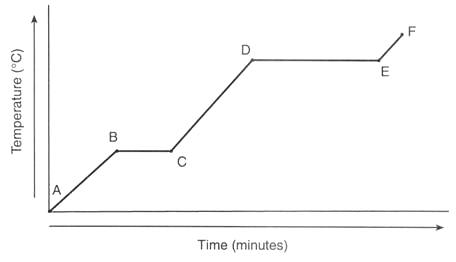
Between which points is the temperature of the substance remaining constant? (Diagram F)
A-B only.
A-B, C-D, E-F
B-C only.
B-C, D-E
Predict the products for the this reaction:
Mg + CuCl2 -->
MgCl2 + Cu
MgCl + Cu
MgCu + Cl2
CuMg + Cl2
AgNO3 + NaCl → AgCl + NaNO3
2HI --> H2 + I2

Balance this equation.
_CF4 + _Br2 -- _CBr4 + _F2
2,1,2,1
1,2,2,1
1,2,1,2
2,2,2,2
Actual yield = 62g
Calculate the percent yield.
12.00 moles of NaClO3 will produce how many grams of O2?
What mass of O2 will be needed to burn 36.1 g of B2H6?
How many liters of carbon dioxide are produced from 10L of carbon monoxide?
Balance this equation
_Al +_HCl --> _H2 +_AlCl3
2,6,3,2
it's already balanced
4,12,3,4
2,1,4,5
P4+O2 --> P2O3
_Mg + _Cl2 --> _MgCl2

Which conversion factor should be used for the following question - How many molecules are there in 4.00 moles of glucose, C6H12O6?
Which conversion factor should be used for the following question - How many liters are there in 1.00 moles of carbon dioxide?

