
 Worksheets
Periodic Table Anatomy Quiz Review
Total questions: 89
Worksheet time: 3600secs


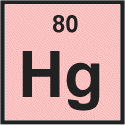

what is the name of group number 1
halogens
noble gases
alkali
alkaline earth
what is the name of group number 2
transition metals
halogens
metaloids
alkaline earth
what is the big group of metals called found within the metals
transition metals
nonmetals
noble gases
halogens
where are the metaloids found
far left, vertical
stair step/diagonal
far right horizontal
at the bottom
what group number are the halogens
18
1
2
17
what group number are the noble gases
17
18
14
15
what is the small group of elements called that include C,N,O
metals
nonmetals
metaloids
noble gases
symbols must have at least
1 cap. letter
2 cap. letters
2 lower case letters
any letter you want
Vertical columns on the periodic table are called ___?
groups
periods
rows
families

Which color on the image of the periodic table corresponds with the halogens.
red
black
blue
orange
Which color on the image of the periodic table corresponds with the lanthanides.
red
black
blue
orange
Which color on the image of the periodic table corresponds with the noble gases.
red
black
blue
orange
Which color on the image of the periodic table corresponds with the transition metals.
red
black
blue
orange
Which color on the image of the periodic table corresponds with the metalloids.
bright yellow
gold
teal
light blue
Which color on the image of the periodic table corresponds with the alkaline earth metals.
yellow
dark yellow
blue/green
teal
Horizontal rows on the periodic table are called ___?
groups
periods
rows
families
Mendeleev first ordered the periodic table of elements by increasing
atomic number
atomic mass
atomic symbol
atomic weight
Which family of elements reacts violently with water and exposure to oxygen?
alkali metals
alkaline earth metals
lanthanides
actanides
transition metals
The periodic table is mostly comprised of what type of element?
Metals
Nonmetals
Metalloids
Which family of elements does not combine with other elements unless under special conditions in a laboratory?
Noble gases
Halogens
Metalloids
Alkaline earth metals
Actinides


an arrangement of the elements according to their atomic numbers so that elements with similar properties are in the same column and properties repeat from row to row
Periodic Table of Elements
Atomic Theory
Isotopes
Subatomic Particles
one or two letters that represent the name of an element
element name
element symbol
atomic number
atomic mass
a unique number for each element that equals the number of protons in an atom of that element
element name
element symbol
atomic number
atomic mass
The maximum number of valence electrons an atom can have is eight, with the exception of helium, which can have only two. In each row, or period, of the periodic table, the last element on the right has the maximum number of valence electrons. Its outermost shell is full, and a new period in which the element on the far left has only one valence electron begins in the next row.
How do you determine how many valance electrons an element has?
Count how far over it is from the left in its row.
Count which row it is in.
They all have eight.
You can not determine this from the periodic table.
In the periodic table, similar elements are arranged in vertical columns called groups. Some of the major groups include Group 1: alkali metals; Group 2: alkaline earth metals; Group 17: halogens; and Group 18: noble gases. Elements within each group have similar properties and characteristic behaviors because of their similar numbers of valence electrons.
In what direction are groups arranged in the periodic table?
Side to side
Up and down.
Diagonally
In sections.
Alkali metals have 1 valence electron, making them highly reactive. With the exception of hydrogen, they tend to be very soft metals with low melting points. Examples include sodium and potassium.
Alkaline earth metals have 2 valence electrons and also are highly reactive and have high melting points. Examples include calcium and magnesium.
Halogens have 7 valence electrons and therefore are highly reactive. They tend to form compounds in nature. Examples include chlorine and fluorine.
Noble gases have a complete outer shell with 8 valence electrons, making them nonreactive. They are typically colorless, odorless gases. Examples include helium, neon, and argon.
Which group of elements tend to form compounds in nature?
Alkaline metals
Alkaline Earth metals
Halogens
Noble Gases
Alkali metals have 1 valence electron, making them highly reactive. With the exception of hydrogen, they tend to be very soft metals with low melting points. Examples include sodium and potassium.
Alkaline earth metals have 2 valence electrons and also are highly reactive and have high melting points. Examples include calcium and magnesium.
Halogens have 7 valence electrons and therefore are highly reactive. They tend to form compounds in nature. Examples include chlorine and fluorine.
Noble gases have a complete outer shell with 8 valence electrons, making them nonreactive. They are typically colorless, odorless gases. Examples include helium, neon, and argon.
Which group is highly reactive with high melting points?
Alkaline metals
Alkaline earth metals
Halogens
Noble gases
The periodic table is further arranged into three major regions, including the metals, metalloids, and non-metals. Metals are on the left of the table; they are shiny and flexible, conduct heat and electricity, and participate in ionic reactions. Non-metals are on the far right of the table; they are dull and brittle, are poor conductors, and typically participate in ionic reactions.
Which one is NOT a major region of elements in the periodic table?
Metals
Mettaloids
Non metals
Gases
Carbon and silicon, however, are examples of non-metals that participate in covalent reactions. Metalloids are located in a zig-zagging line between the two other regions. Metalloids are solid semi-conductors. In contrast to metals and non-metals, metalloids participate in covalent reactions.
Where would you look on the table to find the mettaloids?
In a zigzag line on the right.
In column 17
On the bottom
On the top
The elements in groups 3-12 are called the transition metals. These are similar to the metals in that they are flexible and good conductors but different in that they have unique valence electron structure. They typically form coordinate complexes in which one atom is surrounded by several more in a large complex. Iron, gold, and copper are examples of transition metals.
Which group are the transition metals most like?
Metals, they are flexible and good conductors.
Non metals, they a unique valence electron structure.
Noble gases, they don't want to bond with anything else.
They are like both metals and non metals in some ways.
It stacks the elements in columns according to the number of valence electrons in an atom of the element. Valence electrons are those in the outermost shell of the atom and the ones that participate in reactions. The number of valence electrons is associated with the element’s reactivity. Elements with the same number of valence electrons behave in a similar way in reactions and so are grouped together in the same column on the periodic table.
What does the amount of valance electrons determine about an element?
Its row in the table.
Its atomic number.
Its atomic mass.
Its reactivity with other elements.
In 1869, Dmitri Mendeleev developed the first periodic table, organizing the elements according to atomic weight. When he ordered the elements, he noticed that there were patterns of repeating properties. The modern periodic table sequences elements from left to right by atomic number.
This was the first person to organize a periodic table.
Neils Bohr
Dmitri Mendeleev
Democritus
Ernest Rutherford
The periodic table is a chart that organizes the elements based on their atomic properties. Elements in the periodic table are organized according to the periodic law. The periodic law states that chemical and physical properties of elements are periodic functions of their atomic numbers (the number of protons in the nucleus). As the atomic number of elements increases, different elements display similar characteristics at regular intervals.
Periodic law states that elements are arranged _______________________________________________________________.
in alphabetical order.
from largest to smallest.
as periodic functions of their atomic numbers.
there is no rhyme or reason.


What are valence electrons?
Any of an atom's electrons
Electrons located on the first energy level
Electrons not attached to any atom
electrons located on the outer energy level
What period is Lead (Pb) in?
6
4
Metals
4A
What category is silicon (Si) a part of?
Metal
Nonmetal
Metalloid
Halogens
Why are halogens so reactive?
They want to get rid of their only valance electron
They only need one more electron
They are non reactive, they have a full shell
As you move left to right on a row or period what happens?
Atomic number increases by 1
Electrons decrease
Number of shells decrease
Nothing

Elements in the same group or column have the same ...
# of valence electrons
# of shells
# of protons
Mass Number

Rows on the periodic table are called ___________.
Periods
Sentences
Fences

The columns in the periodic table are called ___________.
Towers
Herds
Groups


Poor conductor of heat and electricity is a property of ___________.
metals
nonmetals
metalloids
Which group is the most stable?
17
1
2
18

