
 Worksheets
Energy and Phases of Matter
Total questions: 89
Worksheet time: 2hrs 30mins

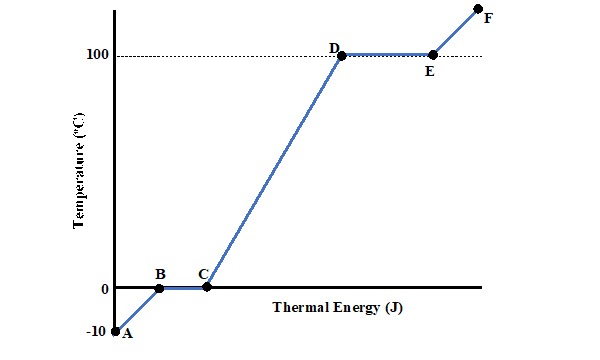
Between which two points is the gas heating up?
A ----> B
B <---- C
C ----> D
D ----> E
E ----> F


Between which two points is Heat of Fusion?
A <----> B
B <----> C
C <----> D
D <----> E
E <----> F


Boiling

Between which two points is Heat of Vaporization?
A <----> B
B <----> C
C <----> D
D <----> E
E <----> F
Between which two points is the solid melting?
A <---- B
B <----> C
C <---- D
D <----> E
E <---- F

What is the flow of energy when the cup of coffee cools down?
Energy leaves the coffee to the room
Energy from the room enters the coffee
Energy is everywhere and doesn't change
Two types of pure substances.
protons and neutrons
elements and compounds
mixtures and compounds
elements and mixtures
The specific heat of platinum is 0.133 J/g°C. How much heat(Q) is absorbed when a 10 g piece of platinum warms from 100°C to 150°C?
66.5 J
665 J
0.0266 J
0.665 J
If 20 g of water undergoes a temperature change from 25° C to 30° C, how much heat energy (Q) moves from the water to the surroundings?
418 J
209 J
83 J
4.18 J
Calculate the energy transferred when raising the temperature of 16000g of water by 3˚C
785 J
126000J
22000J
200640 J
If a cup of coffee at 75 degrees C is left on the counter and cools down to room temperature, what equation would you use to solve for energy?
Q=mcΔT
Q=mHf
What does the law of conservation of matter and energy say?
that matter changes phase when it absorbs thermal or heat energy
that all matter melts when heated
that matter and energy cannot be created or destroyed, but just transformed from one form into another
that energy causes motion in matter
What phase change happens when water is heated on a stove until it disappears?
Vaporization (liquid to gas)
melting (solid to liquid)
freezing (liquid to solid)
sublimation (solid to gas)

"Kinetic" refers to
motion
heat
density
forces
During a PHASE CHANGE, like freezing, temperature...
increases.
decreases.
does NOT change.
varies.
The phase change when a liquid becomes a gas.
melting
condensation
sublimation
evaporation
The phase change when a gas becomes a liquid.
condensation
evaporation
deposition
sublimation

What is it called when a solid turns directly into a gas?
Sublimation
Condensation
Melting
Freezing

What is it called when Gas change to Solid.
Sublimation
Condensation
Deposition
Freezing

What is it called when Solids change to Liquids.
Sublimation
Evaporation
Melting
Freezing
All phase changes (changing states) requires energy to be added or taken away.
True
False
Matter can change phases by changing the amount of _____.
molecules
matter
energy
phase
This is when heat is absorbed, it is an
Exothermic reaction
endothermic reaction
both
none
When heat is released it is an
exothermic reaction
endothermic reaction
both
none
In a heating curve, diagonal lines indicate temperature is __________, while flat lines indicate temperature is __________.
Constant, changing
Changing, constant

At which letter is the substance changing its state of matter?
A only
A, C, and E
D and E
B and D
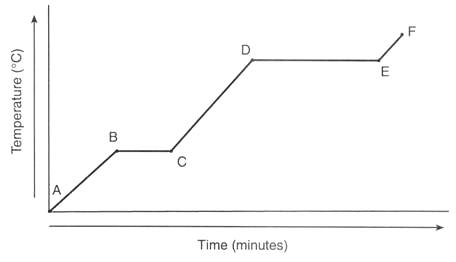
How many states of matter are present during line segment BC?
One
Two
Three
Depends on the temperature
Thermal energy always moves:
From a high temperature object to a lower temperature object.
From a lower temperature object to a higher temperature object.
From an object with lower kinetic energy to an object with higher kinetic energy.
From an object of higher mass to an object of lower mass.
What is holding molecules in a solid close to each other?
Intermolecular forces
Chemical Bonds
Heat
Cold
What is true about intermolecular forces in gases
they have been broken by heat
They are very strong
They cannot be put back together
they represent a chemical change


In which phase are intermolecular forces the strongest?
solid
liquid
gas

What is happening at point B if heat is entering the matter?
melting
freezing
evaporating
condensing

What is happening at point B is heat is leaving the matter?
melting
freezing
evaporating
condensing

What is happening at point D as heat is removed?
evaporating
condensing
boiling
melting
What describes temperature?
The average kinetic energy of the particles
The total kinetic energy of the particles
The transfer of kinetic energy from one substance to another
The average of the beat, rhymes, and punchlines in a freestyle.

At which points can the temperature change?
1
2
3
4
5
At which points is the phase changing?
1
2
3
4
5

From point A to point E, the sample is going through an
exothermic process by releasing heat to the surroundings
exothermic process by absorbing heat from the surroundings
endothermic process by releasing heat to the surroundings
endothermic process by absorbing heat from the surroundings
Q= m c ∆T
The units for specific heat are:
If the specific heat of water is 4.18 J/g∙°C, how much heat is required to increase the temperature of 1.2 kg of water from 23 °C to 39 °C? (show your work)
-80,256 J
80.256 J
80,256 J
-80.256 J
What does "ΔT" mean?
A change in health
A change in heat
A change in height
A change in temperature

Which of the following is true of the Celsius scale?
212o is the boiling point of water
0 degrees is absolute zero
0 degrees is the freezing point of water
32o is the freezing point of water
No more energy can be removed from matter at (where particles cease to move)
its freezing point
0oC
absolute zero
273 K
The more particles a substance has at a given temperature,
the higher its temperature
the more thermal energy it has
the more degrees it has
the more Kelvin it has
Heat, like work, is an energy transfer measured in
watts
degrees
Joules
Kelvin

The amount of energy required to raise the temperature of 1 kilogram of a substance by 1 Kelvin is called its
heat transfer
specific heat
change of state
melting point

Observe the diagram. Which statement is true about the kinetic energy of the molecules in the containers?
The molecules are moving faster in Diagram A
The molecules are moving slower in Diagram A
The molecules are moving at the same rate in both diagrams


Which description defines heat?
total thermal energy of an object or substance
change in the temperature of a substance in degrees Celsius
energy transferred between objects at different temperatures
average kinetic energy of the particles that make up a substance
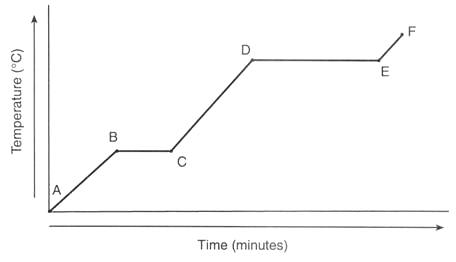
Between which points is the KE of the substance remaining constant? (Diagram F)
A-B only.
A-B, C-D, E-F
B-C only.
B-C, D-E
Between which points is the PE of the substance remaining constant? (Diagram F)
A-B only.
A-B, C-D, E-F
B-C only.
B-C, D-E
What is the formula to calculate heat energy required to raise the temperature of any substance?
Q = m C ∆T
Q = m Hv
Q = ½ m v
m = Q Hf
In heat capacity equations, what does the triangle represent?
Temperature
energy
mass
change in
change in temp
The heat absorbed by melting a solid is known as
heat of fusion
heat of solid
heat of liquid
heat of vaporization

Sections A, C, and E represent....
States of matter
Phase changes
Sections B and D represent....
States of matter
Phase changes

What particle diagram represents this substance during line segment CD


During which line segment(s) is Kinetic Energy Increasing and Potential Energy remaining constant?
(select ALL correct answers)
AB
BC
CD
DE
EF
During which line segment(s) is Kinetic Energy remaining constant and Potential Energy is increasing?
(select ALL correct answers)
AB
BC
CD
DE
EF
Which of the following accurately describes the energy of the particles during line segment BC?
Potential energy is increasing while kinetic energy is decreasing.
Kinetic energy is increasing while potential energy is decreasing.
Kinetic energy is increasing while potential energy remains constant.
Potential energy is increasing while kinetic energy remains constant.

