wayground logo

Free Printable Worksheets

Font size

S
M
L
XL
Worksheets

AP Chemistry Mid Year Review

Total questions: 87

Worksheet time: 2hrs 2mins

Name
Class
Date
1.
How many isotopes are shown in this mass spectrum?
a)
1
b)
84
c)
86
d)
4
2.
Based on the mass spectrum, which isotope of chlorine is most abundant?
a)
35Cl
b)
37Cl
c)
70Cl
d)
72Cl
3.

If an electron moves from n=4 to n=2 it ____

a)

absorbs energy

b)

releases energy

4.
What is the empirical formula if you have 36.84% nitrogen and 63.16% oxygen?
a)
NO
b)
N2O3
c)
N2O4
d)
N2O5
5.

How many molecules are in 2.5 mol of NaCl?

a)

1.5 x 1024 molecules

b)

1.5 molecules

c)

4.15 molecules

d)

1.5 x 10²³ molecules

6.
Which pair has the same empirical formula?
a)
NaCrO4 and Na2Cr2O7
b)
C2H4O2 and C6H12O6
c)
C3H6Oand C2H6O2
d)
CH4 and C2H6
7.
As you move across the periodic table from left to right, the atomic radius decreases.  This is because - 
a)
the number of protons increases, so attraction to electrons increases
b)
the number of energy levels increases
c)
the number of electrons increases
d)
the atomic mass increases
8.
As you move down a group, atomic radius increases because - 
a)
you add more and more neutrons
b)
you add more and more protons
c)
you add more and more shells (energy levels)
d)
you add more atomic mass
9.
As the distance between protons and electrons increases, the force of attraction
a)
remains the same
b)
increases
c)
decreases
d)
is not affected
10.
What are the two variables that affect Coulombic Attraction?
a)
Distance  and number of protons
b)
Number of neutrons and number of protons
c)
Number of neutrons and number of electrons
d)
solids or liquids
11.

List the following atoms in order of increasing ionization energy: Li, Na, C, O, F.

a)

Li<Na<C<O<F

b)

Na<Li<C<O<F

c)

F<O<C<Li<Na

d)

Na<Li<F<O<C

e)

Na<Li<C<F<O

12.

Identify the element based on the Photoelectron spectrum provided.

a)

Hydrogen

b)

Helium

c)

Sodium

d)

Magnesium

13.

The ability of an atom in a molecule to attract electrons is best quantified by the ______.

a)

electronegativity

b)

paramagnetism

c)

diamagnetism

d)

electron change-to-mass ratio

e)

first ionization energy

14.

In the resonance form of ozone shown, the formal charge on the central oxygen atom is _______.

a)

0

b)

+1

c)

-1

d)

+2

e)

-2

15.

The Lewis structure of the CO32- ion is

a)
b)
c)
d)
e)
16.

Which of these bonds takes the most energy to break?

a)

single

b)

double

c)

triple

d)

quadruple

17.

The formal charge on carbon in the molecule shown is _______.

a)

0

b)

+1

c)

+2

d)

+3

e)

-1

18.

Choose the correct shape for H2S

a)

Tetrahedral

b)

Trigonal pyramidal

c)

Bent

d)

Trigonal planar

19.
The electronegativity of C is 2.5, F is 4.0.  predict the character of a C-F bond.
a)
polar covalent
b)
nonpolar covalent
c)
ionic
d)
metallic
20.
How are compounds with metallic bonds similar to ionic compounds? 
a)
Both tend to have double and triple bonds
b)
Both tend to have low boiling points 
c)
Both tend to have poor conductivity
d)
Both tend to have high melting points 
21.

How many sigma and pi bonds are there in C2H2? (the structure will be ordered HCCH)

a)

1 sigma and 1 pi

b)

3 sigma and 1 pi

c)

3 sigma and 2 pi

d)

2 sigma and 3 pi

22.
What is the VSPER shape of PCl5
a)
See-saw
b)
trigonal planar
c)
octahedral
d)
trigonal bipyramidal
23.
Of the following molecules, which has the largest dipole moment?
a)
CO
b)
CO2
c)
O2
d)
HF
24.

Why are metals alloyed?

a)

To improve the appearance of a metal

b)

To make them less likely to corrode

c)

To reduce the amount of iron used

d)

To change the properties of the metal

25.

Definition: an alloy in which the atoms of the different elements are about the same size, so they can replace each other in the metal crystal.

a)

Alloy

b)

Substitutional alloy

c)

interstitial alloy

26.

Definition: an alloy in which the smaller atoms fit into the spaces between the larger atoms

a)

Alloy

b)

Substitutional alloy

c)

interstitial alloy

27.
CCl4 has polar bonds but is a non polar molecule. Why?
a)
bond polarity exist between atoms
b)
bond polarity between atoms cancel
c)
dipole moment exist between atoms in molecule
d)
difference in EN between C and Cl
28.
Which statement is TRUE, based on the diagram provided?
a)
atomic orbital overlap to produce sigma bond
b)
s orbital overlap to produce π bond
c)
s orbital overlap with s orbital to produce sigma bond
d)
p orbital overlap to produce π bond
29.
Which of the statement is TRUE?
a)
s orbital overlap with p orbitals to form sp hybrid orbital
b)
s orbital with two p orbitals to form one sp2 hybrid orbital
c)
s orbital with two p orbitals to form two sp2 hybrid orbital
d)
s orbital with two p orbitals to form three sp2 hybrid orbital
30.
Carbon atom undergo
a)
sp hybridization
b)
sp2 hybridization
c)
sp3 hybridization
d)
dsp3 hybridization
31.
Nitrogen atom undergo
a)
sp hybridization
b)
sp2 hybridization
c)
sp3 hybridization
d)
dsp3 hybridization
32.

Which of the following typically has the lowest melting point?

a)

Metals

b)

Covalent network solids

c)

Ionic compounds

d)

Covalent molecules

33.

Which of the following probably has the highest solubility in water?

a)

Metals

b)

Covalent network solids

c)

Ionic compounds

d)

Covalent molecules

34.
Intermolecular force present in HCl?
a)
dipole dipole
b)
dispersion
c)
H-bond
d)
ionic
35.
Type of intermolecular force present in I2, Br2, and Cl2.
a)
dipole dipole
b)
H-bond
c)
dispersion
d)
metallic
36.
Which of the following has the highest boiling point?
a)
H2
b)
NH3
c)
N2
d)
O2
37.
What information do we look for on the periodic table if we  want to examine intermolecular forces?
a)
atomic mass
b)
atomic number
c)
electronegativity
d)
ionization 
38.
What best explains the difference in melting points between Cl2 (-101.5) and F2 (-219)?
a)
Increased mass (polarizability) of chlorine
b)
Increased electronegativity of fluorine
c)
Increased number of electrons in chlorine
d)
Decrease metallic character of fluorine
39.
A sample of gas with a volume of 30.0 mL at 25.0oC is heated to 50.0oC.  What is the new volume of the gas?
a)
60.0 mL
b)
15.0 mL
c)
27.5 mL
d)
32.5 mL
40.

The density of an unknown gas is 2.00 grams per Liter at 3.00 atmosphere pressure and 127oC. What is the molar mass of this gas?

a)

(254/3) R

b)

188 R

c)

(800/3) R

d)

600 R

41.

A gaseous mixture containing 7.0 moles of nitrogen, 2.5 moles of oxygen, and 0.5 moles of helium exerts a total pressure of 0.90 atmosphere. What is the partial pressure of the nitrogen?

a)

0.13 atm

b)

0.27 atm

c)

0.63 atm

d)

0.90 atm

42.

Which of the following is an assumption of the kinetic-molecular theory of gases?

a)

Collisions between gas particles are inelastic.

b)

Gases consist of closely spaced particles.

c)

Gas particles move around in an orderly manner.

d)

The temperature of a gas depends on the average kinetic energy of the gas particles.

43.

1. Under which conditions does a real gas behave very much like an ideal gas?

a)

high temperature and low pressure

b)

high temperature and high pressure

c)

low temperature and high pressure

d)

low temperature and low pressure

44.

Chromatography separates solutions on the basis of _____ while distillation separates solutions on the basis of ______.

a)

IMFs; solubility

b)

solubility; conductivity

c)

IMFs; boiling point

d)

boiling point; solubility

45.
You have a 0.5 M MgSO4 stock solution available.  Calculate the volume of the stock solution needed to make 2.0 L of 0.20 M MgSO4.
a)
0.8 L
b)
5 L 
c)
0.1 L
d)
0.5 L
46.

A dissolved solute that does not form ions is

a)

a nonelectroyte

b)

a weak electrolyte

c)

a strong electrolyte

d)

insoluble

47.

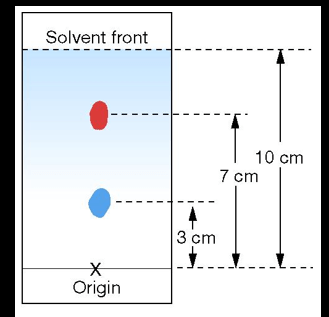
A student extracts the colour from some green smarties and uses paper chromatography to separate components colours. She finds blue has a Rf =0.38 and yellow Rf =0.75 this suggests

a)

the yellow is more strongly adsorbed onto the stationary phase and is less soluble in the mobile phase.

b)

the yellow is more strongly adsorbed onto the stationary phase and is more soluble in the mobile phase.

c)

the blue is more strongly adsorbed onto the stationary phase and is less soluble in the mobile phase.
d)

the blue is more strongly adsorbed onto the stationary phase and is less soluble in the mobile phase.

48.
A high Rvalue indicates strong
a)
strong affinity to the stationary phase
b)
strong affinity to the mobile phase
c)
no affinity to the stationary phase
d)
 no affinity to the stationary phase
49.
The Rvalue  for the blue component is 
a)
0.3
b)
0.7
c)
10
d)
3
50.
A certain photon of light has a wavelength of 4.22x10⁻⁷nm. What is the frequency? (v=c/λ)
a)
7.11x10¹⁴ Hz
b)
7.11Hz
c)
1.41x10⁻¹⁵
d)
-1.41x10¹⁵
51.
As the frequency of an electromagnetic wave increases, the amount of energy in that wave...
a)
increases.
b)
decreases.
c)
stays the same.
52.
What is the Energy of a blue light with the frequency of 6.91x10¹⁴Hz? (E=hv)
a)
4.56x1049J
b)
9.55x10-49J
c)
4.56x10⁻¹⁹J
d)
5.82x10¹⁹J
53.
What is the precipitate formed when you mix silver nitrate with copper chloride?
a)
copper nitrate
b)
copper chloride
c)
silver chloride
d)
silver nitrate
54.
Which is the correct net ionic equation for the reaction of AgNO3 and CaCl2?
a)
Ca2+(aq) +  2Cl- (aq) → CaCl(s)
b)
Ag+(aq)  +  Cl- (aq) → AgCl(s)
c)
Ag +  Cl  →  AgCl
d)
Ag+  +  Ca2+   →Ag2Ca (s)
55.
What are the spectator ions in the reaction of sodium chloride with silver nitrate?
a)
silver and nitrate
b)
sodium and chloride
c)
sodium and nitrate
d)
silver and chloride
56.
In the reaction
2Ca(s) + O2(g) 
→ 2CaO(s), calcium is...
a)
Reduced
b)
Synthesized
c)
Oxidized
d)
None of the above
57.
     In the reaction Zn + H2O --> ZnO2 + H2
 which element, if any, is oxidized? 
a)
Zinc
b)
Hydrogen
c)
Oxygen
d)
None
58.
The following is what type of reaction:
NH3 + HCl  → NH4Cl
a)
Synthesis
b)
Decomposition
c)
Single Replacement Replacement
d)
Double Replacement Replacement
59.
What coefficients are needed to correctly balance the equation?
_Bi   +   _O2   →  _Bi2O3
a)
3,2,3
b)
2,3,2
c)
4,3,2
d)
none of these
60.
The following is what type of reaction:
PbCl2 + AgNO3 → Pb(NO3)2 + AgCl
a)
Synthesis
b)
Decomposition
c)
Single Replacement
d)
Double Replacement
61.
What is oxidation number of H in CaH2?
a)
+1
b)
-1
c)
0
d)
+2
62.

What is the oxidation number of N in NO2-1?

a)

-3

b)

+4

c)

-2

d)

+3

63.
What is the reducing agent of this reaction?
3Mg + N2−−−−> Mg3N2
a)
Mg
b)
N2
c)
Mg3N2
d)
MgN
64.
Which of the following half reactions correctly represents a reduction half reaction?
a)
Fe →Fe2+ + 2e-
b)
Pb4+ + 2e- →Pb2+
c)
2O-2 →O2 + 4e-
d)
Fe + 3e- →Fe3+
65.
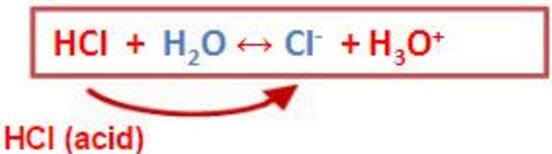
Which of the following shows the correct conjugate acid base pair?
a)
HCI (acid) / H3O+ (conjugate base)
b)
HCI (acid) / CI- (conjugate base)
c)
HCI (base) / CI- (conjugate acid)
d)
HCI (base) / H3O+ (conjugate acid)
66.
HCI dissociates completely and is irreversible. Why?
a)
HCI is a strong acid and CI- is a weak base
b)
H2O is a weak base
c)
CI- is a strong conjugate base, will not accept H+ from H3O+
d)
CI- is a weak conjugate base, will not accept H+ from H3O+
67.

B2H6 + 3O2 -->2 HBO2 + 2 H2O

What mass of O2 will be needed to burn 36.1 g of B2H6?

a)

13.8 g

b)

3.86 g

c)

124 g

d)

198.3 g

68.
Fe + S --> FeS
If 7.62g Fe react with 8.67g S, what is the limiting reactant?
a)
Fe
b)
S
c)
FeS
d)
none 
69.

What is the limiting reactant if 10 moles of NH3 react with 30.0 moles of NO?

4NH3+ 6NO --> 5N2 + 6H2O

a)

NH3

b)

NO

c)

N2

d)

water

70.
What precipitate forms when you mix lead (II) nitrate with sodium chloride?
a)
sodium nitrate 
b)
lead (II) chloride 
c)
sodium lead
d)
chloride nitrate 
71.

Which element has the largest atomic radius?

a)

B

b)

Al

c)

Ca

d)

Mg

72.

Which molecule is nonpolar?

a)

NH3

b)

OF2

c)

SF4

d)

PF5

73.
a)
A. is most exothermic
b)
B. is most exothermic
c)
C. is most exothermic
d)
D. is most exothermic
74.
Which one of the following is a first order, overall reaction
a)
k1= 1.000 M s-1
b)
k1= 5403.2 M½ s½
c)
k1= 1.23 x 10⁻⁶ M-1 s-1
d)
k1= 10.7 s-1
75.
Consider the following rate law: Rate = k[A]n[B]m
How are the exponents n and m determined?
a)
by using balanced chemical equation
b)
By using the subscripts for the formulas
c)
By educated guess
d)
By experiment 
76.
a)
A. has largest Ea
b)
B. has largest Ea
c)
C. has largest Ea
d)
E. has largest Ea
77.
a)
A. is the slowest reaction
b)
B. is the slowest reaction
c)
C. is the slowest reaction
d)
E. is the slowest reaction
78.
step 1: O3 → O2 + O
step 2: O3 + O → 2 O2

The oxygen atom (O) is considered to be a(n)...
a)
reactant
b)
catalyst
c)
reaction intermediate
d)
activated complex
79.
The reaction of (CH3)3CBr with hydroxide ion proceeds:
(CH3)3CBr(aq) + OH-(aq) → (CH3)3COH(aq) + Br-(aq)
What will the initial rate (in mol/L*s) be in Experiment 4?
a)
0.003
b)
0.006
c)
0.009
d)
0.018
80.
In any first order reaction, as the reaction proceeds at constant temperature, which describes the corresponding effects on k (the rate constant) and rate?
a)
k remains the same; rate decreases
b)
k and rate both remain the same
c)
k remains the same; rate increases
d)
k decreases; rate remains the same
81.
A compound has a half-life of 14 min. How much time will it take a 12 mol sample to decay to 1.5 mol?
a)
14 min
b)
28 min
c)
42 min
d)
56 min
82.
a)
IO-, because it was used as a reactant in an earlier step and reproduced in a subsequent step
b)
I-, because it was used as a reactant in an earlier step and reproduced in a subsequent step
c)
IO-, because it was produced in an earlier step and used up in a subsequent step
d)
I-, because it was produced in an earlier step and used up in a subsequent step
83.
a)

rate = k[CO]2[O2]2

b)

rate = k[CO]2[O2]

c)

rate = k[CO][O2]2

d)

rate = k[CO][O2]1/2

84.
Increasing temperature of a chemical reaction:
a)
increases the number of collisions per second of chemical reactants
b)
increases the speed of reaction
c)
can increase the pressure of reactants
d)
all of the above
85.
Multi-step (Consecutive) Reactions:
Mechanisms in which one elementary step is followed by another are very common.
step 1:              A + B → Q
step 2:              B + Q → C
net reaction:    A + 2B → C
Which of the following is false?
a)
The net reaction is just the sum of its elementary steps.
b)
The species Q is an intermediate, usually an unstable or highly reactive species. 
c)
Intermediates such as Q can appear in the rate law of a net reaction.
d)
If both steps proceed at similar rates, rate law experiments on the net reaction would not reveal that two separate steps are involved here.The rate law for the reaction would berate=k[A][B]2
86.

The graph shown depicts the relationship between concentration and time. What is the slope of this line?

a)

-k

b)

-1/k

c)

k

d)

ln[A]o

87.

What is the rate law for this reaction?

a)

rate = k[X]0

b)

rate = k[X]

c)

rate = k[X]2

d)

rate = -k[X]2