
 Worksheets
Mr Kendall Review 1
Total questions: 92
Worksheet time: 1hrs 14mins
Name
Class
Date
1.
True or False: Your hypothesis can never be wrong.
a)
True
b)
False
2.

What property of water helps to moderate earth's temperature?
a)
adhesion
b)
chohesion
c)
Specific heat capacity
d)
Latent heat of vaporization
3.

Used for short term (quick) energy.
a)
carbohydrates
b)
lipids
c)
proteins
d)
nucleic acids
4.
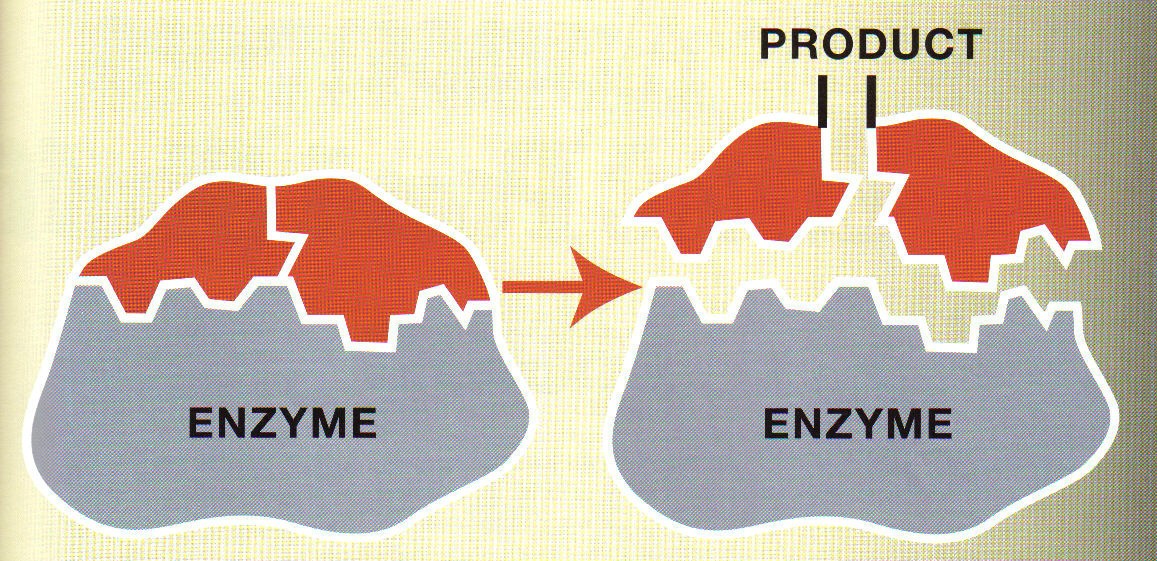
Enzymes speed up reaction rates by changing...
a)
Activation Energy
b)
pH
c)
Hydrogen Bonds
d)
Kinetic Energy
5.

Is found in the cell membrane as a bilayer.
a)
lipids
b)
protein
c)
nucleic acid
d)
carbohydrate
6.

What word describes when water is attracted to other substances?
a)
cohesion
b)
adhesion
c)
capillary action
d)
surface tension
7.
A collection of beliefs such, such as astrology, is known as...
a)
Pseudoscience
b)
Fact
c)
Theory
d)
Law
8.

Identify the macromolecule in the picture.
* look at the R.....
* look at the R.....
a)
carbohydrates
b)
lipids
c)
proteins
d)
nucleic acids
9.
Which question can best be investigated by a scientist?
a)
Should I buy a red shirt or a green shirt?
b)
Does chocolate milk or plain milk taste better?
c)
Does a plant need sunlight to grow?
d)
Which feels softer, cat fur or dog fur?
10.
Any substance that is acted upon by an enzyme is called a(n)?
a)
Coenzyme
b)
Substrate
c)
Vitamin
d)
Polypeptide
11.

Identify the macromolecule in the picture
a)
carbohydrate
b)
lipid
c)
protein
d)
nucleic acid
12.

Why does ice float?
a)
As water freezes, it expands and its density decreases.
b)
As water freezes, it takes up more hydrogen from the atmosphere, causing it to have a greater buoyancy.
c)
As water freezes, air becomes trapped between the hydrogen bonds of water molecules.
d)
As water freezes, it takes up more oxygen from the atmosphere, causing it to have a greater buoyancy.
13.
In order for an explanation to be considered scientific, it must be based on ____________.
a)
an inference
b)
a conclusion
c)
past experience
d)
evidence
14.
Enzymes are...
a)
nucleic acids
b)
proteins
c)
lipids
d)
carbohydrates
15.
Which is NOT a unique property of water?
a)
Frozen water floats on liquid water.
b)
Water covers most of the Earth’s surface and retains a large amount of heat.
c)
Water molecules stick to each other through hydrogen bonds.
d)
Water cools very rapidly.
16.

Contains DNA and RNA
a)
lipids
b)
carbohydrates
c)
proteins
d)
nucleic acids
17.
If something cannot be observed using the 5 senses, is not testable or repeatable, then it is not science.
a)
True
b)
False
18.
What is the function of an enzyme?
a)
enzymes break themselves into small pieces
b)
enzymes slow down chemical reactions
c)
enzymes speed up chemical reactions
d)
enzymes combine products to form reactants
19.
Water striders can walk across the surface of calm water. Their feet push the surface of the water down slightly, but they do not break the surface. Why?
a)
The insects are light enough so they do not break the hydrogen bonds holding the water molecules together
b)
The insects actually use their wings to hover slightly above the water’s surface and they only skim it with their feet.
c)
The insect’s feet are non-polar, so they are repelled by the polar water molecules and are pushed away from the water’s surface.
d)
The insects are small enough to see the individual water molecules, so they are able to step carefully from one molecule to the next
20.

Provides long term energy and insulation,
a)
lipids
b)
carbohydrates
c)
nucleic acids
d)
proteins
21.

The attraction that causes water and other liquids to form drops on thin films is called ________________. This is also water’s ability to be attraction to other water molecules.
a)
adhesion
b)
capillary action
c)
cohesion
d)
surface tension
22.
What happens when enzymes are heated to a high temperature?
a)
The enzymes die.
b)
The shapes of the enzyme are altered denature
c)
The enzymes' amino acid sequence changes.
d)
The enzymes remain the same
23.
What two elements make up water?
a)
Helium and oxygen
b)
Hydrogen and oxygen
c)
helium and carbon
d)
oxygen and carbon
24.
Science is a way of knowing and understanding the ________ world around us.
a)
Abstract
b)
Natural and Physical
c)
Crazy
d)
Spiritual
25.

Building blocks of the body, hair , muscles etc.
a)
protein
b)
nucleic acid
c)
lipids
d)
carbohydrates
26.

Identify the macromolecule in the picture
*GLUCOSE
*GLUCOSE
a)
lipid
b)
protein
c)
nucleic acid
d)
carbohydrate
27.

Identify the macromolecule in the picture
* cholesterol and triglycerides
* cholesterol and triglycerides
a)
carbohydrate
b)
protein
c)
lipid
d)
nucleic acid
28.
How do enzymes speed up chemical reaction?
a)
Increasing activation energy
b)
Decreasing activation energy
c)
Increasing deactivation energy
d)
Decreasing deactivation energy
29.
What is a substance called if it speeds up a chemical reaction?
a)
reusable
b)
catalyst
c)
specific
d)
fragile
30.
With what 3 letters do enzymes typically end?
a)
-ose
b)
-ase
c)
-ese
d)
-tic
31.
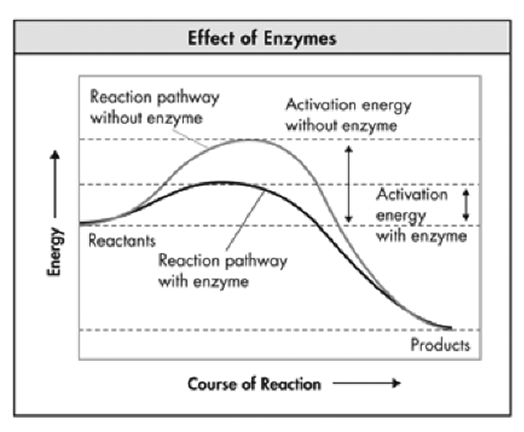
The graph shows how enzymes affect reactions in cells. Which statement best summarizes the information shown in the graph?
a)
Enzymes increase the energy of the reactants.
b)
Enzymes decrease the energy level of the products.
c)
Enzyme decrease the activation energy of the reaction.
d)
Enzymes reverse the direction of the reaction.
32.
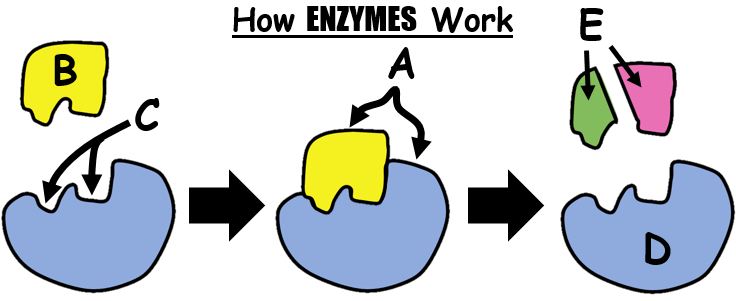
In the diagram, what is letter A?
a)
product
b)
substrate
c)
enzyme-substrate complex
d)
active site
33.

Contains a phosphate, sugar and nitrogen base
a)
nucleic acid
b)
lipid
c)
carbohydrate
d)
protein
34.
An enzyme speeds up a chemical reaction in the cell but can only be used once. True or False?
a)
true
b)
false
35.
Which of these is NOT true?
a)
Enzymes can denature (change shape) when the temperature gets too high.
b)
Enzymes can only be used once in a chemical reaction.
c)
Extreme pH can denature enzymes.
d)
Enzymes speed up chemical reactions.
36.
Which of these is most likely an enzyme?
a)
Sucrose
b)
Galactose
c)
Fructose
d)
Amylase
37.
Babies do not have well developed digestive systems for breaking down proteins; therefore baby food is prepared after treatment with which enzyme?
a)
protease
b)
lipase
c)
carbohydrase
d)
synthase
38.
Which is NOT true?
a)
Enzymes speed up chemical reactions.
b)
Enzymes react best at a specific temperature.
c)
Enzymes only control ONE type of reaction.
d)
Enzymes are made of fatty acids.
39.
What is another name for enzymes?
a)
chemical catalysts
b)
microorganisms
c)
biological catalysts
d)
inorganic catalysts
40.
Which is NOT a step in the scientific method?
a)
Make observation
b)
Form a theory
c)
Collect data
d)
Form a hypothesis
41.
The pH at which an enzyme is most efficient is called the _________ pH of an enzyme.
a)
neutral
b)
optimum
c)
minimum
d)
experimental
42.

Molecule in which opposite ends have opposite electric charges
a)
cohesion
b)
polar molecule
c)
hydrogen bond
d)
solution
43.

The current model of enzyme action is referred to as the...
a)
Induced Fit Model
b)
Lock & Key Model
c)
Singer-Nicolson Model
d)
Davson-Danielli Model
44.
Which of the following binds to the active site of an enzyme?
a)
substrate
b)
product
c)
codon
d)
none of the above
45.
Where do substrates bind on an enzyme?
a)
voltage-gated channels
b)
surface receptor
c)
calcium channels
d)
active site
46.
What is a substance called if it speeds up a chemical reaction?
a)
reusable
b)
catalyst
c)
specific
d)
fragile
47.
Which of the following properties of water enables it to move from the roots to the leaves of plants?
a)
Water expands as it freezes.
b)
Water is an excellent solvent.
c)
Water exhibits cohesive behavior.
d)
Water moderates temperature.
48.

A molecule with electrically charged areas is called a _______________.
a)
magnet
b)
polar molecule
c)
solution
d)
electrical molecule
49.
Which end of the water molecule has a slightly positive charge?
a)
the oxygen end
b)
the hydrogen end
c)
both ends are slightly positive
d)
neither end is positive
50.

Which types of compounds dissolve easily in water?
a)
Polar and Nonpolar
b)
Polar
c)
Nonpolar
d)
Solutions
51.
Water is a universal solvent because it...
a)
It can be found anywhere
b)
It freezes when it gets cold
c)
floats when frozen
d)
Dissolves most substances
52.
Water beads up on the surface of a penny because of this property.
a)
Adhesion
b)
Surface Tension
c)
Universal Solvent
d)
Changes in Density
53.

What is the reason why oil and water don't mix?
a)
Oil is too heavy to mix with water
b)
Water can only mix with polar molecules
c)
Water can only mix with non-polar molecules
d)
Oil is too light to mix with water
54.

Water molecules require a lot of energy to separate one from the others. This gives water a high
a)
density
b)
polarity
c)
solvency
d)
specific heat
55.
Land near large bodies of water will have ___ temperatures because of water's ability to release heat during the winter.
a)
hotter
b)
milder
c)
cooler
d)
cold
56.
At 100° C (212° F), liquid water...
a)
condenses
b)
evaporates
c)
freezes
d)
boils
57.
At 0° C (32° F), liquid water begins to
a)
condense
b)
evaporate
c)
freeze
d)
boils
58.
A possible explanation to a problem that has not yet been tested.
a)
data
b)
theory
c)
hypothesis
d)
fact
59.
This variable in an experiment is the one being deliberately changed by the scientist.
a)
dependent variable
b)
independent variable
c)
data
d)
control group
60.
Should experiments be repeated over and over to see if the results are the same each time?
a)
yes
b)
no
61.
During the summer, bodies of water will ___ heat.
a)
release
b)
absorb
c)
condense
d)
evaporate
62.
There are two types of data. Which type of data involves numbers that are obtained by counting or measuring?
a)
quantitative
b)
qualitative
63.
The summary at the end of an experiment that explains the results.
a)
conclusion
b)
procedures
c)
materials
d)
responding variable
64.
A series of steps used by scientists to solve a problem or answer a question.
a)
scientific method
b)
recipe
c)
data collection
d)
metric system
65.
In a controlled experiment, how many independent variables can be worked with at a time?
a)
one
b)
none
c)
two or more
d)
how ever many makes sense.
66.
A list of the steps anyone could follow to conduct an experiment.
a)
obervations
b)
question/problem
c)
materials
d)
procedures
67.
Two types of data scientists collect are...
a)
hypothesis and theory
b)
qualitative and quantitative
c)
myths and fables
d)
metric and standard measurements
68.
Measuring the number of times a person breathes after exercise involves ____ data.
a)
quantitative
b)
qualitative
69.
Jane Goodall video recorded chimpanzees hunting pigs, this type of data is called ___
a)
qualitative
b)
quantitative
c)
field study
d)
observation
70.
A student is planning an experiment to find out how the height from which he drops a ball affects how high the ball bounces. The dependent variable is the _____.
a)
Diameter of the ball
b)
Force acting on the ball
c)
Height that the ball bounces
d)
Height from which the ball is dropped
71.
An experiment is performed on plants to see how different liquids affect plant growth. Each plant in the experiment is given a different liquid; water, apple juice, or milk. Each plant has the same amount of soil, sunlight, and listens to the same music. In this investigation, what is the dependent variable?
a)
Type of plant
b)
Water, apple juice, milk
c)
Plant growth
d)
Color of the plant's leaves
72.
Science is a continually ongoing process.
a)
True
b)
False
73.
If I study for my scientific method quiz, then I will have a better test score. What is the dependent variable?
a)
Scientific Method
b)
Studying
c)
Independent variable
d)
Test score
74.
This part of the experiment serves as a basis of comparison; the one variable being tested has been omitted.
a)
experimental group
b)
control group
c)
data
d)
variables
75.
The pH scale is a range from:
a)
1-7
b)
0-14
c)
1-5
d)
1-20
76.
A(n) ______ is a substance with a pH less than 7
a)
Acid
b)
Alkaline
c)
Base
d)
Buffer
77.
What is the only substance with a neutral pH of 7?
a)
Milk
b)
Orange Juice
c)
Water
d)
Blood
78.

Is this substance acidic, basic, or neutral?
a)
Acidic
b)
Basic
c)
Neutral
79.

Is this substance acidic, basic, or neutral?
a)
Acidic
b)
Basic
c)
Neutral
80.
A solution with a pH of 8.6 would be...
a)
Acid
b)
Base
c)
Neutral
d)
Acid and Base
81.
A solution with a pH of 3.6 would be...
a)
Acid
b)
Base
c)
Neutral
d)
Acid and Base
82.
A solution with a pH of 7.0 would be...
a)
Acid
b)
Base
c)
Neutral
d)
Acid and Base
83.
The pH scale 8-14 are...
a)
acids
b)
bases
c)
neutral
84.
This substance releases OH- into solution
a)
Acid
b)
Base
c)
Neutral
85.
An acid is a substance that releases
a)
H+ is water
b)
H- in water
c)
OH in water
d)
OH- in water
86.
In a water molecule, which atom(s) has/have a partial negative charge?
a)
Oxygen
b)
Hydrogen
c)
None of the atoms
d)
All of the atoms
87.
What is the maximum number of hydrogen bonds one molecule of water can form?
a)
1
b)
2
c)
3
d)
4
88.
Ice has ___________ density as compared to water.
a)
higher
b)
lower
c)
the same
89.
What does pH measure?
a)
Amount of Oxygen Ions
b)
Amount of Hydrogen/Hydronium Ions
c)
The amount of salt in a solution
d)
The density
90.
Large bodies of water do not quickly fluctuate in temperature. Why?
a)
Water is a solvent.
b)
Water has a high heat capacity.
c)
Water acts as a buffer.
d)
Water is non-polar.
91.

Attractions between water molecules are called
a)
Covalent bonds
b)
Ionic bonds
c)
Polar bonds
d)
Hydrogen bonds
92.
A water molecule is a ________ molecule, which has one oxygen that has a __________ charge and two hydrogens that have a ___________ charge.
a)
nonpolar, positive, negative
b)
polar, positive, negative
c)
polar, negative, positive
d)
nonpolar, negative, positive
100 %

