
 Worksheets
Evolution & Animal Behavior Unit Review
Total questions: 88
Worksheet time: 5hrs 34mins
Name
Class
Date
1.

Separation of populations as a result of geographic change or migration to geographically isolated place
a)
geographic isolation
b)
adaptive radiation
c)
punctuated equilibrium
d)
embryology
2.

Evolutionary model suggesting species often diverge in spurts of relatively rapid change, followed by long periods of little change.
a)
geographic isolation
b)
adaptive radiation
c)
punctuated equilibrium
d)
embryology
3.

Study of multicellular organisms as they develop from fertilized eggs to fully formed organisms.
a)
geographic isolation
b)
adaptive radiation
c)
punctuated equilibrium
d)
embryology
4.
What is the principle that defines evolution in terms of allele frequency?
a)
Natural Selection
b)
Convergent Evolutions
c)
Directional Selection
d)
Hardy -Weinberg
5.

Which of the following is an example of a vestigial structure?
a)
the wings of a red-tailed hawk
b)
the hind limbs of a house cat
c)
the fins of sharks
d)
the wings of an ostrich
6.

If an organism has a vestigial structure, that structure likely once had a function in a(n)
a)
close relative
b)
early ancestor
c)
unrelated organism
d)
embryological stage
7.

Some organisms that share a common ancestor have features that have different functions, but similar structures. These are known as
a)
vestigial structures
b)
analogous structures
c)
homologous structures
d)
fossil structures
8.

A measure of how commonly a particular allele occurs in a population is known as the
a)
gene pool
b)
allele frequency
c)
mutation rate
d)
phenotype
9.

The hind leg bones in a whale are examples of
a)
homologous structures
b)
analogous structures
c)
fossils
d)
vestigal structures
10.
Combined alleles of all individuals in a population is called
a)
phenothype
b)
gene pool
c)
mutation rate
d)
allele frequency
11.
Structures that no longer serve a purpose.
a)
Homologous structures
b)
gene pool
c)
population
d)
Vestigial structures
12.
Structures that have common evolutionary origins, provide evidence for common ancestor.
a)
Species
b)
Vestigial Structures
c)
Population
d)
Homologous Structures
13.
Group of organisms all of the same species, living in the same place at the same time.
a)
gene pool
b)
population
c)
species
d)
evolution
14.

How would you describe this evolution?
a)
Homologous structure
b)
Analogous structure
c)
Structural adaption
d)
Functional adaption
15.
The preserved remains of traces of an organisms that lived in the past
a)
Adaptation
b)
Fossil
c)
Mutation
d)
Evolution
16.
The intentional mating of two animals in an attempt to produce offspring with desirable characteristics
a)
Selective Breeding
b)
Mutation
c)
Natural Selection
d)
Variation
17.
What type of speciation involves geographic isolation?
a)
Allopatric
b)
Sympatric
c)
Both
18.
What type of speciation involves isolation due to behavior such as sexual selection or habitat differentiation?
a)
Allopatric
b)
Sympatric
c)
Both
19.
Which type of speciation occurred when maggot flies living on hawthorns began to feed on apples?
a)
Allopatric
b)
Sympatric
20.
The model that predicts evolution occurs at a slow, steady rate is called...
a)
gradualism
b)
punctuated equilibrium
c)
adaptive radiation
d)
convergent evolution
21.
Which of the following is NOT evidence of evolution?
a)
homologous structures
b)
gravity
c)
vestigial structures
d)
intermediate fossils
22.
Which diagram can be used to identify a common ancestor of modern organisms?
a)
genetic code
b)
cladogram
c)
punnett square
d)
periodic table
23.
What was the name of the ship Charles Darwin sailed on?
a)
Boaty McBoaty Face
b)
HMS Beagle
c)
HMS Britannia
d)
HMS Bulldog
24.
Where did Charles Darwin travel to?
a)
Australia
b)
Barbados
c)
Galapagos
d)
Trinidad
25.
What animals did Charles Darwin study when at the Galapagos Islands?
a)
Giraffes
b)
Seagulls
c)
Seals
d)
Finches
26.
What is the title of Charles Darwin's famous book?
a)
The origin of species
b)
Origin of species
c)
On the origin of species
d)
Species. The origin
27.

What type of selection?
a)
Directional
b)
Stabilizing
c)
Disruptive
28.
"Survival of the Fittest" describes which theory
a)
a) natural selection
b)
b) gravity
c)
c) heredity
d)
d) string theory
29.
What causes variation?
a)
Change in the Environment
b)
Mutation
c)
Isolation
30.
When antibiotics were first introduced they killed almost all bacteria, but varieties have now evolved which are resistant to antibiotics. Which is the final event that occurred during this process.
a)
resistant organisms survived while others were killed
b)
resistant organisms reproduced
c)
resistant organisms occurred by mutation
31.
Which is the first event that takes place during speciation?
a)
Isolation
b)
Mutation
c)
Selection pressure
32.
During speciation when do two groups become recognized as separate species?
a)
When they look different
b)
When they are separated by an isolation barrier
c)
When they cannot interbreed
33.
The dark form of the peppered moth:
a)
has a selective advantage in polluted areas
b)
never occurs in unpolluted areas
c)
is well camouflaged against lichen.
34.
The light form of the peppered moth became less common in the nineteenth century because:
a)
it was poorly camouflaged when lichens died
b)
it changed to the dark form by mutation
c)
it was killed by industrial pollution
35.

Change can happen in a _____________.
a)
single organism
b)
whole population
36.

What type of selection is depicted in the picture?
a)
stabilizing
b)
directional
c)
disruptive
d)
the answer is not here
37.
You look at two species and see very similar DNA. What does this likely tell you?
a)
These are the same animal.
b)
These animals have a common ancestor.
c)
These animals are not likely related.
d)
These animals are likely becoming one species.
38.
Horse breeding for specific desired traits is an example of which type of evolutionary evidence?
a)
Artificial selection
b)
Embryology
c)
Fossils
d)
Biochemical molecules
39.
An inherited characteristic that increases an organisms ability to survive and reproduce in its specific environment is called a(n)
a)
vestigial structure
b)
speciation
c)
analogous structure
d)
adaptation
40.
According to the theory of natural selection, some individuals more likely than others to survive and reproduce because they:
a)
pass on to their offspring their newly acquired traits.
b)
are better adapted to their environment than others and will pass on those adaptations to future offspring.
c)
do not pass on newly acquired traits.
d)
produce fewer offspring than others in the same environment.
41.

Which of the following is a term for a group of similar organisms that can reproduce fertile offspring?
a)
individual
b)
population
c)
species
d)
fossil
42.
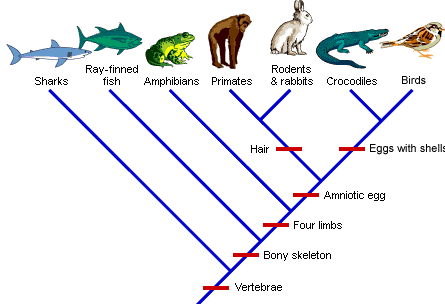
According to this cladogram, sharks are MOST closely related to which organism?
a)
Amphibians
b)
Ray finned fish
c)
Crocodiles
d)
Birds
43.
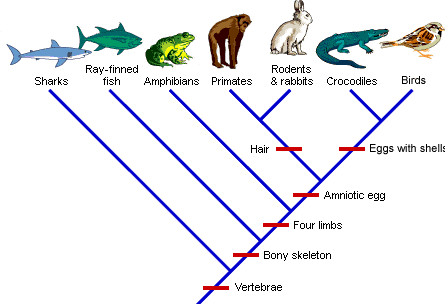
Which two organisms have hair?
a)
Sharks & Ray Finned Fish
b)
Primates & Rodents
c)
Birds & Crocodiles
d)
Rabbits & Birds
44.
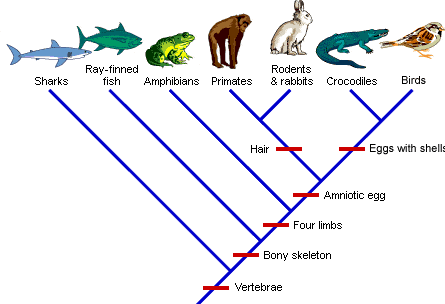
According to this cladogram, birds are LEAST related to:
a)
Amphibians
b)
Sharks
c)
Ray Finned Fish
d)
Crocodiles
45.
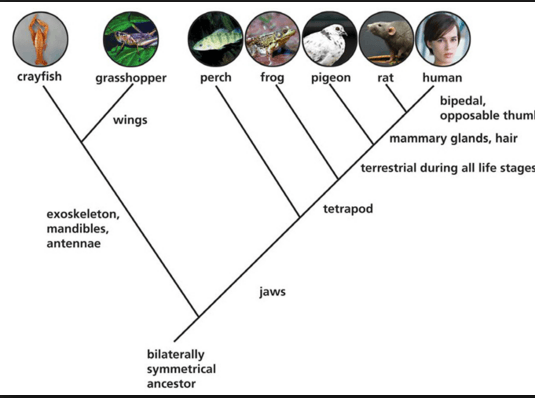
Which trait do only humans have, according to the cladogram?
a)
jaws
b)
mammary glands & hair
c)
terrestrial during all life stages
d)
bipedal & opposable thumbs
46.
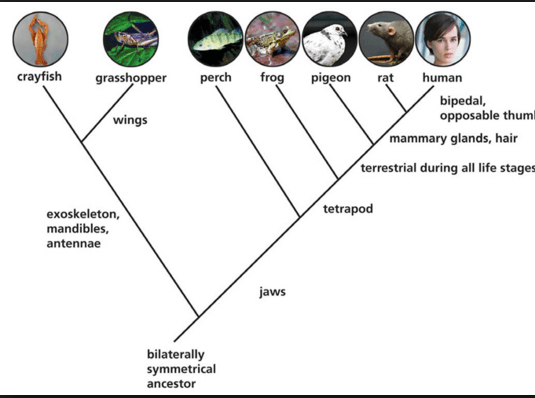
According to the cladogram, which organism is most distantly related to the human?
a)
crayfish
b)
grasshopper
c)
perch
d)
frog
47.
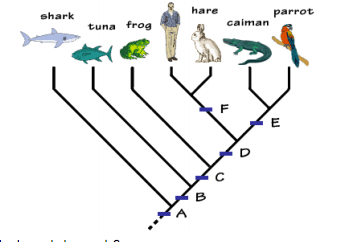
On the cladogram, which organism is the closest relative of the human?
a)
Frog
b)
Hare
c)
Caiman
d)
Parrot
48.
Why are advantageous traits more likely to be passed onto offspring?
a)
Because they are more likely to survive and reproduce.
b)
Because they look cooler.
c)
Because they come from recessive alleles.
d)
Because the trait is an acquired phenotype.
49.
The ability of an organism to survive and reproduce is known as...
a)
Adaptation
b)
Trait
c)
Fitness
d)
Variation
50.
The science of animal behavior
a)
ethology
b)
instinct
c)
colony
d)
cecum
51.
The ability of an animal, based on its genetic makeup, to respond to an environmental stimulus.
a)
instinct
b)
ethology
c)
imprinting
d)
intelligence
52.
Process of learning by associating a certain response with a certain stimulus.
a)
conditioning
b)
cloning
c)
colony
d)
cecum
53.
The way an animal responds to its environment
a)
Behavior
b)
Adaptation
c)
Migration
d)
Communication
54.
Getting used to something after being exposed to it for a long period of time is an example of which type of learned behavior?
a)
insight Learning
b)
Playing
c)
Habituation
d)
Observational Learning
55.
Which of the following is an example of an animal using chemical communication?
a)
pheromone production
b)
social grooming
c)
making an alarm call
d)
showing teeth as a sign of agression
56.
Which is an example of courtship?
a)
A peacock shows off his feathers
b)
A rabbit runs away from a wolf
c)
A bear hibernates
d)
Bees communicating with phromones
57.
A kind of behavior common to some newly hatched birds or newly born animals that causes them to adopt the first person, animal or object they see as their parent.
a)
Fingerprinting
b)
Abandonment
c)
Imprinting
d)
Rejection
58.
Which gas was not present in early Earth atmosphere?
a)
Oxygen (O2)
b)
Methane (CH4)
c)
Carbon Dioxide (CO2)
d)
Water Vapor (H2O)
59.
Nature has a way of causing organisms that inherit advantageous traits to survive and reproduce more successfully than the ones that don't. This process is known as...
a)
natural selection
b)
genetic variation
c)
adaptation
d)
overproduction
60.

A beetle's ability to camouflage (blend in) with a nearby leaf allows it to escape a hungry frog's appetite.
This is an example of an:
This is an example of an:
a)
overproduction
b)
genetic variation
c)
selection
d)
adaptation
61.

In both the past and the present, humans have selected plants or animals for breeding based on desirable traits. This process is known as...
a)
artificial selection
b)
natural selection
c)
farming
d)
cropping
62.
The process in which populations change over time.
a)
artificial selection
b)
natural selection
c)
evolution
d)
mutation
63.
Evolution is the fundamental concept underlying all of biology and is supported by multiple forms of scientific evidence. Which of the following types of evidence supports evolution?
a)
fossil records
b)
molecular biology
c)
comparative embryology
d)
all of these
64.
The human appendix is a __________ structure that suggests that humans evolved from plant-eating ancestors.
a)
homologous
b)
embryonic
c)
essential
d)
vestigial
65.
Through his observations made in the Galapagos Islands, __________ formulated a theory of how species change over time, called natural selection.
a)
Pierre Curie
b)
Charles Darwin
c)
Richard Dawkins
d)
Jean-Baptiste Lamarck
66.
The first organisms evolved on Earth around 4 billion years ago. The fossil record indicates that the first organisms were which of the following?
a)
prokaryotes
b)
mitochondria
c)
plastids
d)
eukaryotes
67.

Genetic variation can arise from a random change in the DNA of a gene. The change is called a(n)
a)
mutation
b)
gene flow
c)
gene pool
d)
allele
68.

Two organisms that are closely related would have
a)
very similar DNA sequence
b)
exactly the same DNA sequences
c)
no proteins in common
d)
completely different DNA sequence
69.

Which type of evidence is illustrated in this picture
a)
fossil evidence
b)
molecular
c)
anatomical
d)
embryological
70.

According to the law of superposition, the oldest fossils are found
a)
At the top of the rock layers
b)
Near the bottom of the rock layers
c)
In the middle of the rock layers
d)
Somewhat near the surface
71.
What is survival of the fittest?
a)
It is where the fittest die out and therefore reproduce and pass on their genes
b)
It is where the fittest die out and therefore can't reproduce and pass on their genes
c)
It is where the fittest don't die out and therefore can't reproduce and pass on their genes
d)
It is where the fittest don't die out and therefore reproduce and pass on their genes
72.
Being the "fittest" in evolutionary terms always means the biggest, strongest, fastest
a)
True
b)
False
73.
What theory explains the complexity of cells and suggests that prokaryotic organisms that made their own food were engulfed by eukaryotic organisms and started living & working together?
a)
Cell Theory
b)
Spontaneous Generation
c)
Endosymbiotic Theory
d)
Miasma Theory
74.
What two organelles are evidence for the endosymbiotic theory?
a)
chloroplasts and mitochondria
b)
mitochondria and ribosomes
c)
vacuoles and mitochondria
75.

A small group that leaves a population and establishes a new one in a geographically isolated region is an example of
a)
Gene Flow
b)
Genetic Drift
c)
Speciation
d)
Mutation
76.

Wind carrying seeds to a new, uninhabited site is an example of
a)
Gene Flow
b)
Genetic Drift
c)
Species Development
d)
Sexual Selection
77.

Relationships between organisms can be identified by studying similarities in
a)
Carbohydrates and lipids
b)
Water and salt retention
c)
Mercury levels
d)
DNA and proteins
78.
The process by which new species develop
a)
rapid speciation
b)
speciation
c)
adaption
d)
derived character
79.
Which of these factors should be compared to best determine how closely species are related to each other?
a)
number of genes
b)
location of chromosomes
c)
physical similarities in body structure
d)
sequence of amino acids
80.
Why is it necessary to have the flu shot every year?
a)
A person's antibodies level never declines after receiving the vaccine
b)
People only have passive immunity to the flu for one year
c)
The flu virus evolves quickly
d)
The flu virus remains unchanged from year to year
81.
Which is an example of passive immunity?
a)
people being vaccinated against disease
b)
people taking vitamins to boost their immune response
c)
people receiving antibodies from their mothers before birth
d)
people producing antibodies against organisms that cause diseases they have had previosuly
82.
Which best describes the relationship between antibodies and antigens?
a)
Antibodies are specific to one antigen
b)
Antigens are produced in response to antibodies
c)
One antibody can affect several different antigens
d)
Immunity develops when an antigen destroys an antibody.
83.
The resistance to a disease acquired as a result of exposure to the disease or agent:
a)
Active Immunity
b)
Cell-Mediated Immunity
c)
Passive Immunity
d)
Natural Immunity
84.
How do vaccines help to fight infection?
a)
the body creates memory cells that stay in the blood to fight infection if they are exposed again
b)
the body creates brain cells that stay in the blood to fight infection if they are exposed again
c)
the body creates antibiotics that stay in the blood to fight infection if they are exposed again
85.
What is the cellular response in acquired immunity?
a)
Red blood cells bring oxygen to keep us healthy
b)
Toxins cause of to get sick once pathogens enter
c)
T-Cells and Macrophages attack pathogens once antibodies recognize them
d)
Antibodies attack pathogens once T-cells recognize them
86.
Which type of cell will remember what the antigen looks like and produce a rapid secondary response?
a)
Plasma B cells
b)
Memory B cells
c)
Plasma T cells
d)
Memory T cells
87.
Circadian rhythm refers to:
a)
a pattern of biological functioning that occurs on a 24-hour cyclle
b)
the cycle of five distinct stages that we experience during a normal night's sleep
c)
the experiences of jet lag following an extensive transoceanic flight
d)
the pattern of emotional ups and downs we routinely experience
88.
Which is an example of temporal isolation?
a)
flowers that bloom in different months
b)
birds that have different mating calls
c)
fruit flies that mate in different locations
d)
squirrels that have different fur colors
100 %

