wayground logo

Free Printable Worksheets

Font size

S
M
L
XL
Worksheets

S24 Final Review

Total questions: 90

Worksheet time: 5hrs 18mins

Name
Class
Date
1.
2 NaBr + 1 Ca(OH)2 ----> 1 CaBr2 + 2 NaOH
a)
Synthesis (or combination)
b)
Decomposition
c)
Single displacement
d)
Double displacement
2.

What type of reaction is CH3COOH + O2 --> CO2 + H2O ?

a)

synthesis

b)

decomposition

c)

combustion

d)

single replacement

e)

double replacement

3.
Two Reactants and One Product
a)
Decomposition
b)
Synthesis
c)
Combustion
d)
Single Replacement
4.
Always starts with a Hydrocarbon that reacts with oxygen and produces carbon dioxide and water. 
a)
Decomposition
b)
Synthesis
c)
Combustion
d)
Single Replacement
5.

Start with one thing and make two things.

a)
Decomposition
b)
Synthesis
c)
Combustion
d)
Single Replacement
6.
One element replaces another in a compound.
a)
Synthesis
b)
Combustion
c)
Single Replacement
d)
Double Replacement
7.

Which type of reaction is the following: Ba + HCl → BaCl2 + H2 ?

a)

synthesis

b)

decomposition

c)

combustion

d)

single replacement

e)

double replacement

8.

Which type of reaction is the following: KBrO3 → KBr + O2 ?

a)

synthesis

b)

decomposition

c)

combustion

d)

single replacement

e)

double replacement

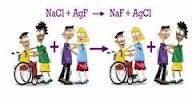
9.
This pictures simulates what type of reaction?
a)
Synthesis
b)
Decomposition
c)
Single Replacement
d)
Double Replacement
10.

Which type of reaction is the following: N2O5 → 2N2 + 5O2 ?

a)

synthesis

b)

decomposition

c)

combustion

d)

single replacement

e)

double replacement

11.

Based on the activity series, will this reaction occur?

Au (s) + HCl (l) →

a)

AuCl + H

b)

No Reaction

c)

AuCl + H2

d)

Au2Cl + H2

12.

How many Sodium atoms in the following compound?

Na3PO4Na_3PO_4  

a)

3

b)

4

c)

7

d)

12

13.

What is the name of this Compound? NaCl

a)

Sodium Chloride

b)

Sodium(II) Chloride

c)

Sodium(I) Chloride

d)

Nitrogen Chloride

14.

What type of Compound is the following? P2Cl3

a)

Ionic

b)

Synthetic

c)

Covalent

d)

Doric

15.

The Ionic Charge of the Anion in the following compound is? K2S

a)

+1

b)

+2

c)

-2

d)

-1

16.

The correct name for the following Polyatomic Ion is? SO4

a)

Sulfate

b)

Sulfite

c)

Persulfate

d)

Hyposulfite

17.

What is the correct formula for the Compound Tin (IV) Nitrate?

a)

Sn(NO3)4

b)

Ti(NO3)4

c)

Sn4NO3

d)

Sn(NO2)4

18.

What is the name of the Cation in the following compound? (NH4)3PO3

a)

Ammonia

b)

Ammonium

c)

Phosphate

d)

Phosphite

19.

What is the Ionic Charge of the Anion in the following compound? NaOH

a)

+1

b)

-1

c)

-2

d)

There is no Anion in this compound nice try Mr. Kuilan

20.

What is the name of the Anion in the following compound? (NH4)3PO3

a)

Ammonia

b)

Ammonium

c)

Phosphate

d)

Phosphite

21.

What is the correct formula for the following compound? Sulfur Hexafluoride

a)

SF6

b)

SF4

c)

SF7

d)

S6F

22.

Which is the correct formula for the following Compound? Cromium (VI) Phosphate

a)

Cr6PO4

b)

Cr(PO4)2

c)

Cr(PO3)2

d)

Cr2PO3

23.
What is the correct formula for Sodium Oxide?
a)
NaO
b)
NaO2
c)
Na2O
d)
Na2O2
24.
The chemical formula of tetraphosphorus heptaoxide is
a)
F₄O₁₀
b)
P₄O7
c)
PO
d)
P₁₀O₄
25.
Which of the following is an ionic compound:
a)
CH4
b)
I2
c)
LiBr2
d)
CO
26.
What is the name for FeO
a)
Iron oxide
b)
Iron (I) oxide
c)
Iron (II) oxide 
d)
Iron (III) oxide
27.
What is the formula for Calcium phosphate? 
a)
CaPO4
b)
Ca3(PO4)2
c)
Ca2PO4
d)
CaP
28.
What is the formula for Potassium Fluoride? 
a)
KF
b)
K2F
c)
KF2
d)
none of the above
29.
What is the formula  for Disulfur trichloride
a)
Su2Cl3
b)
2S3Cl
c)
S2Cl3
d)
Si2Cl3
30.
What is the name of PCl3?
a)
Phosphorus trichloride
b)
Monophosphorus trichloride
c)
Phosphorus chloride
d)
Phosphorus trichlorate
31.

Name this compound:

Ca(CO3)

a)

Calcium carbon oxide

b)

Calcium carbonate

c)

Calcium carbide

d)

Carbonate calcide

32.
What is the formula for lead (II) iodide
a)
PbI
b)
PbI2
c)
Pb2I
d)
LbI2
33.
The name of Cu₃N₂ is
a)
copper (III) nitride
b)
copper (II) nitride
c)
copper nitride
d)
tricopper dinitride
34.
The chemical formula of magnesium phosphide is
a)
MgP
b)
Mg₂P₃
c)
Mg₃P₂
d)
Mg₃(PO₄)₂
35.
Name the compound S2F8
a)
sulfur (II) fluoride
b)
disulfur octafluoride
c)
sulfur fluorine
d)
sulfur octafluoride
36.
How would you say Ni3P2?
a)
nickel (II) phosphide
b)
nickel phosphide
c)
trinickel diphosphide
d)
nickel phosphorous
37.
Write the name for Mn(CO3)2 
a)
manganese (IV) carbonate
b)
manganese (II) carbonide
c)
manganese dicarbonate
d)
manganese carbonate
38.
Name: PI3
a)
phosphorous (III) iodide
b)
monophosphorous iodide
c)
phosphorous triiodide
d)
phosphide
39.
CaCO3 is called... 
a)
calcium carbonate
b)
calcium carbon oxide
c)
calcium monocarbonate
d)
calcium (II) carbonate
40.

36.0 g of Be contains how many moles?

a)

0.25 mol

b)

4.0 mol

c)

45 mol

d)

320 mol

41.
4.0 moles of H2O would have what mass?
a)
72 g
b)
23 g
c)
68 g
d)
4.5 g
42.
How many moles are in 15 grams of lithium?
a)
0.5 moles
b)
104.1 moles
c)
2.2 moles
d)
50 moles
43.
How many grams are in 88.1 moles of magnesium?
a)
2141 g
b)
0.3 g
c)
30 g
d)
3.6 g
44.
How many atoms of iodine are in a mole of iodine?
a)
53
b)
63.55g
c)
126.9
d)
6.02 x 10²³
45.
The number 6.02 x 10²³ is called...
a)
Obama's number
b)
Bohr's number
c)
Trump's number
d)
Avogadro's number
46.
What is the molar mass of NaCl?
a)
58.45g/mol
b)
28g/mol
c)
12g/mol
d)
6.02 x 10²³
47.
What is the molar mass of C2H4O2?
a)
40g
b)
50g
c)
60g
d)
68g
48.
What is the mass of 0.75 moles of (NH4)3PO4?
a)
101.75 g
b)
121.75 g
c)
111.75 g
d)
131.75 g
49.
How many particles would be in 8.4 moles of Octane (C8H18)?
a)
5.77 x 10²³
b)
5.04 x 1024
c)
5.77 x 1026
d)
5.04 x 10²³
50.
Which has more molecules?
a)
1 mole H2O
b)
1 mole Al(OH)3
c)
1 mole NaCl
d)
There are all the same
51.
How many moles of carbon atoms are there in 5g of carbon?
a)
60 mol
b)
17 mol
c)
0.42 mol
d)
7 mol
52.
How many molecules are there in 5.9 moles of NaCl?
a)
3.5x1024molecules
b)
9.79x10⁻²⁴molecules
c)
1.02x10²³molecules
53.
How many moles are in 4.3 x 1024 molecules of H2O?
a)
6.02 x 10²³
b)
7.14
c)
18.02
d)
128.66 
54.

Molar mass is the

a)

atomic mass of atoms in a compound

b)

sum of the atomic masses of all atoms in acompound

c)

amount of moles in a compound

55.
How many grams are in 88.1 moles of magnesium?
a)
2141 g
b)
0.3 g
c)
30 g
d)
3.6 g
56.

How many molecules of NH4+ make up 5 moles?

a)

30 x 1023 molecules NH4+

b)

3.1 x 10²³ moles NH4+

c)

3.0 x 10²³ molecules

d)

13 x 1023 molecules NH4+

57.

How many moles of O2 are produced when 68g of Al2O3 decomposes?

2Al2O3 --------> 4Al + 3O2

a)

1.0 mol O2

b)

2.0 mol O2

c)

56 mol O2

d)

13 mol O2

58.
Increase in temperature of the reactants can do one of the following
a)
Slow collision frequency
b)
Allow less effective collision between the particles
c)
Cause particles to lose speed
d)
Increase collision between the particles thus increasing the rate.
59.
Which factors increase the rate of a reaction.
a)
increasing temperature
b)
increasing concentration
c)
increasing surface area
d)
all of these
60.
A ______________ is a substance that increases the rate of a reaction without being used up during the reaction. 
a)
catalyst
b)
product
c)
reactant
d)
solute
61.
Increasing the concentration of the reactants will slow down the reaction.
a)
false 
b)
true
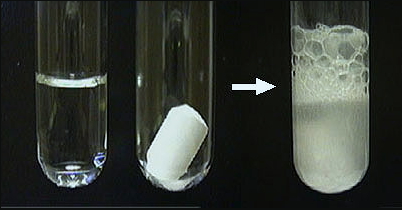
62.

How could we make this reaction happen more quickly?

a)

Decrease the concentration of the acid

b)

crush the chalk to increase the surface area

c)

Put the test tube in an ice bath

63.
Activation energy is required to start a chemical reaction. What is activation energy?
a)
The energy needed for a reaction to occur
b)
The minimum amount of energy needed for a reaction to potentially occur
c)
The energy added by a catalyst
d)
The energy possessed by the products
64.
Smaller particle size allows for a _________ surface area to be exposed for the reaction.
a)
larger
b)
smaller
65.

Which factors affect the rate of a reaction?

a)

temperature

b)

concentration

c)

surface area

d)

pressure

e)

catalyst

66.

If you decrease the temperature...

a)

Reaction Rate will increase

b)

Reaction rate will decrease

67.

If you decrease the concentration...

a)

Reaction Rate will increase

b)

Reaction rate will decrease

68.

If you decrease the pressure...

a)

Reaction Rate will increase

b)

Reaction rate will decrease

69.

If you increase the particle size...

a)

Reaction Rate will increase

b)

Reaction rate will decrease

70.

If you increase the pressure...

a)

Reaction Rate will increase

b)

Reaction rate will decrease

71.

Which letters are reactants?

a)

A

b)

B

c)

C

d)

D

72.

Which letters are products?

a)

A

b)

B

c)

C

d)

D

73.

Which is the balanced chemical equation?

a)

2H2+ O2  >  2H2O2H_2+\ O_2\ \ ->\ \ 2H_2O

b)

H2 + O2 > H2OH_2\ +\ O_2\ ->\ H_2O

c)

2H2 + 2O2  > 2H2O2H_2\ +\ 2O_{2\ }\ ->\ 2H_2O

74.

What color are the coefficients?

a)

Black

b)

Blue

c)

Red

75.

What color are the subscripts?

a)

Black

b)

Blue

c)

Red

76.

Which of the following is a compound?

a)

N2

b)

H2

c)

NH3

77.

Which of the following are elements?

Select all that apply.

a)

N2

b)

H2

c)

NH3

78.

What does the arrow mean in the picture?

a)

Used to separate things being added together

b)

Yields or equals

c)

Solid

d)

Liquid

e)

Gas

79.

Which is the balanced chemical equation?

a)

P4 + O2 > P2O3P_4\ +\ O_2\ ->\ P_2O_3

b)

undefined

c)

2P4 + O2 > 2P2O32P_4\ +\ O_2\ ->\ 2P_2O_3

80.

What does the + mean in the picture?

a)

Used to separate things being added together

b)

Yields or equals

c)

Solid

d)

Liquid

e)

Gas

81.
Balance this equation,            Al2O3 ---> Al + O2 
a)

Cannot be balanced

b)

2Al2O3 ---> 2Al + 3O2 

c)

2Al2O3 ---> 4Al + 3O2 

d)

3Al2O3 ---> 2Al + O2 

82.
_BaS + _PtF2  _BaF2 + _PtS
a)

BaS + PtF2 → BaF2 + PtS

b)

4 BaS + 2 PtF2 → BaF2 +  PtS

c)

BaS + 2 PtF2→ 2 BaF2 +  2 PtS

d)

BaS + 3 PtF2 → BaF2 +  2 PtS

83.
_Al + _HCl →_H2 + _AlCl3
a)
2 Al + 2 HCl → 2 H2 + 6 AlCl3
b)
3 Al + 3 HCl → 6 H2 + 2 AlCl3
c)

Al + HCl → 3 H2 + AlCl3

d)
2 Al + 6 HCl → 3 H2 + 2 AlCl3
84.
_AlBr3 + _K2SO _KBr + _Al2(SO4)3
a)

6 AlBr3 + K2SO4 → 6 KBr + Al2(SO4)3

b)

2 AlBr3 + 3 K2SO→ 6 KBr + Al2(SO4)3

c)

AlBr3 + K2SO→ 2 KBr + 3 Al2(SO4)3

d)

2 AlBr3 + 3 K2SO→ KBr + 2 Al2(SO4)3

85.
Balance this equation:
MgCl2 --> Mg4+ Cl2
a)
It's already balanced.
b)
4MgCl2 --> Mg4+ 4Cl2
c)
4MgCl2 --> Mg4+ 5Cl2
86.
Balance this equation
_Zn+_HCl-->_ZnCl+_H2
a)
1,1,2,1
b)
1,1,1,2
c)
1,2,1,1
d)
2,1,1,1
87.
Balance this equation:
Al2O3 -> Al + O2 
a)
2Al2O3 -> 2Al + 3O2 
b)
2Al2O3 -> 4Al + 3O2 
c)
3Al2O3 -> 2Al + O2 
d)
2Al2O3 -> 3Al + 2O2 
88.

What number do I need to balance the following chemical reaction?

C4H8+C_4H_8+  _ O24CO2+4H2OO_2\rightarrow4CO_2+4H_2O  

a)

2

b)

4

c)

6

d)

8

89.

How many Carbon atoms are there in the following compound?

C4OH10C_4OH_{10}  

a)

1

b)

4

c)

10

d)

14

90.

How many Nitrogen atoms are in the following?

5N2O45N_2O_4  

a)

2

b)

6

c)

10

d)

40