wayground logo

Free Printable Worksheets

Font size

S
M
L
XL
Worksheets

Chesapeake Bay Unit Exam

Total questions: 97

Worksheet time: 3hrs 6mins

Name
Class
Date
1.

Use the picture to select the correct statement.

a)

Oil is denser than water

b)

Pasta is less dense then crayon

c)

The paper clip is denser than every thing else

2.

Put the liquids in order from most dense to least dense?

a)

4,3,2,1

b)

1,2,3,4

c)

3,4,2,1

d)

4,3,1,2

3.

Which box has a higher density?

a)

A

b)

B

c)

They are the same

4.

What causes an object to sink in a water?

a)

if the object's density is less than the water's density.

b)

if the object's density is the same as water's density.

c)

if the object's density is greater than water's density.

d)

if the object's density is zero

5.

When two materials that have different densities, like oil and water, encounter one another, they will?

a)

exchange densities.

b)

mix uniformly.

c)

repel one another.

d)

separate according to their densities.

6.
What is the formula for density?
a)
density = mass x volume
b)
density = mass / volume
c)
density = mass + volume
d)
density = mass - volume
7.
Frank has an eraser. It has a mass of 4g, and a volume of 2cm3. What is its density?
a)
8 g/cm3
b)
2 g/cm3
c)
1/2 g/cm3
d)
24 g/cm3
8.
Jack has a rock. The rock has a mass of 14g and a volume of 2cm3. What is the density of the rock?
a)
7 mL
b)
7 g/cm3
c)
28 g/cm3
d)
1/7 g/cm3
9.
What is the volume of Object X?
a)
10.0 cm3
b)
15.0 cm3
c)
20.0 cm3
d)
25.0 cm3
10.
Helium balloons rise on earth because
a)
helium is less dense than air
b)
helium is more dense than air
c)
helium is cooler than air
d)
helium is warmer than air
11.
What is the measuring unit for mass?
a)
centimeter 
b)
millimeter 
c)
grams 
d)
pounds
12.
Which units of measurement are used for volume?
a)
grams
b)
centimeters
c)
grams/milliliter
d)
milliliter
13.
What units are used to measure Density?
a)
cm3/g
b)
g
c)
g/cm3
d)
cm3
14.

What is the formula for Mass?

a)

Mass/Volume

b)

Density x Volume

c)

Mass/Density

15.

What is the formula for Volume?

a)

Mass/Volume

b)

Density x Volume

c)

Mass/Density

16.

What method would you use to separate a mixture of salt and water so that you can get keep the salt AND the water?

a)

sorting by hand

b)

distillation

c)

chromatography

17.

Dyes in a felt-tip pen may be separated by....

a)

Distillation

b)

Decanting

c)

Chromatography

d)

Centrifuge

18.
Which one of the following is a disadvantage of evaporation?
a)
It always requires heat
b)
It cannot be used for insoluble solids
c)
All of the solute is recovered
d)
The solvent (liquid part) is not recovered
19.

No matter what you do, sand will not dissolve in water, because sand is _________.

a)

dissolved

b)

soluble

c)

insoluble

d)

aqueous

20.

Which separation technique is used to obtain pure water from seawater?

a)

Simple distillation

b)

Filtration

c)

Chromatography

d)

Evaporation

21.

What is the physical property on which fractional distillation depends?

a)

different boiling points

b)

different melting points

c)

different solubilities

d)

different densities

22.

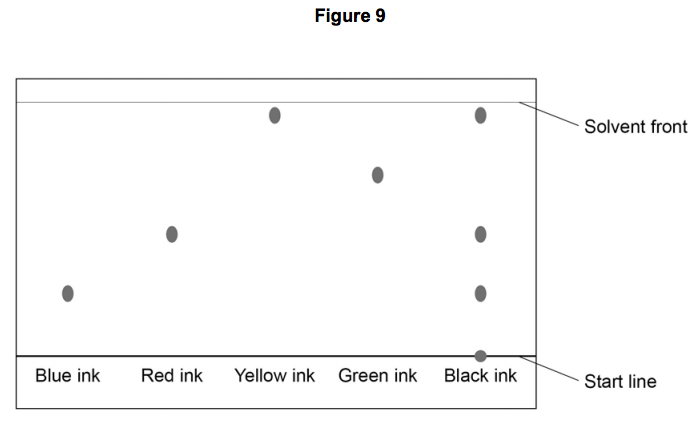
Which ink is a mixture?

a)

Blue

b)

Red

c)

Yellow

d)

Black

23.

Referring to the chromatogram, black ink contains

a)

Blue, red and yellow ink only

b)

Blue, red, yellow and green ink

c)

Blue and yellow ink

d)

Black ink only

24.

How can we separate an insoluble solid from a liquid?

a)

chromatography

b)

evaporation

c)

filtration

d)

condensation

25.
Which one of the following is NOT an example of a separation technique?
a)
boiling an egg
b)
fishing net
c)
surgical mask
d)
 tea strainer
26.
Which one of the following would you use to separate sand from iron filings?
a)
a bar magnet
b)
 filter paper
c)
distillation apparatus
d)
chromatography paper
27.
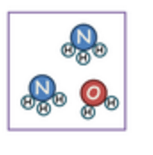
This picture represents: 
a)
Element
b)
Compound
c)
Mixture of Elements
d)
Mixture of Compounds
28.
A solution that contains a large amount of solute is best described as 
a)
unsaturated
b)
concentrated
c)
dilute
d)
weak
29.
No matter what you do, sand will not dissolve in water, sand is _________ ?
a)
dissolved
b)
soluble
c)
insoluble
d)
aqueous
30.

You've got copper sulfate pentahydrate dissolved in water and you want to get rid of the water and get crystals. What's the suitable separation technique?

a)

sieving

b)

decanting

c)

crystallization

d)

distillation

31.
What is it about the water molecule that makes it a great solvent?
a)
water demonstrates polarity; a partial charge on each side of the molecule
b)
due to its molecular formula
c)
it has a liner molecular shape
d)
due to it's non-polar molecular structure
32.
Which of the following would result in being able to dissolve a greater amount of gas in a
solution?
a)
Heat the gas and solution
b)
Decrease the pressure of the solution
c)
Make the gas an electrolyte
d)
Cool the gas and solution
33.
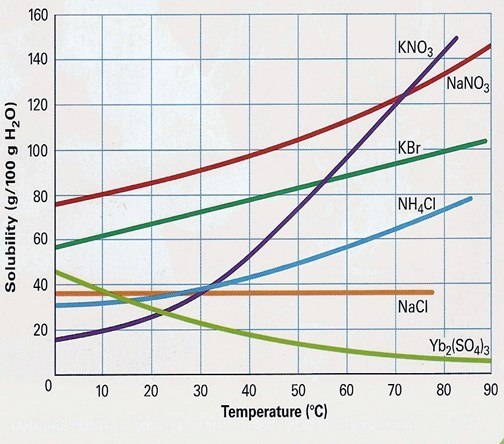
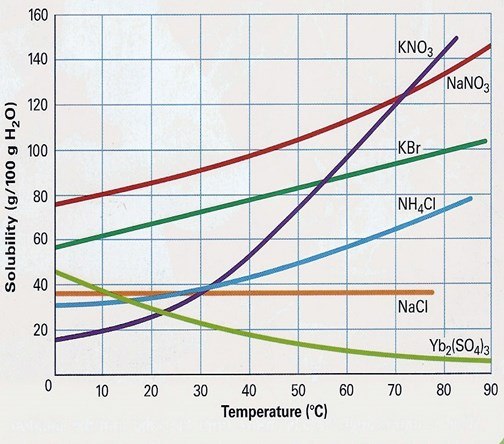
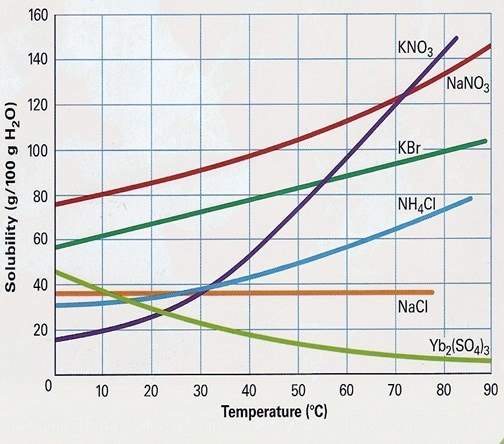
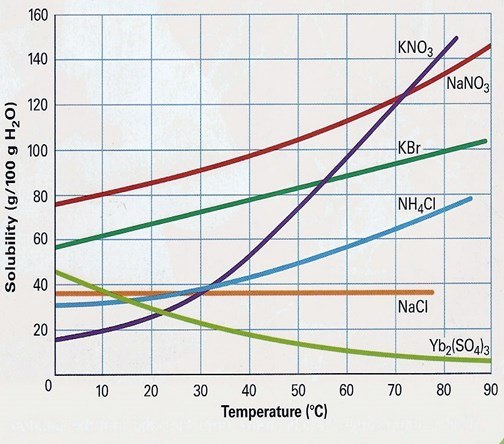
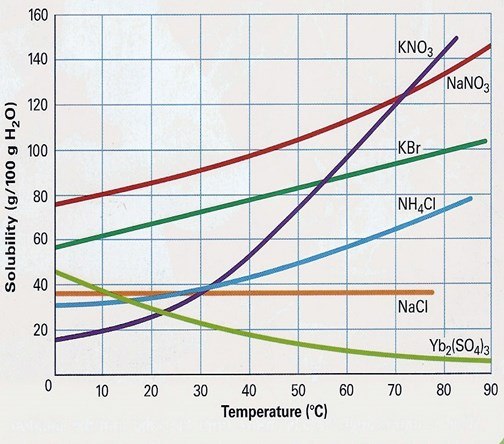
90 grams of sodium nitrate (NaNO3) are put into 100 grams of water and stirred. The final
mixture has a temperature of 20°C. About how many grams of the sodium nitrate dissolved?
a)
23
b)
73
c)
80
d)
88
34.
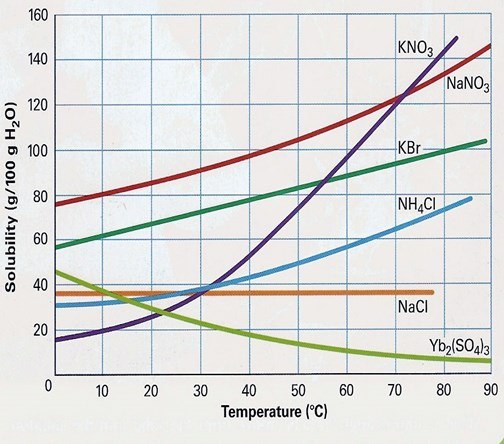
Students are asked to make statements about the solubility graph above. Which student does
the best job of communicating the general features of the graph?
a)
Most salts require 100 grams of water in order to dissolve completely.
b)
Table salt has the average solubility of all salts.
c)
The solubility of most salts increases with increasing temperature.
d)
Most curves show a decreasing slope as the temperature rises.
35.
Which of the following would decrease the rate of solution when dissolving a solid in water?
a)
Raise the temperature of the solution
b)
Crush the solid before mixing
c)
Stir the solution after mixing
d)
Use a single cube of solid
36.
Which of the following is the best way to determine if an aqueous solution  is supersaturated?
a)
add more solvent
b)
measure the temperature
c)
filter out excess solute
d)
add a seed crystal
37.
If a substance has a pH of 10 it is considered
a)
Acidic
b)
Basic
c)
Neutral
38.
Acids produce _________ ions when they break down or dissocciate. 
a)
Hydroxide (OH-)
b)
Water
c)
Chlorine (Cl-)
d)
Hydrogen (H+)
39.
Bases release ____________ ions when they break down or dissociate. 
a)
Hydrogen (H+)
b)
Hydroxide (OH-)
c)
Chlorine (Cl-)
d)
no
40.
Water is neutral because the number of hydrogen and hydroxide ions is _________.
a)
the same
b)
different
41.
The pH scale ranges from ____________.
a)
0-7
b)
1-100
c)
1-20
d)
0-14
42.
HF
a)
flouric acid
b)
hydrofluoric acid
c)
fluorate acid
d)
hydrogen fluoridic acid
43.
hydrochloric acid
a)
HClO3
b)
HClO2
c)
HClO
d)
HCl
44.

Which solution can turn phenolphthalein pink?

a)

NaOH(aq)

b)

CH3COOH(aq)

c)

CH2OH(aq)

d)

HCl(aq)

45.

Which solution would turn litmus red?

a)

KOH(aq)

b)

NaCl(aq)

c)

HCl(aq)

d)

NH3(aq)

46.

Which solution would turn litmus blue?

a)

HCl(aq)

b)

CH3COOH(aq)

c)

H2SO3(aq)

d)

NH3(aq)

47.

Phenolphthalein has a pink color in a solution that has a pH of

a)

5

b)

11

c)

1

d)

7

48.

To neutralize a solution of HCl(aq), what solution should be added?

a)

NaOH(aq)

b)

H3PO4(aq)

c)

HNO3(aq)

d)

C12H22O11(aq)

49.

Which of these is the pH of an alkali?

a)

3

b)

5

c)

7

d)

9

50.

What colours do we see with phenolphthalein?

a)

red - orange

b)

colourless - pink

c)

red - orange - green - blue

d)

red - blue

51.

What colours do we see with litmus paper?

a)

red - orange

b)

colourless - pink

c)

red - orange - green - blue

d)

red - blue

52.

Lemon juice is an..?

a)

acid

b)

alkali

53.

Drain cleaner is an..?

a)

acid

b)

alkali

54.

Red litmus paper will change to ___________ in a base.

a)

blue

b)

green

c)

black

d)

red

55.

Blue litmus paper will change to ___________ in a acid.

a)

blue

b)

green

c)

black

d)

red

56.

Red cabbage indicators will turn ___________ when mixed with an asid.

a)

blue

b)

green

c)

yellow

d)

red

57.

Red cabbage indicators will turn ___________ when mixed with an base.

a)

purple

b)

black

c)

yellow

d)

red

58.

Which Ph Scale number shows an acid?

a)

14

b)

11

c)

7

d)

4

59.

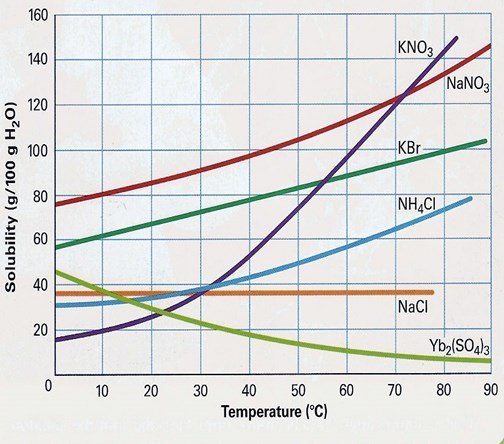
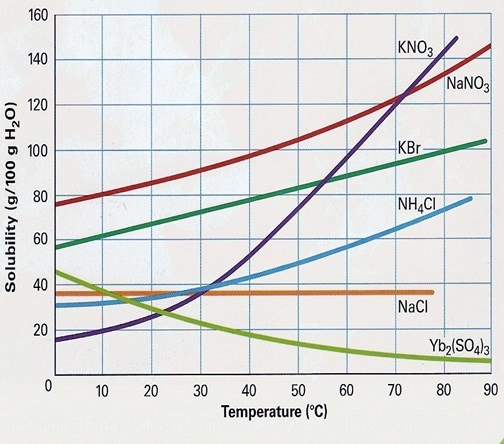
At 30'C, which substance has the lowest solubility?

a)

KNO3

b)

KBr

c)

NaCl

d)

Yb2(SO4)3

60.

At 30'C, which substance has the lowest solubility?

a)

KNO3

b)

KBr

c)

NaCl

d)

Yb2(SO4)3

61.

At which temperature do KBr and KNO3 have the same solubility?

a)

60

b)

55

c)

50

d)

Never

62.

The solubility of Yb2(SO4)3 ________________ with added temperature.

a)

increases

b)

decreases

c)

remains the same

63.

At 80'C, KBr's solubility is:

a)

100

b)

90

c)

80

d)

0

64.

Determine the solubility for the substances at 55'C and arrange them in order from lowest to highest solubility.

a)

NaCl, NH4Cl, KBr, NaNO3

b)

NaCl, NH4Cl, NaNO3, KBr

c)

NH4Cl, NaCl, NaNO3, KBr

d)

NaNO3, KBr, NH4Cl, NaCl

65.

At 10'C, NaNO3's solubility is 80 g/100 g of H2O. Based on this information, what would the solubility be in 50 g of H2O.

a)

40

b)

80

c)

160

d)

16

66.

Identify if the following solution would be saturated, unsaturated, or supersaturated: 103 g KBr at 70'C.

a)

Unsaturated

b)

Saturated

c)

Supersaturated

67.

Identify how many grams of KNO3 is required to make a saturated solution at 40'C.

a)

50 g

b)

45 g

c)

60 g

d)

33 g

68.

How could you change a saturated solution to an unsaturated solution?

a)

Add solvent

b)

Add solute

69.

Water becomes __________ changing from a solid to a liquid

a)

more dense & more kinetically chaged

b)

less dense & less kinetically charged

c)

more dense & less kinetically charged

d)

less dense & more kinetically charged

70.

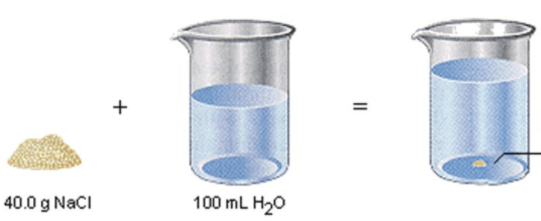
Identify the saturation associated with the product of this experiment.

a)

Unsaturated

b)

Saturated

c)

Supersaturated

71.

Identify a method to decrease the dissolving rate of a solution:

a)

decrease the temperature

b)

add KE

c)

stir the solution

d)

increase the temperature

72.

How could you change a saturated solution to an unsaturated solution?

a)

Add solvent

b)

Add solute

73.

Identify the saturation associated with the product of this experiment.

a)

Unsaturated

b)

Saturated

c)

Supersaturated

74.

Identify a method to decrease the dissolving rate of a solution:

a)

decrease the temperature

b)

add KE

c)

stir the solution

d)

increase the temperature

75.
What does NOT produce carbon dioxide?
a)
Photosynthesis
b)
Burning Fossil Fuels
c)
Animal respiration
d)
Plants decaying
76.
Combustion is another word for __________.
a)
Transportation
b)
Respiration
c)
Fossil Fuels
d)
Burning
77.
Organisms that do not decompose can be buried and become what?
a)
water
b)
nutrients
c)
air
d)
fossil fuels
78.
Respiration is the process by which animals take in _____ and release _____. 
a)
photosynthesis, air
b)
carbon, oxygen
c)
oxygen
d)
oxygen, carbon dioxide
79.
The average temperature of the surface of Earth has increased approximately 1°C in the past century. Which reason best explains this increase in temperature?
a)
lower levels of ozone in the atmosphere
b)
lower levels of nitrogen in the atmosphere
c)
higher levels of carbon dioxide and other greenhouse gases in the atmosphere
d)
higher levels of oxygen in the atmosphere
80.

Which of the following is true about the greenhouse effect? you can choose more than one

a)

It is a natural process

b)

It is caused by gasses trap heat from infrared radiation

c)

It makes life on Earth possible

d)

It is the cause of global warming

81.
How does the law of conservation of energy relates to photosynthesis?
a)
The energy from glucose is transform into light energy
b)
Light energy from the sun is converted into chemical energy in glucose 
c)
Energy from carbon dioxide is converted into chemical energy in Oxygen
d)
All other answers are correct
82.
Ocean acidification begins with 
a)
pollution from ships
b)
carbon dioxide released from combustion
c)
dumping of waste from cities into the ocean
83.
Carbon dioxide and seawater combine to form
a)
calcium carbonate
b)
carbon monoxide
c)
carbonic acid 
84.
Marine organisms make their shells from calcium and
a)
chloride
b)
carbonate
c)
seawater
85.
Very slight increases in the acidity of seawater __________  marine organisms that make shells.
a)
doesn't bother
b)
has no effect on 
c)
is unhealthy and stresses
86.

According to this slide

a)

CO2 is causing marine life to die by "poisoning' the water

b)

CO2 is destroying sea shells

c)

CO2 is formed from the combustion of Octane

87.

What do some marine creatures do with the carbonate ion?

a)

use it as a food source

b)

use it as a defense mechanism

c)

use it to build shells and exoskeletons

d)

use it to cool body temperatures

88.

Which organism might benefit from the increase of carbon dioxide in the world’s oceans?

a)

crabs and lobster

b)

Fishes

c)

Clams and oysters

d)

Sea grasses

89.

Which is a source of sulfur dioxide found in nature?

a)

forest fires

b)

lightning

c)

plant emissions

d)

volcano

90.
One of the six types of air pollution monitored by the EPA.  Is formed from incomplete combustion.
a)
CO2
b)
CO
c)
SO2
d)
O3
91.

Acid deposition forms as a result of

a)

nitrogen oxides and photochemical smog

b)

carbon monoxide and VOC's

c)

sulfur dioxide and VOC's

d)

nitrogen oxides and sulfur dioxides

92.

Which method is used to reduce the nitrogen oxide emissions

a)

installation of catalytic converters

b)

increased temperature of combustion

c)

the use of calcium carbonate to absorb the emissions

d)

the use of fluidized bed combustion

93.

Which below is a source of particulate matter?

a)

burning wood

b)

dust from gravel roads

c)

volcanoes

d)

forest fires

e)

all of these are sources of particulate matter

94.

Photochemical smog results from a reaction between

a)

nitrogen, oxygen and sunlight

b)

nitrogen, carbon and sunlight

c)

oxygen, water and lead

d)

sunlight, sulfur and carbon

e)

carbon, hydrogen, and methane

95.

Volcanic eruptions can be sources of air pollution

a)

True

b)

False

96.

Concentration of nitrogen in the atmosphere

a)

21%

b)

55%

c)

78%

d)

95%

97.

A sample has 2600 radioactive nuclei. It's half-life is of 1 day. How many days pass for there to be 650 nuclei left?

a)

1

b)

2

c)

3

d)

4