
 Worksheets
Chemical Reactions Review
Total questions: 62
Worksheet time: 1hrs 14mins

The compound with a pink square is known as a ___.
Reactant
Product

In order for this equation to be balanced, what number must be written as a coefficient for the substance in the blue box?
1
2
4
0

Which type of reaction is shown?
Combustion
single replacement
double replacement
decomposition

What must be done to this equation for it to be balanced?
change the subscript to 3 in the reactants
change the subscript to 3 in the products
no change; it's balanced as is
change the coefficients to 2

What type of reaction is shown?
Decomposition
Single replacement
Combustion
Combination (or Synthesis)

To balance this equation, what coefficient belongs in the red box?
3
2
1
0

What type of reaction is this?
Combination (or Synthesis)
Single replacement
Double replacement
Decomposition

Which type of reaction is shown?
Combustion
Combination (or Synthesis)
Decomposition
Double replacement
Which type of chemical reaction involves the production of a single complex compound from several simpler reactants?
Decomposition
Combustion
Combination (or Synthesis)
Single replacement
What are the products of a combustion reaction?
a single complex compound
several simpler elements
carbon dioxide and water
carbon dioxide and hydrogen
Which element is always present in the reactants of a combustion reaction?
oxygen
hydrogen
carbon
water

Which type of reaction is shown?
Single replacement
Double replacement
Combustion
Decomposition

To balance this equation, what coefficient must be written in the red box?
1
2
4
5
Which of the following is an example of a synthesis reaction?


Which of the following is an example of a decomposition reaction?
Which of the following is an example of a single replacement reaction?
Which of the following is an example of a double replacement reaction?

The red numbers in the image represent
subscripts
coeffiecients
roman numerals
none of the answer options are correct
The blue numbers in the image represent
subscripts
coeffiecients
roman numerals
none of the answer options are correct

When balanced, the correct coefficients for the reaction are:
1, 1, 1, 1
1, 2, 1, 1
2, 1, 1, 2
2, 1, 2, 1
Why must the number of atoms on either side of the arrow be equal to each other in a chemical equation?
to abide by the law of conservation of energy
to abide by law of conservation of mass
to abide by the law of fundamental equations
because everything must be even for the universe to stay in balance
When balancing a chemical equation, you can only change _________, you can never change _______!
coefficients, subscripts
subscripts, coefficients
formulas, subscripts
coefficients, formula units

What state of matter is this substance?
solid
liquid
gas
aqueous
Predict the product(s) of this reaction (don't worry about balancing):
Li + H2O →
Li2O + H2
LiO + H2
LiOH + H2
Li(OH)2
Predict the product(s) of this reaction (don't worry about balancing):
Mg + HCl →
MgHCl
MgCl2 + H2
MgCl2 + H
MgCl + H2
Predict the product(s) of this reaction (don't worry about balancing):
SrI2 +Br2→
Sr + I2Br2
SrBr + I2
SrBr2 + I2
Sr + IBr2
C12H22O11 + O2 →
Pb(NO3)2 + KI →
Fill in the blank. (Copper has a charge of 2+)
Cu+ AgNO3 → Ag + _____
Cu(NO3)2
CuNO3
CuAg
Cu
The symbol for a substance dissolved in solution is ______
(s)
(l)
(aq)
(g)
What is the charge of Iron in this compound. (Hint: think swap drop method):
Fe3(PO4)2
3+
2+
1+
6+
Na1+ F1-
Cr3+ O2-
K1+ S2-
Which of the following is the correct notation for the ionic compound of NO3- and Li+?
NO3Li
LiNO3
Li+1NO3-
NLiO3

which factor that affect reaction rate is represented?
Temperature
Catalyst
Surface Area
Concentration
Indicate whether each of the following will: Increase / Decrease / have No effect on the rate of reaction.
Increasing temperature
Increase
Decrease
No Effect
Indicate whether each of the following will: Increase / Decrease / have No effect on the rate of reaction.
Decrease Reactant Concentration
Increase
Decrease
No Effect
Which factors affect the rate of a reaction?
temperature
concentration
surface area
pressure
catalyst
Why does a higher concentration increase the rate of reaction?
it increases the amount of reactants
it lowers the activation energy
it increases the energy of particle collisions
it increases the frequency of particle collisions
Grains of sugar have a greater _______ than a solid cube of
sugar of the same mass, and therefore will dissolve quicker in water.
Surface Area
Catalyst
Temperature
Concentratrion
Which of the following will lower the rate
of reaction?
adding an enzyme to the reaction
decreasing the temperature from 40°C to
10°C
breaking a chunk of calcium up into
smaller pieces
increasing the amount of solute
dissolved in a solution
In a chemical reaction, how quickly or slowly reactants turn
into products is called the
Catalyst
Reaction Rate
Concentration
Temperature
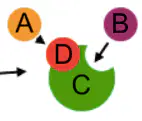
In the image, which of the following is a catalyst?
A
B
C
D
In the image, which of the following is an inhibitor?
A
B
C
D
In the image, which of the following are reactants?
A
B
C
D

Which of the following factors affecting reaction rate is described in the image?
Temperature
Concentration
Agitation
Surface Area

Which of the following factors affecting reaction rate is displayed in the image?
Concentration
Pressure
Inhibitor
Surface Area
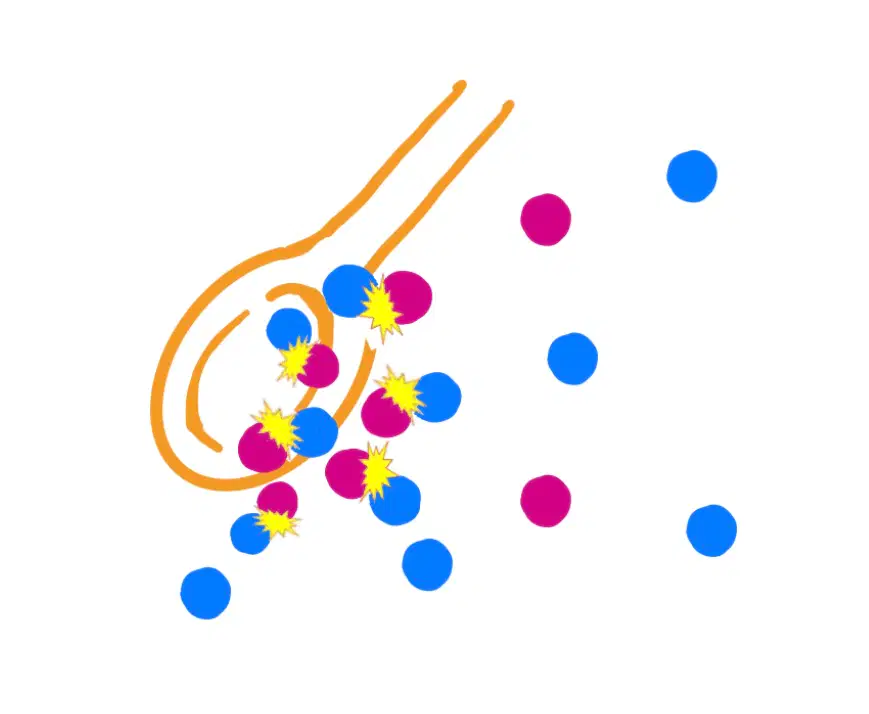
Which of the following factors affecting reaction rate is displayed in the image?
Agitation
Temperature
Inhibitor
Surface Area
What does the arrow in a chemical equation represent?
created
makes
yields
destroys
Indicates heat was supplied to the reaction.


Indicates the use of the catalyst.
Indicates a reversible reaction.

yields
solid
aqueous
catalyst
Which word equation represents a neutralization reaction?
base + acid → salt + water
base + salt → water + acid
salt + acid → base + water
salt + water → acid + base

