
 Worksheets
Chapter 1-4 Review Physics 110
Total questions: 70
Worksheet time: 2hrs 47mins
Astrology is an example of a
Science
Pseudoscience
When we throw an object up in the air, its velocity at the peak
cannot be calculated.
is -9.8 m/s
is 0 m/s
is -9.8 m/s/s
On the interstate the speed limit is 70 MPH, how many m/s is that?
50.3 m/s
23 m/s
1877 m/s
31.3 m/s
(a) is when science is applied to make our lives easier
Examples of physical sciences include:
Chemistry
Biology
Physics
Astronomy
(a) is related to all sciences including physical and life sciences
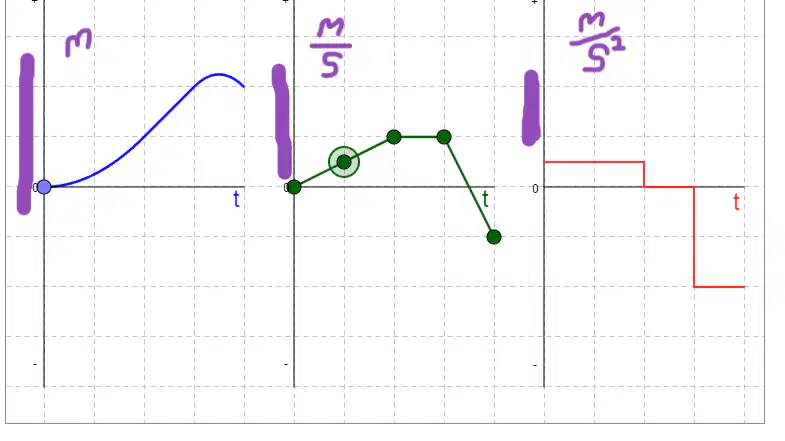
Which of these graphs show velocity vs time?
the blue one
the green one
the red one
none
What is the formula to calculate the average speed of an object moving in a straight line?
v=td
v=dt
v=dt
v=d+t
a hypothesis that has been tested repeatedly and has not been contradicted
Observation
Theory
Law
Fact
The difference between speed and velocity is that speed lacks a (a)
How many centimeters are there in 2 meters?
20 cm
200 cm
2 cm
2000 cm
If you have a length of 2500 millimeters, how many meters is that?
2.5 m
25 m
250 m
0.25 m
Convert 12 inches to centimeters. (Note: 1 inch = 2.54 cm)
30.48 cm
24.00 cm
5.08 cm
120.00 cm
What is the net force acting on an object in equilibrium?
Equal to its weight
Constantly changing
Zero
Equal to its mass
What is the term for the rate of change of velocity?
Speed
Acceleration
Momentum
Force
Which of the following is a scalar quantity?
Velocity
Acceleration
Speed
Force
an educated guess that is only presumed to be factual until supported
by experiment
Observation
Theory
Fact
Hypothesis
What is the unit of force in the International System of Units (SI)?
Newton
Joule
Pascal
Watt
Which of the following is not an appropriate unit for measuring acceleration?
mi/hr^2
km/min/s
m/s
ft/s^2
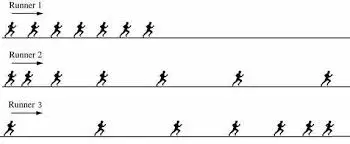
Which of these runners are running with increasing acceleration?
Runner 1
Runner 2
Runner 3
None
Which law of motion states that for every action there is an equal and opposite reaction?
Newton's First Law of Motion
Newton's Second Law of Motion
Newton's Third Law of Motion
Newton's Law of Universal Gravitation
The ______ component(s) of a projectile motion stay the same throughout the motion
Vertical
Horizontal
Neither
Both
What is the formula for calculating the kinetic energy of an object?
KE=21mv2
KE=mv
KE=mgh
KE=2mv2
A skydivers acceleration is zero when
Air drag is equal to acceleration due to gravity
They land
The parachute opens
They reach terminal velocity

An inflated balloon released from rest moves horizontally.
The law that best explains this event is
Newton's 1st Law
Newton's 2nd Law
Newton's 3rd Law
Law of Gravity
Total distance an object travels with direction.
Displacement
Distance
Path
Velocity
Does upward movement of an object have a negative or positive velocity?
Negative
Positive
When an object starts from rest, what is its original velocity?
Depends on the problem
0
Always positive
Always negative
If an object comes to a stop in a problem, what is its final velocity?
Depends on the problem
0
Always positive
Always negative
Change in velocity each second that goes by
Velocity
Displacement
Acceleration
Apex
A frog jumps vertically straight up. Which of the following is true?
gravity gives the frog a vertical speed of -10 m/s
gravity gives the frog a vertical acceleration of -10 m/s2
the frog has a horizontal speed of -10 m/s
the frog has a horizontal acceleration of -10 m/s2
a synthesis of a large body of information that encompasses well-tested and verified
hypotheses about certain aspects of the natural world
Theory
Law
Principle
Fact
If an object is simply dropped from an elevated position, then the __________ of the object is 0 m/s.
initial velocity
final velocity
acceleration
displacement
All free falling objects on Earth accelerate downward at a rate of __________.
9.8 m/s/s
-9.8 m/s
-9.8 m/s/s
9.8 m/s
Objects thrown into the air have a downward acceleration
only in its way upwards.
only in its way downwards.
as soon as they are released.
? = 1/2 x acceleration x time^2
Velocity
Speed
Distance
Displacement
Which are examples of types of forces
Friction
Tension
Normal Force
Weight
Applied Force

In the picture, cannonball A was launched at 10 m/s at 60°, and B was launched at 18 m/s at 25°. The cannonball that hit the ground first was
A, because it had less total velocity.
B, because it had more total velocity.
A, because it had less initial vertical velocity.
B, because it had less initial vertical velocity.

A projectile is launched, and its vertical and horizontal velocities are shown in the graph. What is the magnitude of the projectile's initial velocity?
25 m/s
10 m/s
325 m/s
18 m/s

Two objects of the same mass are launched from the ground. Object A has a launch angle of 45, while Object B has a launch angle of 65. Which object has the greatest maximum height height?
A
B
Both objects reach the same height
unable to determine with the given information
What is a factor that affects projectile motion?
(a)
Free fall is when an object falls under the influence of _____
Air resistance/drag
Both air resistance and gravity
Gravity only
Mass is a measure of
The inertia of the object
The amount of matter in an object
The force on the object due to gravity
Which of the following is a unit of force?
Joule
Newton
Watt
Meter per second
What is the primary effect of unbalanced forces acting on an object?
The object moves in a circular path
The object's velocity remains constant
The object accelerates
The object levitates
What is the effect of friction on the motion of objects?
It speeds them up
It slows them down
It changes their direction
It has no effect
Which of the following is true about balanced forces?
They cause an object to start moving
They cause an object to stop moving
They do not change the motion of an object
They always act in the same direction
(a) is a force that is calculated with the formula m*g
What is inertia?
The tendency of an object to resist changes in its motion
The speed of an object in motion
The force that pulls objects to the ground
The force that moves objects in a circular path
What happens to the speed of an object if a constant force is applied in the direction of motion?
It decreases
It stays the same
It increases
It changes direction
Which is a unit of weight?
Slugs
Grams
Pounds
Newtons

