
 Worksheets
Reviewer Quiz in General Physics 2 - Finals
Total questions: 25
Worksheet time: 4hrs 10mins
Which of the following is not true about electric potential energy?
It increases if the charge q0 moves in the same direction as the electric force.
It decreases if the charge q0 moves in the direction opposite of the electric force.
It can only be defined when the force responsible for the displacement is a conservative force.
It increases if the charge q0 moves in the direction opposite of the electric force.
What happens to the capacitance when the voltage and area are constant, and the conducting plates are moved closer together?
It will decrease
It will increase
It will be unaffected
The data are inconclusive
Given the same situation in the previous item, what will happen to the potential difference in the system?
It will increase
It will decrease
It will be unaffected
The data are inconclusive
What might happen to the capacitance if the area of plates increased triple times from its normal size?
It will be halved
It will decrease three times
It will increase three times
It will be remaining the same
Suppose a fully-charged capacitor has been detached from a battery and a dielectric was inserted between its plates. How is the voltage in the capacitor influenced?
It will increase
It will decrease
It will increase, then decrease
It will decrease, then increase
Which of the following refers to the energy that is needed to move a charge against the electric field?
Dielectrics
Capacitance
Potential difference
Electric potential energy
Which of the following refers to the ability of a capacitor to store charges?
Ammeter
Conduit
Resistance
Capacitance
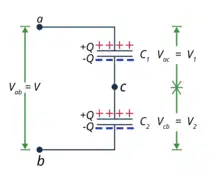
What kind of connection is shown in the schematic diagram at the right?
Parallel connection
Series connection
Series and parallel connection
Cannot be determined
What is the voltage passing through each capacitor, according to the schematic diagram from the previous item?
It will be same throughout the circuit.
It will be different for each capacitors.
It will be equivalent to the total voltage of the circuit.
Cannot be determined.
Which refers to the amount of work done in moving a unit positive test charge from two specific points along an electric field.
Capacitance
Electric potential
Potential difference
Electric potential energy
Which of the following electrical devices is responsible for storing a small amount of charge and is typically used during an electrical outage?
Resistor
Transistors
Capacitor
Connecting wire
Under which condition can maximum energy be attained by a system of capacitors?
When they are in a series connection.
When they are in a parallel connection.
When they are combined in both connection.
When they are in a combination of series and parallel connections.
Which of the following shows the general formula of electric potential?


Which of the following properties has no effect on the capacitance of a capacitor in a specific electrical circuit?
Area of plates
Dielectric material
Distance of plates
Equipotential surface
What is its capacitance when a cylindrical capacitor was charged with 1.2 nC, a voltage of 220 V was measured between the two cylinders?
5.45 x 10^-12 F
545 x 10^-12 F
54.45 x 10^-12 F
0.545 x 10^-12 F
Which of the following is true about a dielectric and its insulating ability?
The lower the value of the dielectric constant, the better insulator it is.
The higher the value of the dielectric constant, the better conductor it is.
The higher the value of the dielectric constant, the better insulator it is.
There is no direct relationship between the dielectric constant and insulation.
What is the electric potential of a fragment that contains 5 protons separated by 0.543 x 10^-14 m?
13.3 x 10^6 V
0.133 x 10^6 V
1.33 x 10^6 V
133 x 10^6 V
How much work is needed to move a 44.55 x 10^-9 C charge through a potential difference of 150 V?
66.8 x 10^-6 J
0.668 x 10^-6 J
688 x 10^-6 J
6.68 x 10^-6 J
The diagram shows three capacitors (C1, C2, and C3) connected in series and parallel with capacitances of 2.34 μF, 4.56 μF, and 7.80 μF, respectively. What is the equivalent capacitance of parallel ones?
12.4 x 10^-5 F
1.24 x 10^-5 F
124 x 10^-5 F
0.124 x 10^-5 F
If 13.45 x 10^-3 J of work is needed to move a 4.78 x 10^-6 C charge from point A to point B, what is the potential difference between points A and B?
281 x 10^3 V
0.281 x 10^3 V
2.81 x 10^3 V
28.1 x 10^3 V
FACT OR BLUFF:
The familiar term voltage is the common name for potential difference.
FACT
BLUFF
FACT OR BLUFF:
Electric field refers to the amount of work done to bring the unit positive charge from infinity to a point.
FACT
BLUFF
FACT OR BLUFF:
A negative electric potential energy does a positive electric potential.
FACT
BLUFF
FACT OR BLUFF:
The higher the permittivity constant of a dielectric, the lower its capacitance.
FACT
BLUFF
FACT OR BLUFF:
The amount of electric charge passing through each capacitor in a parallel connection is different.
FACT
BLUFF

