
 Worksheets
Energy Test Review
Total questions: 54
Worksheet time: 2hrs 36mins
Energy stored by something that can stretch or compress.
elastic potential energy
gravitational potential energy
chemical potential energy
potential energy
Energy stored in chemical bonds.
mechanical energy
chemical potential energy
elastic potential energy
kinetic energy
Energy stored by objects due to their position above Earth’s surface.
kinetic energy
gravitational potential energy
mechanical energy
What is the unit of measurement for potential energy?
Watts
Joules
Newtons
Meters
I have the most potential energy if I am:
5 feet high
10 feet high
15 feet high
20 feet high
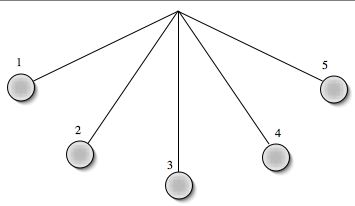
Which object will have the largest value for its potential energy?
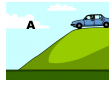
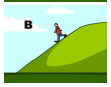

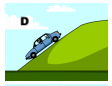

Observe the model to answer the following question: When does the skater have the most potential energy?
At the top of the ramp.
At the bottom of the ramp.
Observe the model to answer the following question: When does the skater have the least potential energy?
At the top of the ramp.
At the bottom of the ramp.
Observe the model to answer the following question: When does the skater have the most kinetic energy?
At the top of the ramp.
At the bottom of the ramp.
Observe the model to answer the following question: When does the skater have the least kinetic energy?
At the top of the ramp.
At the bottom of the ramp.
Observe the model to answer the following question: Which of the following statements is true about the skater’s potential energy?
The skater gains potential energy as he travels down the ramp.
The skater loses potential energy as he travels down the ramp.
Observe the model to answer the following question: Which of the following statements is true about the skater’s kinetic energy?
The skater gains kinetic energy as he travels down the ramp.
The skater loses kinetic energy as he travels down the ramp.
A bicycle and a person with a total mass of 80 kg are traveling at a velocity of 7 m/s. What is their kinetic energy?
156,800 J
1,960 J
0.82 J
7,840 J
What is the kinetic energy of a 4kg shotput thrown with a velocity of 13m/s?
676 J
3.25 J
17J
338 J
Potential energy is based on ....
height
speed

What is the formula for gravitational potential energy?
distance / time
mass x acceleration
velocity / time
½(mass) x (velocity)2
(mass) x (acceleration of gravity) x (height)

What is the formula for kinetic energy?
distance / time
mass x acceleration
velocity / time
½(mass) x (velocity)2
(mass) x (acceleration of gravity) x (height)

A 6kg cat misjudges a jump and falls 5 meters. How much gravitational potential energy does the cat have? (The cat is fine by the way.)
294 J
180000 J
1225 J
3920000 J

nuclear
thermal

Find the kinetic energy for the star on the image.
100 J
75 J
50 J
25 J

Find the kinetic energy for the star in the image.
100 J
75 J
50 J
0 J

Find the potential energy for the star in the image.
(All objects the ball is sitting on have the same height and all the balls are the same mass.)
60 J
40 J
20 J
0 J

Find the potential energy of the star in the image.
(All objects the balls are sitting on have the same height and all balls have the same mass.)
60 J
40 J
20 J
0 J

Find the kinetic energy of the star in the image.
(All objects the balls are sitting on have the same height and all balls have the same mass.)
60 J
40 J
20 J
0 J

If all animals in the image are traveling at the same velocity, which animal would have the LARGEST kinetic energy?
Bear
Mouse
Fox

Both turtles in the image have the same mass. Which turtle would have the LEAST kinetic energy?
Top Turtle
Bottom Turtle

At what position would a cyclist have the MOST kinetic energy?
At what position would a cyclist have the LEAST kinetic energy?
At what position would a cyclist have the LEAST potential energy?
At what position would a cyclist have the MOST potential energy?
What is the formula for calculating work done when a force is applied?
force x distance
force / distance
mass x acceleration
velocity x time
If a machine does 500 J of work in 10 seconds, what is its power output?
0.5 W
5000 W
5 W
50 W
Which of the following units is used to measure power?
Watt
Newton
Meter
Joule
What are the units for work?
Watts
Joules
Newtons
g x m/s
How quickly work is done is called _______ .
energy
force
power
work
You wait in line holding a box for 2 minutes but DO NOT MOVE. Is holding the box considered work?
yes
no
Machine A and machine B do the same amount of work. Machine A does the work much faster than machine B. Which machine has the most power?
Machine A
Machine B
If a force of 10 N is applied to move an object 5 meters, how much work is done?
50 J
100 J
5 J
15 J

