
 Worksheets
Unit 9 Evolution Review
Total questions: 54
Worksheet time: 58mins
Match the following
Descent with modification
A change in gene frequency over time.
Adaptation
A feature that allows an organisms to better survive in its environment
Variation
Differences in the physical traits of organisms
Overproduction of Offspring
Lots of offspring and limited resources causes competition for those resources.
Match the following definitions with the appropriate mechanism of evolution
Random change in the frequency of alleles in a population over time.
Small population / Genetic Drift
Selection of traits that aren't necessarily good for survival fitness, but without them you can't reproduce.
Non-random mating
Any change in a DNA sequence
Mutation
Movement of genes in/out of a population
Gene flow/ movement
Organisms more fit for their environment will survive and reproduce more offspring
Natural selection
A population of birds has a large population size and isolated so no new birds are moving into the population. The birds do not practice any type of preference for mates, no new traits have been seen. However they are adapting for larger beak shapes because of the only food available for most birds are large seeds. Large beaks are becoming more common in birds.
Is this population of birds evolving or not?
Evolving
Not evolving
Echidnas and hedgehogs both have quills however one lays eggs and the other gives birth to live young. They have both developed quills over time. This is an example of... (a)

Many different groups of organisms have wings, even though they do not share a recent common ancestor. This is because they evolved in environments with similar selective pressures. Wings are an example of a(n) ______________ structure.
vestigial
analogous
homologous
Homologous structures and vestigial structures show evidence of
divergent evolution
convergent evolution
both divergent and convergent evolution
analogous structures

The female birds of paradise tend to look for the most colorful, best dancing males to make babies together.
Genetic Drift
Non-random mating
Gene flow
Mutation
Charles Darwin observed that finches of different species on the Galápagos Islands have many similar physical characteristics, this supports the hypothesis that these finches
are twins
acquired traits through use and disuse.
all eat the same type of food.
descended from a common ancestor.
What is speciation?
when a population reaches a balance and change is no longer occuring
when populations move away from each other
when species begin to pass on acquired traits and change their behavior
when two species can no longer interbreed
In a population of ladybugs, black bugs are more successful in escaping predators. Overtime, this gene becomes more popular in the population and the ladybug population loses its red color. This is an example of?
Natural Selection
Mutation
Genetic Drift
Gene Flow
There was a forest fire that wiped out birch trees randomly and left a few dispersed throughout the forest. The surviving trees evolve overtime changing the gene pool. This is an example of?
genetic drift
gene flow
bottleneck effect
founders effect
genetic flow
The bottleneck effect and founder effect are results of
gene flow
genetic drift
natural selection
non-random mating
mutations
How do populations change due to genetic drift?
A random event occurs that reduces the population, and the new surviving population has a different allele frequency from the original population.
The population undergoes competition with each other for limited resources changing allele frequency from the original population.
The organism/animal with the most favorable trait will be able to produce more offspring than others creating the new population.
organisms within a population undergo symbiotic relationships with each other due to mutations

Which species is a common ancestor for species B and D?
C
F
G
H
K


Which two organisms are most closely related?
Horse + Donkey
Pigeon + Snake
Horse + Kangaroo
Snake + Penguin

What do amphibians, birds, prosimians and humans all have in common? Check all that apply.
Hair
Endothermic
Eukaryotic
Tetrapod
Vertebrate
A scientist proposes that a certain species of bacteria has an unusually high rate of evolutionary change, allowing them to develop new adaptations relatively quickly. Which observation about the bacteria would most strongly support the scientist’s proposal?
The bacteria have a high rate of mutation.
The bacteria have a low rate of mutation.
The bacteria generally reproduce asexually.
The bacteria use circular DNA.
Darwin proposed that the Galapagos Islands were settled by a small population of a single species of finches. This species was the ancestor of all the finch varieties that Darwin had observed on the islands. According to the modern theory of evolution, what was the role of mutations and sexual reproduction in this process?
Mutations and sexual reproduction maintained the genetic variation among the population, but they did not affect the evolution of the finches.
Mutations and sexual reproduction increased the genetic variation among the population and allowed new adaptations to evolve.
Mutations and sexual reproduction increased the genetic variation among the population and determined which adaptations increased fitness.
Mutations and sexual reproduction decreased the genetic variation among the population, allowing only the most fit to survive.
A population of warblers lives in a forest. Which of these events would cause an evolutionary change in the warbler population, yet most likely does not involve natural selection?
A mutation introduces a new, advantageous trait to the warbler population.
A forest fire kills about one third of the warbler population.
The removal of a predator allows the warbler population to increase.
The introduction of a new competitor causes the warbler population to decrease.
In many animal species, males attract female mates with behaviors such as singing, dancing, or giving a gift. As explained by Darwin’s theory of natural selection, are these behaviors examples of adaptations?
Yes. They are adaptations because they help animals with high fitness reproduce.
Yes. They are adaptations because they help animals survive, regardless of whether the animal has offspring.
No. They are not adaptations because they do not help animals survive in their environment.
No. They are not adaptations because they evolved by chance, and not by natural selection.

Two students are reading an article about the evidence of the endosymbiotic theory. As they are reading, they have drawn images of what they believe to be occurring on index cards. The two students are engaging in a discussion on how the index cards should be ordered to accurately show the evolution of eukaryotic cells.
Student A claims the order should be B, E, D, A, C. Their reasoning is that since the small circles without lines in the index cards represent chloroplasts, photosynthesizing organisms evolved before aerobic organisms.
Student B claims the order should be B, A, C, E, D. Their reasoning is that since the small ovals with lines in the index cards represent mitochondria, respiratory organisms evolved before photosynthesizing organisms
Use the diagram to answer the question. Which statement below is accurate about the discussion above?
student A has a correct ordering of index cards but incorrect reasoning.
student B has a correct ordering of index cards and correct reasoning.
Student A has a correct ordering of index cards and correct reasoning.
Student B has a correct ordering of index cards but incorrect reasoning.
_____ and _____ are organelles that arose from endosymbiosis
nucleus and cell membrane
mitochondria and chloroplasts
cell wall and chloroplasts
mitochondria and nucleus
Which type of cell does NOT contain membrane-bound organelles?
plant cells
animal cells
prokaryotic cells
eukaryotic cells
Which of the following is evidence to support the endosymbiotic theory?
Mitochondria and chloroplasts have their own DNA, which is similar to prokaryotic DNA.
Fossil evidence shows that the first forms of life were prokaryotic cells.
All eukaryotic cells have a double-layered membrane composed of phosplipids and proteins.
Prokaryotes have the same number and types of enzymes as eukaryotes.
The theory of Endosymbiosis explains
The origin of eukaryotes
How bacteria live
How species develop
Why cells rely on one another
Which types of organisms developed first due to the early environmental conditions on Earth?
prokaryotic and aerobic
prokaryotic and anaerobic
eukaryotic and aerobic
eukaryotic and anaerobic
One of the accepted scientific theories describing the origin of life on Earth is known as chemical evolution. According to this theory, which of the following events would need to occur first for life to evolve?
onset of photosynthesis
origin of genetic material
Synthesis of organic molecules
formation of the plasma membrane
The Miller-Urey experiment of 1953 was designed to test the hypothesis that lightning supplied the energy needed to turn atmospheric gases into organic molecules such as amino acids. Which of the following describes why the Miller-Urey theory is widely accepted today?
Amino acids spontaneously form from molecules in the atmosphere today.
Organic molecules are present today in extremely high concentrations.
The process of synthesizing organic molecules from a mixture of gases has been successfully modeled in the laboratory.
No other alternative hypotheses have been introduced.

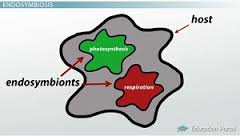
The diagram below shows a proposed theory of the origin of eukaryotic cells, called endosymbiosis.
Which of the following explains why cells that contained mitochondria-like organelles had an evolutionary advantage?
They were able to photosynthesize
They had more DNA
They were able to make more use of available energy
They were immune to bacterial invasion.
Fossil evidence suggests life on Earth arrived
1.5 bya
4.6 bya
3.8-3.5 bya
4-5 bya
How are mitochondria and chloroplasts like bacteria cells?
They divide by meiosis
They can make their own food
They have the same membrane-bound organelles
They contain their own DNA
A bat wing and a butterfly wing are both used for flying but they are made differently. What type of structure is this?
Homologous structure
Analogous structure
Vestigial structure
Fossil structure
A human arm and a whale fin have similar bone structure but the whale fin is used for swimming and the arm is used for reaching and grabbing. What type of structures are these?
Homologous structures
Analogous structures
Vestigial structures
Fossil structures

The moth wing and the bat wing are example of structures.
(a)

Which of the pictures above would be examples of homologous structures? (pick 2)
1
2
3

What type of evidence is shown with the diagram above?
Molecular
Anatomical
Embryological
Fossil
Analogous Structure
Same function different structure
Homologous Structure
Same structure different function
Comparative Embryology
Comparing embryological development of different species
Biochemical Evidence
Comparing DNA and amino acid sequences of different species
Vestigial Structures
Structures in the body of an organism that no longer work.

Which answer best describes macroevolution?
Largest-scale evolutionary changes via speciation or extiniction that occur over time
A scientist who classifies organisms into groups and makes a hypothesis on whether they are a different species based on the evidence
Identification of species by differences in their appearances
AP biological trait evolves in two unrelated species as a result of exposure to similar environments
The evolution of an ancestral species into an array of species that occupy different niches
convergent evolution
coevolution
speciation
adaptive radiation
What is convergent evolution?
evolution toward similar traits in unrelated species
evolution toward different traits in closely related species
elimination of a species from Earth
the rise of two or more species from one existing species
Sharks and dolphins both have streamlined bodies that allow them to move through water efficiently, this is an example of which type of evolution?
Divergent
Coevolution
Convergent
Artificial
In convergent evolution, organisms share physical similarities because they
have a common ancestor
live in similar environments
develop homologous structures
are closely related

What type of evolution is demonstrated in this photo?
Coevolution
Convergent evolution
Punctuated evolution
Gradualistic evolution
Cichlid fishes in lakes of the East African Rift. The lakes in this area are believed to support and sustain about 2,000 different species of these fish, each with different ecological and morphological characteristics such as body size. These lakes form a fragmented landscape that bio-geographically isolates the different species of cichlid fish from one another, allowing them, and many of the organisms they live with, to evolve separately.
Phyletic Speciation
Adaptive Radiation
Convergent Evoltion
Co-evolution
Humans are causing extiction in which ways?
By over hunting animals for food or products.
By destroying the natural habitat of species.
By polluting the environments of the world.
All of the above.

