
 Worksheets
Sound Check
Total questions: 15
Worksheet time: 8mins
Name
Class
Date
1.
1. Sound waves need _________ to travel through.
a)
an echo
b)
a medium
c)
reflection
d)
absorption
2.
2. Most adult voices are lower in pitch than children’s voices. What can you conclude based on this information?
a)
Adults’ vocal cords usually vibrate more slowly than children’s vocal cords.
b)
Children’s vocal cords usually vibrate more slowly than adults’ vocal cords.
c)
Adults' vocal cords usually vibrate more quickly than children's vocal cords.
d)
It is not possible to draw a conclusion based on this information.
3.
3. How is frequency related to pitch?
a)
The pitch of a sound is always twice as large as the frequency of the sound.
b)
Objects that vibrate quickly produce low-pitched sounds that travel at low frequencies.
c)
Objects that vibrate quickly produce high-pitched sounds that travel at high frequencies.
d)
None of the above are ways in which frequency is related to pitch.
4.
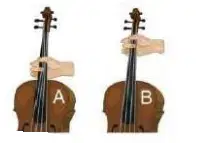
4. Notice where the two fingers are placed on the strings of the violins. With fingers in these positions, which violin would play the higher pitched sound?
a)
A. violin A
b)
B. violin B
c)
C. both play the same high sound
d)
D. both play the same low sound
5.
5. Through which does sound travel the fastest?
a)
metal
b)
rubber
c)
water
d)
smoke
6.
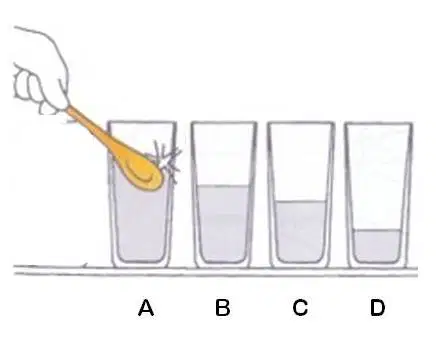
6. Which glass when tapped will have the lowest pitch?
a)
A
b)
B
c)
C
d)
D
7.
7. Kara is designing a bedroom for her new home. She wants a room that is very quiet to make sure that her parents are not disturbed by her loud music. She also wants to make sure that she cannot hear the noise from the street. Which items should Kara include in her room design in order to absorb sound waves? Select THREE that apply.
a)
bean bag chairs
b)
window curtains
c)
large glass windows
d)
a full-body mirror
e)
a soft rug
8.
8. During a thunderstorm, you see the lightning before you hear thunder. This is because _________.
a)
light has a greater mass than sound
b)
sound has longer wavelengths than light
c)
light travels faster than sound
d)
sound and light travel at the same
9.
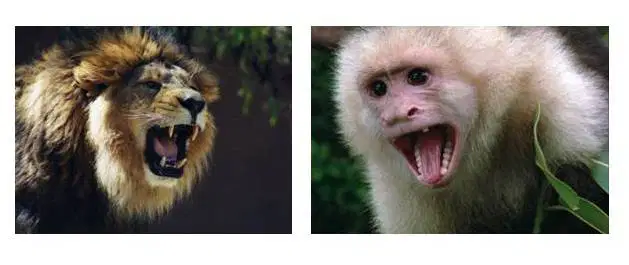
9. The monkey's call is a higher pitch than the lion's call. Why?
a)
The monkey uses more energy to make his noise.
b)
The lion has a bigger body and is a predator.
c)
The monkey's vocal cords vibrate at a faster rate.
d)
The monkey's vocal cords vibrate at a slower rate.
10.
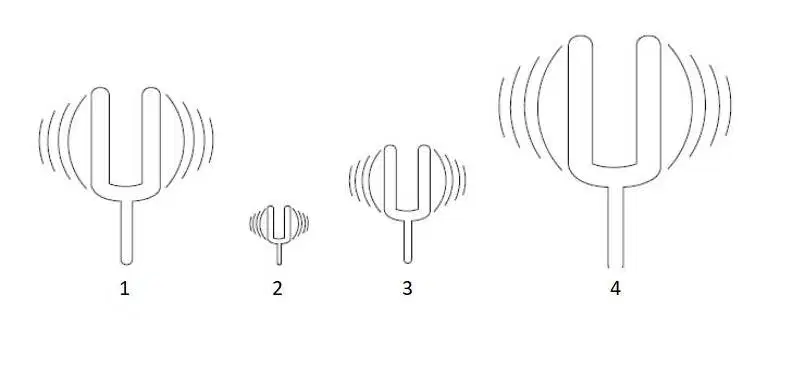
10. Place these tuning forks in order from the lowest pitch to the highest pitch.
a)
2, 3, 1, 4
b)
1, 2, 3, 4
c)
4, 1, 3, 2
d)
3, 2, 4, 1
11.
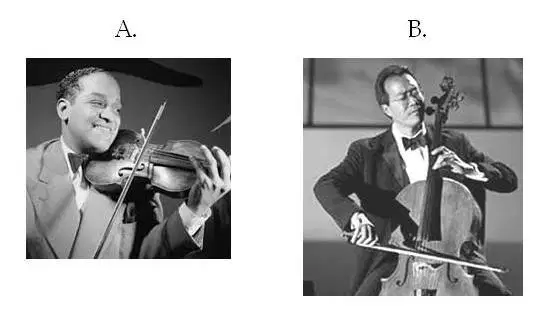
11. Instrument B can play lower notes than instrument A. Therefore, which of the statements below is true? Select FOUR that apply.
a)
Instrument A will have faster vibrations than instrument B.
b)
Instrument A will have a higher frequency.
c)
Instrument B will have a lower frequency.
d)
Instrument B will have notes that have a lower pitch.
e)
Instrument A will have slower vibrations than instrument B.
12.
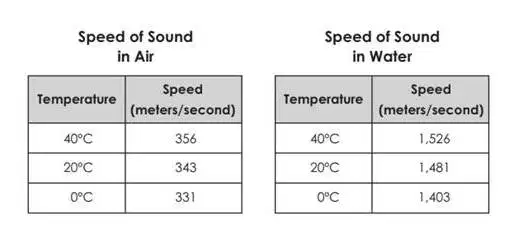
12. A teacher shows a student the following data about the speed of sound in air and water. Which THREE conclusions could the students make about the properties of sound based on the data?
a)
Sound travels faster through water than the air.
b)
Sound travels faster through the air than water.
c)
Sound travels through warmer air faster than colder air.
d)
Sound travels slower through colder water than warmer water.
13.
13. Light is sometimes reflected when it hits an object. Which behavior of sound is similar to light being reflected?
a)
sound traveling through air
b)
sound bouncing off a wall in an empty house creating an echo
c)
sound being absorbed by rugs and furniture in a living room
d)
sound increasing in volume
14.
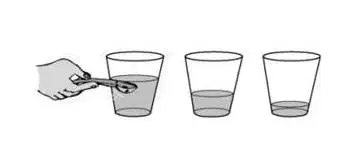
14. A student fills three identical glasses with different amounts of water. He taps each one with a spoon and observes that each glass produces a sound with a different pitch. Which statement explains the student's observation?
a)
Sound travels faster through larger amounts of water.
b)
The amount of water in the glass affects the vibration rate.
c)
Some of the glasses were tapped harder with the spoon.
d)
The student held the spoon in a different way.
15.

15. A student has recorded data on the speed of sound in meters per sec (m/s) in different materials. Which conclusion can be made based on the data.
a)
Sound travels in water at the same speed as it travels in other liquids.
b)
Sound travels faster through the air than through solids.
c)
No conclusions can be made because it need to be record in minutes, not seconds.
d)
Sound travels faster in solids than in gases.
100 %

