
NEW
Font size
 Worksheets
Ecology, populations and Human impact Review
Total questions: 41
Worksheet time: 3hrs 5mins
What is the PRODUCT of the process used by producers that is passed on as energy throughout an ecosystem?
photosynthesis
Sun
glucose
carbon dioxide
water
If there are 100 KJ of energy available at the secondary consumer level, how many KJ of energy are available at the producer level?
10 KJ
1,000 KJ
10,000 KJ
1 KJ
What would happen within a few months after the formation of a volcanic island?
pioneer species would grow
no pioneer species would grow
trees and large plants would grow
rich, organic soil would be present
What would happen within a few months after the formation of a volcanic island?
pioneer species would grow
no pioneer species would grow
trees and large plants would grow
rich, organic soil would be present

Which organisms would be at the top or last trophic level?
plant
herbivore
omnivore
carnivore

The monkey would be a
decomposer
producer
primary consumer
secondary consumer
Which is an example of where primary succession could occur?
a glacier melts and exposes new rocks
natural fire burns a prairie
a corn field is abandoned and left to overgrow
flood covers a piece of land

Mice might grow in population and destroy the community by eating all of the berry bushes if
wolves and snakes were removed from the food web
another predator migrated in to the community
the snake population grew
none of these

These organisms are often not shown in a food chain, but are important for recycling nutrients
producers
decomposers
primary consumers
carnivores
Which event would not cause secondary succession?
forest fire
flooding of a valley
volcanic lava flow
tornado

90% of the energy that gets lost as you move up a food pyramid or chain gets lost as
pollution to the environment
heat to the environment
energy for decomposers
gets recycled
What percentage of energy is passed on to the next trophic level?
5%
10%
50%
90%

Populations consist of
a single species
multiple species
the biotic and abiotic factors of an environment
a grouping of ecosystems

What decreases the size of a population
immigration
emigration

primary succession
secondary succession

Faster
primary succession
secondary succession

An ecosystems limit of growth
carrying capacity
limiting factors
growth cap
What do limiting factors do?
Separate biotic factors from abiotic factors.
Determine which is the predator and which is the prey.
Regulate how many organisms live in an ecosystem.
Determine which natural disasters will hit an area.
In ecology, what is carrying capacity?
The maximum population size an ecosystem can support.
A total list of the limiting factors.
How much weight an organism can lift.
How much pain an organism can tolerate.

What happens to the population of a species after it reaches its carrying capacity?
Increases linearly (in a straight line) over time.
Increases exponentially (line is curved) over time.
Decreases to zero in a very short amount of time.
Remains relatively the same.
If a natural disaster devastates an ecosystem, what will this do to the carrying capacity of the population of a species within that ecosystem?
Increase it.
Will not affect it, so it will stay the same.
Always reduce it down to zero.
Decrease it.
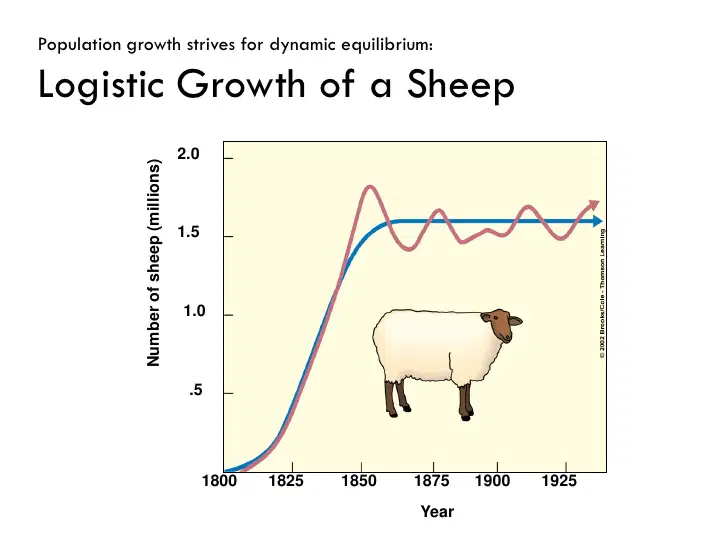
What is the carrying capacity for this sheep population?
1.8 million
1.25 million
1.6 million
1.0 million
The northern elephant seal was almost hunted to extinction in the 1800s. By the late 1890s, approximately one hundred seals were left, reducing the gene pool of the population. What will be the consequence of this reduction?
Competition within the population will increase.
The surviving elephant seals will be better able to adapt.
Inbreeding will be less frequent among the remaining population.
The elephant seals will be more vulnerable to environmental change.

A ski resort installed a wind turbine similar to those represented below to supply some of its energy needs. This turbine was most likely installed because wind power is:
Renewable and does substantial damage to the atmosphere.
Renewable and does minimal damage to the atmosphere.
Nonrenewable and does substantial damage to the atmosphere.
Nonrenewable and does minimal damage to the atmosphere
A community is concerned about the water quality of a nearby lake. Increased sedimentation in the lake is endangering the native habitat. The increased sedimentation is most likely caused by which of the following?
trees planted along the shore of the lake
construction of homes along the lake
the amount of sunlight on the lake
the amount of fish in the lake
Salt water is an abundant resource but unusable for irrigation and drinking. As demands on freshwater sources increase, the use of desalination processes to remove salt from ocean water is increasing. A concern of desalinating water is the large amounts of recovered salts that are returned to the ocean. Which of the following describes the most likely impact of desalination on the surrounding ocean environment?
Methane gas would pollute the ocean environment as shoreline organisms begin to die and decay.
Alteration in ocean salt levels would cause loss of species and unbalanced populations in marine food webs.
Nonrenewable resources in the ocean environment would become depleted and upset the ecosystem's balance.
Increased levels of salts and minerals in the ocean would result in overpopulation of marine bivalves due to strengthened shells.
An increase in the use of fossil fuels has increased the amount of sulfur compounds in Earth’s atmosphere. Which of these is a direct result of the increased amount of sulfur in the atmosphere?
an increase in acid rain
an increase in severe storms
an increase in global warming
an increase in the rate of ozone depletion
A scientist wanted to find out if low numbers of fish found in a nearby lake were related to acid rain. During his three-year study, he analyzed rainwater and lake water samples. By gathering samples of fish, he estimated the number of fish in the lake. Each year he found that both the rainwater and lake water became more acidic, and the number of fish decreased. His data suggested that acid rain may be responsible for the decrease in the number of fish found in the lake.
What most likely led to the rainwater’s increasing acidity?
ultraviolet radiation
sedimentation
burning fossil fuels
global warming
When fertilizers run off farmland into streams and ponds, the nitrogen content of the water increases. This can lead to rapid growth of algae in a process called eutrophication. How can this process affect other organisms in the water?
Oxygen is used up as algae is decomposed, reducing the amount available to other organisms.
The water becomes better able to support aerobic organisms.
The algae provide food for fishes and other organisms, leading to decreased algae populations.
The extra nitrogen provides additional food for the other organisms, increasing their population.
Industries often spring up along major rivers, such as the Willamette in Central Oregon. Some of these industries used PCBs (toxic, cancer-causing chemicals), which are not biodegradable. If PCBs escaped into the river in large amounts and entered the lower levels of the food chain, what would be the likely outcome?
All species, except scavengers such as riparian crustaceans, would be harmed by the PCBs.
Only the small fish and crustaceans that are most exposed to the PCBs would be significantly harmed.
Over time, PCBs would collect in top predators such as salmon, making them unsafe for human consumption.
The PCBs would become harmless as they break down over time with exposure to the forces of nature and the environment.
DDT and other pesticides used over 50 years ago are still affecting the environment today. Scientists have found these substances in recent glacier runoff. Glacier runoff occurs during the summer, when precipitation that has fallen on glaciers during the winter is released. Ice layers from existing glaciers have been analyzed. The results of this analysis show that the concentrations of DDT and other pesticides were highest about 10 years after the use of these substances was banned. This information shows that
DDT and other pesticides cause glacier runoff during the summer.
it takes humans over 50 years to analyze a glacier.
precipitation helps to break down pesticides.
the decision of one human generation may have an impact on future generations.

The zebra mussel is a highly invasive species that was accidentally introduced to the Great Lakes region of the United States in the 1980s. The map below shows the distribution of zebra mussels in 2010.
What is the primary reason the large-scale spread of zebra mussels concerns scientists?
Zebra mussels are a freshwater species.
Zebra mussels are a desired food for humans.
Zebra mussels are eaten by some fish and birds.
Zebra mussels outcompete native mussel species.
A strip mining company wants to lease some land that is currently part of a national park. They promise to reclaim the land should any minerals be mined from the area, and they are willing to pay top dollar for the rights. As an ecologist, what factors would you raise with the local government?
the threat to local biodiversity
management of the land after the company leaves
the new jobs that would be created
the increased traffic in the area


In this photo, what is an abiotic factor?
Deer
Grass
rain

In an ecosystem, there are populations of moose, rabbits, grass, and pine trees. Suddenly, a fire blazes through the area, which kills all of the populations. As the months go on, new species of grass begin to take root. This attracts animals, and eventually the ecosystem is restored.
What type of ecological succession happened?
Primary succession
Secondary succession
Tertiary succession
None of the above

What is the greenhouse effect?
It is a phenomenon where the sun’s rays are absorbed by clouds.
It is a phenomenon that occurs when heat escapes into space.
It is when heat is trapped by gases, then sent back to earth’s surface.
It describes the atmosphere’s composition.
The number of pythons found throughout Everglades National Park has increased in recent years. These huge snakes are not native to Florida and are believed to have been released into the wild by pet owners. Wildlife biologists have initiated attempts to capture and remove these pythons. Which statement best explains the biologists’ reason for removing these pythons from the Everglades?
The pythons could upset the territorial boundaries of native organisms.
The pythons could adapt to overcome diseases common to native snakes.
The pythons could prey on native organisms and cause native populations to decline.
The pythons could begin to interbreed with native snakes and produce a more successful species.

