
 Worksheets
Ch 11 & 12 review Final Quiz Review
Total questions: 110
Worksheet time: 55mins
What type of waves do not require matter to carry energy?
electromagnetic
mechanical
compressional
transverse
Electromagnetic waves are made by ________.
vibrating air molecules
vibrating water molecules
vibrating electric charges
strong compressions
Electromagnetic waves are at ________ angle to each other.
30 degrees
60 degrees
90 degrees
180 degrees
Electromagnetic waves are what type of waves?
longitudinal
transverse
In which of these substances does light move slowest?
Vacuum
Air
Water
Glass
The energy carried by an electromagnetic wave is called ________ energy.
radiant
mechanical
thermal
potential
In which of the following materials will light travel the fastest?
air
vacuum
water
glass
As the frequency of an electromagnetic wave increases, the wavelength ________.
decreases
increases
remains constant
becomes faster
As the frequency of an electromagnetic wave decreases, the wavelength _______.
decreases
increases
remains constant
becomes faster
If an object is emitting electromagnetic waves and it gets hotter, what can be said about the wavelength of the electromagnetic waves emitted?
Longer
Shorter
Remain the same
Cannot be determined
To determine the energy of an electromagnetic wave we need to look at _______.
Frequency
Speed
Medium
Amplitude
Electromagnetic waves are made up of ________.
Protons
Photons
Electrons
Leptons
Electromagnetic waves exhibit properties of waves and particles.
True
False
In the double slit experiment when we observed the photons, the photons behaved as?
Particles
Waves
In the double slit experiment when we didn't observe the photons, the photons behaved as?
Particles
Waves
The entire range of the electromagnetic wave frequencies is known as ________.
visible light
ultraviolet radiation
magnetism
the electromagnetic spectrum
Electromagnetic waves with wavelengths between about 1 cm and 20 cm are called _______.
infrared waves
microwaves
ultraviolet rays
X-rays
Which of the following devices uses infrared waves?
cellular telephone
satellite
television remote control
radar
Which of the following electromagnetic waves enables your body to make vitamin D?
infrared waves
visible light
gamma rays
ultraviolet rays
Which of the following electromagnetic waves can destroy cancer cells?
gamma rays
radio waves
infrared waves
microwaves
Electromagnetic waves with wavelengths shorter than 100 trillionths of a meter are
radio waves
infrared waves
visible light
gamma rays
Electromagnetic waves with wavelengths longer than 10 cm are
radio waves
infrared waves
visible light
ultra violet waves
Electromagnetic waves with wavelengths from 400 billionths to 10 billionths of a meter are known as:
infrared waves
ultraviolet waves
radio waves
x-rays
visible light
Electromagnetic waves with wavelengths from 10 billionths to 10 trillionths of a meter are known as:
x-rays
radio waves
infrared waves
visible light
ultraviolet waves
Electromagnetic waves with wavelengths from 1 thousandth to 700 billionth of a meter are known as:
x-rays
visible light
radio waves
ultra violet waves
infrared waves
The range of electromagnetic waves that you detect with your eyes, which have a wavelength of 700 billionths to 400 billionths of a meter, is called:
visible light
x-rays
ultra violet waves
radio waves
infrared waves
This technique involves the emitting of Electromagnetic waves and detecting the waves that bounce off the object(s) to measure the distance, speed, and size of an object. It is known as:
Sonar
Radar
X-Ray
MRI
When a police officer checks your speed he is using which technique?
Sonar
Radar
X - Ray
MRI
Which will take the longest for a microwave to heat up due to the substance's inability for atoms to rotate freely in the presence of an electromagnetic wave?
Solid
Liquid
Gas
Plasma
What helps protect us from the sun's harmful UV rays?
Clouds
Ozone layer
Rain
Carbon Dioxide
The specific frequency of the electromagnetic wave that a radio station is assigned is called the ______.
amplitude modulation
carrier wave
frequency modulation
cathode
________ are small, portable radio receivers used by restaurants to alert customers that their tables are ready.
Transceivers
Cell phones
Pagers
Satellites
A(n) ________ transmits a radio signal at one frequency and receives radio signals at a different frequency.
Transceivers
Television remote control
Carrier wave
Microwave oven
The Global Positioning System is a system of satellites, ground monitoring stations and receivers that ________.
Provide information about the receiver's exact location at or above Earth's surface
Provide mobile telephone service
Broadcast television signals
Provide two-way radio service for police cars, fire trucks, and ambulances
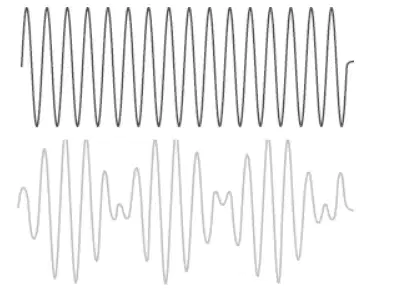
The bottom waves show ____________.
a carrier wave
frequency modulation
amplitude modulation
a digital wave
________ is an electrical signal where there are only 2 possible values. On or Off.
modulation
analog signal
digital signal
GPS
The process of adding the signal wave to the carrier wave is called _______.
modulation
analog signal
digital signal
GPS
_______ is a system of satellites, ground monitoring stations, and receivers that determine your exact location at or above earth's surface.
modulation
analog signal
digital signal
GPS
Electronic signals whose values change smoothly over time are called _______.
modulation
analog signal
digital signal
GPS
Type of radio signal where the amplitude is modulated
AM
FM
Satellite
None of the above
Type of radio signal where the frequency is modulated
AM
FM
Satellite
None of the above
____ are the type of electromagnetic waves that are used in radar and MRI
Infrared Waves
Ultraviolet waves
Carrier wave
If you stay outdoors too long, your skin might be burned by exposure to ______ from the Sun.
Radio waves
Infrared Waves
Ultraviolet waves
Carrier wave
Transverse waves that are produced by vibrating electric charges and consist of vibrating electric and magnetic fields are ______.
Radio waves
Infrared Waves
Ultraviolet waves
Electromagnetic Waves
Which of the following produces electromagnetic waves?
vibrating electric charge
direct current
static electric charge
constant magnetic field
The frequency of an electromagnetic wave has which unit?
hertz
Newtons
nanometers
meters/second
Which explains how interference is avoided between the signals that cordless phones receive and the signals that they broadcast?
The signals have different frequencies
The signals travel at different speeds
The signals have different amplitudes
The signals are only magnetic
Which person explained how light can behave as a particle, called a photon, whose energy depends on the frequency of light?
Einstein
Newton
Hertz
Galileo
Which of the following has the shortest wavelength?
radio waves
gamma rays
x rays
visible light
The warmth that you feel from a fire is thermal energy transmitted to you by which type of electromagnetic waves?
x rays
microwaves
ultraviolet waves
infrared waves
______ materials only absorb and reflect light.
Translucent
Transparent
Clear
Opaque
Which of these types of material transmits light without scattering it?
Translucent
Transparent
Clear
Opaque
Which of these types of material transmits light but also scatters it?
Translucent
Transparent
Clear
Opaque
The angle which light strikes a surface is ______ the angle at which it is reflected.
the same as
greater than
less than
twice as great as
Why can't you see your reflection in a brick wall?
Light rays are reflected in only one direction from the rough surface.
Reflection of light from a rough surface is regular reflection.
Light rays are reflected in many directions from the uneven surface.
No light is reflected from a brick wall.
Reflection of light waves from a smooth, mirror-like surface is called ________.
diffuse reflection
irregular reflection
refraction
regular reflection
What property of a material indicates how much light slows down when traveling through it?
index of refraction
density
wave index
index of diffusion
If the handle of your aquarium net appears to be bent more when it is placed into a glass aquarium full of water than it does when the tank is empty, which of the following statements is true?
The index of refraction of water is less than the index of refraction of glass.
The index of refraction of water is greater than the index of refraction of air.
The angle of incidence of the water is greater than the angle of reflection of the glass.
The index of refraction of water is less than the index of refraction of air.
A glass prism ______ light, producing the individual colors of visible light.
refracts
reflects
diffuses
diffracts
When visible light passes through a prism, why does red light bend the least?
Longer wavelengths are refracted more by a prism than shorter wavelengths.
Longer wavelengths are refracted less by a prism than shorter wavelengths.
Shorter wavelengths cannot pass through a prism.
Longer wavelengths cannot pass through a prism.
an image of a distant object produced by the refraction of light through air layers of different densities
polarized image
mirage
refracted image
picture
Why is it that smooth pot does not show a reflection?
It is made of the wrong material
The light is polarized when it strikes it making it opaque
Their are microscopic rough surfaces that cause diffuse reflection
We can always see our reflection in the pot.
What refracts light to create rainbows?
wind
sun
our eyes
water droplets
A ray of light hits a mirror at 27 degrees from the normal. What is the angle between the reflected ray and the normal?
A) 27 degrees
B) 52 degrees
C) 13.5 degrees
D) 104 degrees
A ray of light strikes mirror at an able of 42 dress from the surface of the mirror. What angle does the reflected ray make with the normal?
A) 42 degrees
B) 48 degrees
C) 84 degrees
D) 126 degrees
Which of the following colors of visible light has the longest wavelength?
Yellow
Blue
Red
Violet
Which of the following colors of visible light has the shortest wavelength?
yellow
blue
red
violet
What determines the color of an object?
The wavelength of light it absorbs.
The wavelength of light it reflects.
The index of refraction of the object.
The index of diffraction of the object.
A green leaf absorbs all colored light but what?
red
blue
green
yellow
If a transparent blue filter is placed over a camera lens, what happens to visible light entering it?
All colors of visible light pass through the filter and enter the camera lens.
Blue light is transmitted by the filter to the camera, and other colors of light are absorbed by the filter.
Blue light is absorbed by the filter, and the other colors of visible light enter the camera lens.
Blue light is reflected by the filter away from the camera, and the other colors of visible light enter the camera.
The part of the eye that focuses the light is called the __________.
pupil
lens
iris
retina
The part of the eye that contains rods and cones __________.
pupil
lens
iris
retina
Which of the following types of cells is located in the retina?
cone
olfactory
conjunctiva
sclera
Which of the following cells is most useful at night?
rod
red cone
green cone
blue cone
A ________ is a colored material that absorbs some colors and reflects others.
filter
laser
prism
Which cone cells absorb yellow light?
red and green
red and yellow
blue
blue and yellow
The three primary colors of pigment appear ______ when they are mixed.
white
gray
black
brown
What are the primary colors of light (check all that apply)?
red
green
blue
magenta
cyan
What are the primary colors of pigment?
Yellow
Cyan
Red
Magenta
Green
If light reflected from an object passes through a green filter, then a red filter, and finally a blue filter, what color will the object appear to be?
Black
White
Green
Blue
Which of the following best describes an incandescent light?
Gives off light when phosphors absorb ultraviolet radiation.
Contains argon gas at low pressure.
Gives off light when a tungsten filament is heated.
Uses the least amount of electricity to produce light.
What makes a neon light glow?
The filament is heated until it glows, producing light.
Phosphors absorb ultraviolet light from gas molecules and begin to glow.
The gas inside it is heated until it glows, producing light.
Electrons collide with the gas molecules inside it and produce visible light.
____ light is light of only one wavelength that travels in one direction with a constant distance between corresponding crests.
Incoherent
Coherent
Incandescent
Compact
____ light is light that can have more than one wavelength, can travel in more than one direction, and does not travel with a constant distance between the corresponding crests of the waves.
Incoherent
Coherent
Incandescent
Compact
What type of light bulb uses phosphors to convert ultraviolet radiation into visible light?
incandescent light bulb
fluorescent light bulb
tungsten-halogen bulb
neon light
_____ is a tube that contains a mixture of neon gas, a small amount of argon gas, and a small amount of sodium metal.
incandescent light bulb
sodium vapor light
tungsten-halogen bulb
neon light
_____ is a light that has a tungsten filament inside a quartz bulb or tube. The tube is filled with a gas that contains one of the halogen elements.
incandescent light bulb
sodium vapor light
tungsten-halogen bulb
neon light
About 90% of the energy is given off as thermal energy by which type of light bulb?
Incandescent light bulb
Sodium vapor light
Tungsten-halogen bulb
Neon light
These lights are glass tubes filled with gas often neon. When there is an electric current through the tube, electrons collide with the gas molecules and emit visible light. What are these lights called?
Incandescent light bulb
Sodium vapor light
Tungsten-halogen bulb
Neon light
Which of the following produces a narrow, intense beam of coherent light?
Lasers
Fluorescent bulbs
Neon lights
Tungsten-halogen lights
Which of the following does not use lasers?
cataract surgery
CD players
rainbows
holograms
Which consume 1/5 the energy of the other and is thus more energy efficient?
incandescent
fluorescent
LED
Halogen
Is this an example of coherent light or incoherent light? A flashlight
coherent light
incoherent light
ultraviolet light
polarized light
Is this an example of coherent light or incoherent light? A laser
coherent light
incoherent light
ultraviolet light
polarized light
Is this an example of coherent light or incoherent light? Light coming in through polarized sunglasses
coherent light
incoherent light
visible light
ultraviolet light
Light waves whose magnetic fields vibrate in only one direction is called ______ light.
reflected
refracted
diffused
linearly polarized
A(n) ________ is an image of a three-dimensional object produced without using a lens.
digital photograph
optical fiber
hologram
light pipe
________ is the complete reflection of light at the boundary between two surfaces.
Holography
Mirage
Rainbow
Total internal reflection
Highspeed internet is available because the lines that transmit the information take advantage of?
Holography
Mirage
Rainbow
Total internal reflection
Supermarket cashiers use ______ to read bar codes.
mirages
optical scanners
neon lights
polarizing filters
Two polarizing filters at right angles will transmit ______ that strikes them.
all of the light
none of the light
some of the light
most of the light
Light waves in which the magnetic field vibrate in any direction are called ______.
Polarized light
Unpolarized light
Reflected light
Refracted light
To have total internal reflection we need ______.
The angle of incidence to be less than 90 degrees
The angle of incidence to be greater than 90 degrees
The angle of incidence to be greater than the critical angle
The angle of incidence to be less than the critical angle
If you were wearing sunglasses could you tell if the light coming off a lake was polarized by tilting your head sideways; rotate the lenses by 90 degrees. If the lake appeared noticeably darker or brighter, then you could say the light is polarized.
True
False
Which type of cells in your eyes allows you to see the color violet?
red cones
green cones
blue cones
rods
What do you see when you note the color of an object?
the light it reflects
the light it absorbs
the light it refracts
the light it diffracts
Which term best describes the light from a laser?
incoherent
incandescent
coherent
opaque
Which property of material indicates how much light slows down when traveling in material?
pigment
filter
index of refraction
mirage
Which event explains why a prism separates white light into the colors of the rainbow?
interference
diffraction
fluorescence
refraction
In which situation is light refracted?
light hits a wall
light travels in a vacuum
light hits a mirror
light travels from air into water

