wayground logo

Free Printable Worksheets

Font size

S
M
L
XL
Worksheets

BIG REVIEW (2nd Semester)

Total questions: 90

Worksheet time: 6hrs 44mins

Name
Class
Date
1.
Determine where X' would be if you translated X 3 units to the left and 9 units down.
a)
(-4, 4)
b)
(-10, 2)
c)
(-4, -5)
d)
(-1, 5)
2.
How is trapezoid ABCD translated to trapezoid A'B'C'D'?
a)
Translated 5 units down and 5 units to the right
b)
Translated 5 units down and 1 to the right
c)
Translated 8 units down and 5 units to the right
d)
Translated 5 units down and 4 units to the right
3.
Determine how to translate triangle A'B'C' to triangle ABC.
a)
(x+2, y-5)
b)
(x+2, y-9)
c)
(x-2, y-9)
4.
What is this transformation?
(x, y) ----> (-x, y) 
a)
Reflect over the x axis
b)
Reflect over the y-axis
c)
Slide down 1
d)
slide left 1
5.
Reflect the point (2, -4) over the y-axis.
a)
(-4, 2)
b)
(-2, 4)
c)
(-2, -4)
d)
(2, 4)
6.
Point C (-5, 4) is reflected over the x-axis. What are the coordinates of C'? 
a)
(5, 4)
b)
(-5, -4)
c)
(5, -4)
d)
(-5, 4) 
7.
Find K' if the figure is reflected across the x-axis
a)
(4, 1))
b)
(-1, -4)
c)
(1, -4)
d)
(1, 4)
8.
Reflect Point C over the y-axis:
a)
(-3, 2)
b)
(3,2)
c)
(-2,3)
d)
(3,0)
9.
Rotate the point (-3,-4) around the origin 180 degrees. State the image of the point.
a)
(-4,-3)
b)
(-4,3)
c)
(4,-3)
d)
(3,4)
10.
Triangle B is rotated 90° clockwise with the origin as the center of rotation to create a new figure. Which triangle shows the new location?
a)
A
b)
B
c)
C
d)
D
11.
Triangle A is rotated 270° counterclockwise with the origin as the center of rotation to create a new figure. Which triangle shows the new location?
a)
A
b)
B
c)
C
d)
D
12.
If the scale factor is less than 1, the dilation is...
a)
an enlargement
b)
a translation
c)
a rotation
d)
a reduction
13.
If the scale factor is greater than 1, the dilation is...
a)
an enlargement
b)
a rotation
c)
a translation
d)
a reduction
14.
Enlargement or reduction?  Find the scale factor!
a)
It's a reduction; the scale factor is 2.
b)
It's an enlargement; the scale factor is 2.
c)
It's an enlargement; the scale factor is 1/2.
d)
It's a reduction; the scale factor is 1/2.
15.
Triangle ABC will be dilated by a scale factor of 1/2.  What will be the coordinates of C'?
a)
(-1, -2.5)
b)
(12, 6)
c)
(3, -1.5)
d)
(0, 1.5)
16.
Triangle ABC will be dilated using the rule (x, y)→(2x, 2y).  What will be the coordinates of C'?
a)
(12, -3)
b)
(12, -6)
c)
(3, -1.5)
d)
(8, -5)
17.
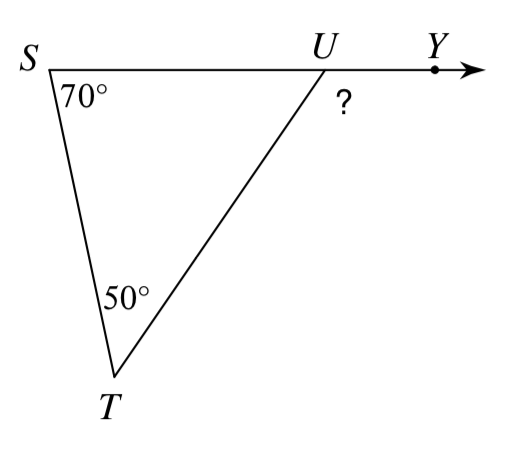
Find the measure of the indicated angle. 
a)
95
b)
85
c)
35
d)
45
18.
Find the missing angle.
a)
29° 
b)
39° 
c)
49° 
d)
59° 
19.
Find the measure of the indicated angle. 
a)
145
b)
113
c)
102
d)
78
20.
Find the measure of the indicated angle. 
a)
89
b)
211
c)
119
d)
81
21.

What is the value of x?

a)

38

b)

57

c)

76

d)

85

22.
Find the measure of the missing angle.
a)
90o
b)
100
c)
130o
d)
50o
23.

What is the value of the missing angle?

a)

90

b)

100

c)

20

d)

120

24.

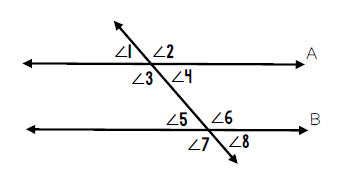
Angle 3 and Angle 6 are examples of which type of angle pair?

a)

Alternate exterior angles

b)

Alternate interior angles

c)

Vertical angles

d)

Corresponding angles

25.

Angle 1 and Angle 5 are examples of which type of angle pair?

a)

Alternate exterior angles

b)

Alternate interior angles

c)

Vertical angles

d)

Corresponding angles

26.

Angle 6 and Angle 7 are examples of which type of angle pair?

a)

Alternate exterior angles

b)

Alternate interior angles

c)

Vertical angles

d)

Corresponding angles

27.

Which of the following angles would NOT be congruent to the measure of 7\angle7 ?

a)

2\angle2  

b)

3\angle3  

c)

6\angle6  

d)

8\angle8  

28.

Which of the following is NOT an example of supplementary angles?

a)

7 and 8\angle7\ and\ \angle8  

b)

2 and 3\angle2\ and\ \angle3  

c)

1 and 7\angle1\ and\ \angle7  

d)

6 and 4\angle6\ and\ \angle4  

29.

If the  m7 = 115°,m\angle7\ =\ 115\degree,  find the measure of  2.\angle2.  

a)

115°115\degree  

b)

65°65\degree  

c)

180°180\degree  

d)

Cannot be determined

30.

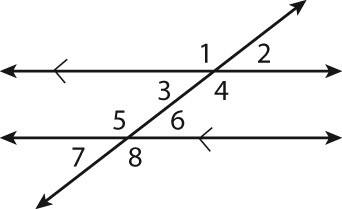
If the  m5 = 63°,m\angle5\ =\ 63\degree,  find the measure of  3.\angle3.  

a)

63°63\degree  

b)

117°117\degree  

c)

180°180\degree  

d)

Cannot be determined

31.
Which of these angles is NOT congruent to angle 5?
a)
Angle 6
b)
Angle 8
c)
Angle 1
d)
Angle 4
32.
The Pythagorean Theorem ONLY works on which triangle? 
a)
obtuse
b)
scalene
c)
isosceles
d)
right
33.
Find the length of the missing side.
a)
20 in.
b)
68 in.
c)
16 in.
d)
80 in.
34.
A 10-foot ladder is leaning against the wall.  The bottom of the ladder is 4 feet from the base of the wall.  Which of the following is closest to the distance from the top of the ladder to the base of the wall?
a)
9ft
b)
11ft
c)
6ft
d)
14ft
35.
Casey travels from her house directly west to the bank and then directly north from the bank to the mall. She then travels home on the road connecting the mall and her house. What is her total distance traveled?
a)
17 miles
b)
32 miles
c)
37 miles
d)
40 miles
36.
Find the length of the missing side. 
a)
17 cm
b)
22 cm
c)
15 cm
d)
13 cm
37.
What is the formula for finding the hypotenuse?
a)
a2+b2=c2
b)
a+b=c
c)
a-b=c
d)
c-a=c
38.
Find the volume to the nearest whole number using 3.14 instead of Pi.
a)
151 ft3
b)
152 ft3
c)
150 ft3
d)
150.72 ft3
39.
V = ?
a)
150.72 mm3
b)
904.32 mm3
c)
2,712.96 mm3
40.
Find the volume to the nearest hundredth using 3.14 instead of Pi.
a)
5572.45 cm3
b)
506.59 cm3
c)
126.65 cm3
d)
1393.11 cm3
41.
A can of chili has a radius of 5.25 cm and a height of 13 cm.  Find the volume.
a)
1152.67 cubic cm
b)
1125.67 cubic cm
c)
281.48 cubic cm
d)
255.25 cubic cm
42.
v = ?
a)
2,144.66 m3
b)
1,608.49 m3
c)
536.17 m3
d)
498.62 m3
43.
A styrofoam model of a volcano is in the shape of a cone. The model has a circular base with a diameter of 48 centimeters and a height of 12 centimeters. Find the volume of foam in the model to the nearest tenth. Use 3.14 for π.
a)
7234.6 cm3
b)
7984.6 cm3
c)
8934.4 cm3
d)
6034.7 cm3
44.
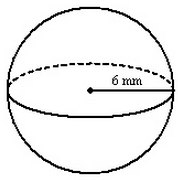
You have a globe that has a radius of 11 inches. Find the volume of your globe. 
a)
523 in3
b)
16,717 in3
c)
5,575 in3
d)
7,235 in3
45.
Volume = ?
a)
1,356 m3
b)
1,734 m3
c)
377 m3
d)
590 m3
46.
Which label would NOT be appropriate for volume.
a)
square miles
b)
inches3
c)
cm3
d)
cubic feet
47.
What is the type of correlation?
a)
Negative 
b)
no association
c)
positive 
48.
What type of correlation does this graph have?
a)
positive 
b)
negative
c)
none
d)
all of the above
49.
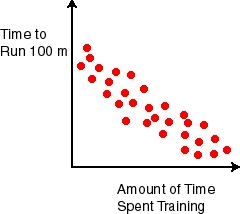
What type of correlation does this graph have?
a)
positive
b)
negative
c)
none
d)
all of the above
50.
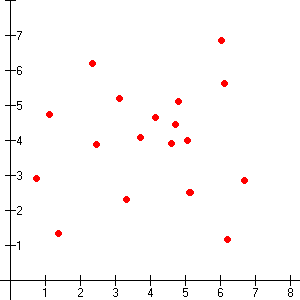
What type of correlation does this scatter plot show?
a)
positive linear association
b)
negative linear association
c)
no association
d)
nonlinear association
51.
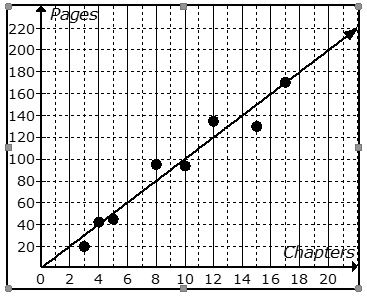
The scatter plot shows the relationship between the number of chapters and the total number of pages for several books.  Use the trend line to predict how many chapters would be in a book with 140 pages. 
a)
12 chapters
b)
19 chapters
c)
14 chapters
d)
21 chapters
52.
As x increases, y decreases.
a)
no correlation
b)
negative correlation
c)
correlation coefficient
d)
positive correlation
53.
What is a scatter plot?
a)
A graph that shows the relationship of two data sets.
b)
A graph drawn using rectangular bars to show how large each value is.
c)
A graph that shows information that is connected in some way.
d)
A graph that shows data changing over time.
54.

What is the equation of the line of best fit?

a)

y= 2x+3

b)

y=3x+2

c)

y= 12x +3\frac{1}{2}x\ +3

d)

y= 12x +3-\frac{1}{2}x\ +3

55.

What is the equation of the line of best fit

a)

y= -2x + 10

b)

y= 10x+ 2

c)

y=2x+10

d)

y= 10

56.
Select the statement that best describes the line.
a)
The line is the line of best fit.
b)
The line is NOT a line of best fit because it does not pass through two points.
c)
The line is NOT a line of best fit because it does not go through the middle of the data set.
d)
The line is NOT a line of best fit because it does not go through the origin.
57.
Which of the following lines represents the line of best fit for the scatter plot?
a)
A
b)
B
c)
C
d)
D
58.

What percent of people who attended the basketball game also attended the school play?

a)

38%

b)

47%

c)

25%

d)

54%

59.

What number should go in the blue box?

a)

21

b)

135

c)

19

d)

22

60.

How many total have no cell phone?

a)

13

b)

9

c)

22

d)

100

61.

How many total people were surveyed?

a)

78

b)

22

c)

70

d)

100

62.
How many sophomores like burritos and pizza?
a)
6
b)
5
c)
11
d)
50
63.
In a class of 25 students, 80% of students maintain an A average. How many students don't have an A average?
a)
0 Students
b)
-3 Students
c)
15 Students
d)
5 Students
64.
According to the table, what is the relative frequency of students ages 10 - 13 who eat breakfast?
a)
About 33%
b)
About 50%
c)
About 40%
d)
About 44%
65.
Which age group liked Action movies the least?
a)
18-25
b)
25-49
c)
50+
d)
238
66.
How many females were surveyed?
a)
10
b)
16
c)
26
d)
14
67.
Of the mechanical engineers, what is the probability that math is their favorite subject?
a)
1.91
b)
52%
c)
17%
d)
35%
68.
What is the relative frequency (to the nearest percent) of boys among those who cannot bike to school? 
a)
4%
b)
14%
c)
13%
d)
29%
69.
What was the most popular party type?
a)
Bowling
b)
Skating
c)
Dancing
d)
Total
70.
A survey explored the relationship between gender and band class. Which is a reasonable conclusion?
a)
There are more band members than non-band members
b)
There are more boys in the class than girls
c)
There are more boys in band than not in band
d)
More than half of the bands members in the class are girls
71.
What is the definition of function?
a)
Has inputs and outputs
b)
Every input has only ONE output
c)
Inputs have different outputs every time
d)
x-values and y-values
72.
a)
Function
b)
Not a Function
73.
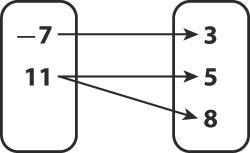
Is this mapping a function or not a function? 
a)
Function
b)
Not a Function
74.
Is the relation a function? Why.
a)
Yes, because the x-value 11 has two y-values pair with it.
b)
Yes, because each x-value has only one y-value paired with it.
c)
No, because the x-value 11 has two y-values pair with it.
d)
No, because each x-value has only one y-value paired with it.
75.
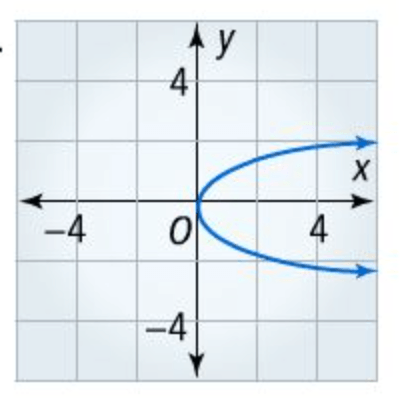
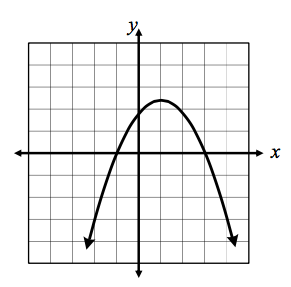
Is this graph a function or not a function? 
a)
Function
b)
Not a Function
76.
Which set of values is a function?
a)
(9,5) (10,5) (9,-5) (10,-5)
b)
(3,4) (4,-3) (7,4) (3, 8)
c)
(6,-5) (7, -3) (8, -1) (9, 1)
d)
(2, -2) (5, 9) (5, -7) (1, 4)
77.
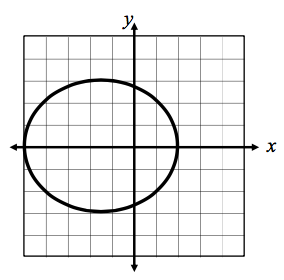
Is this graph a function or not a function? 
a)
Function 
b)
Not a Function 
78.
Does the table represent a function?
a)
Yes, there  is a repeated x-value. 
b)
No, there aren't any repeated y-values. 
c)
Yes, there are repeated y-values. 
d)
No, there is a repeated x-value. 
79.
Is the function Linear or Nonlinear?
a)
Linear
b)
Nonlinear
80.
Is the function Linear or Nonlinear?
a)
Linear
b)
Nonlinear
81.
Is function represented by the table linear or nonlinear?
a)
linear
b)
nonlinear
82.
Is this function linear or nonlinear?
a)
Linear
b)
Nonlinear
83.

Compare the initial values of each function.

a)

The initial value of item I is greater than the initial value of item II.

b)

The initial value of item I is equal to the initial value of item II.

c)

The initial value of item II is greater than the initial value of item I.

84.

Determine if the following functions are increasing or decreasing.

a)

Both functions are decreasing.

b)

The function in item I is increasing, and the function in item II is decreasing.

c)

The function in item I is decreasing, and the function in item II is increasing.

d)

Both functions are increasing.

85.

Compare the rates of change.

a)

The rate of change of item II is greater than the rate of change of item I.

b)

The rate of change of item I is greater than the rate of change of item II.

c)

Both items have the same rate of change.

86.

Compare the initial values and rate of change of both functions.

a)

Both functions have the same initial value and rate of change.

b)

The functions have different initial values and different rates of change.

c)

The rates of change are the same, but the initial values differ.

d)

The initial values are the same, but the rates of change differ.

87.

Compare the initial values and the rates of change.

a)

The functions have different initial values and different rates of change.

b)

The rates of change are the same, but the initial values are different.

c)

The functions have the same initial value, but the rates of change differ.

d)

The y-intercepts are the same, but the rates of change differ.

88.
Find the distance.
a)
9.7
b)
10.7
c)
11.7
d)
12.7
89.
What is the distance between the two points?
a)
6.3
b)
6.5
c)
6.7
d)
16
90.

Find the volume of the hemisphere

a)

904.3 in3

b)

226.1in3

c)

113.0 in3

d)

452.4 in3