wayground logo

Free Printable Worksheets

Font size

S
M
L
XL
Worksheets

Electrical Principles ELO 2 Quiz

Total questions: 46

Worksheet time: 30mins

Name
Class
Date
1.
The picture shows an electrical circuit. This circuit is a series circuit because: 
a)
It has 3 light bulbs.
b)
The same current flows through all three light bulbs.
c)
It uses a single battery.
d)
The electrical current is divided between the three light bulbs.
2.
This is the symbol for a _____?
a)
switch
b)
light 
c)
battery
d)
wires
3.
This is the symbol for a _____?
a)
an AC current source
b)
a DC current source
c)
a battery
d)
a single cell
4.
This is the symbol for a _____?
a)
an AC current source
b)
a DC current source
c)
a battery
d)
a single cell
5.
This type of circuit only has one path for current to flow. 
a)
series
b)
parallel
c)
combination
d)
split
6.
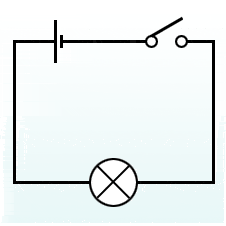
this circuit is .....?
a)
open
b)
parallel
c)
closed
d)
The cutest little circuit evah!
7.
Which best describes a parallel circuit?
a)
Electricity flows along one pathway.
b)
The flow of electricity comes from one source. 
c)
Electricity flows along more than one pathway. 
d)
The flow of electricity comes from more than one source. 
8.
What is one problem with using a series circuit? 
a)
It has a lot of series. 
b)
If one goes down, they all go down! 
c)
It doesn't work properly.
d)
There are no problems. 
9.
What is one benefits of using a parallel circuit?  
a)
It gets confusing.
b)
There are no problems.
c)
If one goes down, it does not affect the others. 
d)
Porque es para llelio. 
10.
In a parallel circuit if one of the light bulbs burns out the rest _________.
a)
stop the flow of electricity
b)
 can still light up
c)
 will go out
d)
of the light bulbs burn out also
11.
Does this diagram represent a series or parallel circuit?
a)
series circuit
b)
parallel circuit
12.
What kind of circuit is this?
a)
Series
b)
Consecutive
c)
Parallel
d)
Training
13.

If more bulbs were added to this circuit, each bulb would get ___.

a)

brighter

b)

dimmer

14.

In a series circuit, when you add more appliances, each appliance gets ___ power/electrical pressure.

a)

more

b)

less

15.
Pick the correct sentence.
a)
This circuit will work because it is a closed circuit.
b)
Energy will freely flow in this circuit.
c)
This circuit will not work because there is no energy source.
d)
This circuit will not work because there is no switch.
16.
What will happen if one light bulb is removed from this circuit?
a)
The other bulbs will go out.
b)
The other bulbs will stay on
c)
The other bulbs will get dimmer.
d)
The battery will become stronger.
17.
When you remove a bulb from a three bulb circuit, and the other two bulbs go off, then the bulbs must have been connected in __________.
a)
parallel
b)
series
c)
open
d)
closed
18.
The force that pushes the electricity through a circuit is called...
a)
resistance
b)
voltage
c)
current
d)
switch
19.
The flow of electricity through a conductor is called...
a)
resistance
b)
voltage
c)
current
d)
source of electric current
20.
The best conductors for electricity are made of...
a)
wood
b)
plastic
c)
rubber
d)
metal
21.
What slows down the flow of electricity in a circuit?
a)
resistance
b)
voltage
c)
current
d)
source of electric current
22.
If I add more light bulbs to a series circuit what happens?
a)
The current speeds up and the lights get brighter
b)
The current slows down and the lights dim lower
c)
The current speeds up and the lights dim lower
d)
The current slows down and the lights get brighter
23.

In a closed circuit, how does battery voltage affect current?

a)

As voltage increases, current increases.

b)

As voltage increases, current decreases.

c)

Voltage has no affect on current.

d)

If voltage exceeds current, a short circuit circuit will develop.

24.
An incomplete circuit is shown.
To complete the circuit, a wire should be placed from —
a)
Point D to Point C
b)
Point B to Point C
c)
Point A to Point D
d)
Point B to Point D
25.

How many light bulbs would be ON with this complete circuit?

a)

1

b)

3

c)

2

d)

4

26.

How many light bulbs would be ON if the wire of this circuit was cut where the scissors are?

a)

1

b)

3

c)

2

d)

0

27.

How many light bulbs would be ON if the wire of this circuit was cut where the scissors are?

a)

1

b)

3

c)

2

d)

0

28.

In a series circuit...

a)

the current is the same everywhere.

b)

the current is split between components.

c)

the voltage is the same everywhere.

d)

the voltage is split between components.

29.
An insulator is a material that:
a)
Transfers thermal and electrical energy
b)
Transfers electrical energy and slows thermal energy
c)
Slows electrical energy and allows thermal energy to pass
d)
Slows thermal and electrical energy from transfering
30.
What object would best complete this circuit?
a)
A battery
b)
a peice of yarn
c)
an insulator
d)
a conductor
31.
The plastic covering is there to:
a)
Provide a conductor for electrical energy to flow.
b)
Provide an insulator so that electrical energy will not pass outside of the wires.
c)
Provide a conductor so that electrical energy can NOT flow.
d)
Provide an insulator so that electrical energy can flow.
32.

What is an electrical circuit?

a)

a whole bunch of wires

b)

a broken path that electric charges can flow

c)

a circuit board

d)

a complete, unbroken path through which electric charges flow

33.

What device opens and closes an electric circuit?

a)

a switch

b)

a power source

c)

a load

d)

a current

34.

What happens if you disconnect a circuit from its positive terminal?

a)

The electrons shoot out from the negative terminal.

b)

The electrons stop flowing, and the current stops.

c)

The current reverses direction.

d)

Nothing happens.

35.
The mathematical relationship among Voltage, Current, and Resistance
a)
Faraday's Law
b)
Tesla's Law
c)
Edison's Law
d)
Ohm's Law
36.
What is resistance measured in?
a)
Ω (Ohms)
b)
V (Volts)
c)
A (Amps)
d)
W (Watts)
37.
What is current measured in?
a)
Ω (Ohms)
b)
V (Volts)
c)
A (Amps)
d)
W (Watts)
38.
What is the Voltage of a circuit that has a resistance of 5 Ω and a current of 2 A?
a)
25 V
b)
10 V
c)
2.5 V
d)
0.4 V
39.

If the voltage is increased and the resistance stays the same, what will current do?

a)
Increase
b)
Decrease
c)
Stay the same
d)
X
40.
What size resistor would produce a 3 Amp current flow with a 12 Volt battery
a)
1 Ohm
b)
3 Ohms
c)
4 Ohms
d)
12 Ohms
41.

If there is a current of 2A and a resistance of 24 ohms, what voltage will there be?

a)

26 V

b)

48 V

c)

12 V

d)

22 V

42.
How many Volts would we need to produce a current flow of 8 Amps through a 6 Ohm resistor
a)
12 volts
b)
24 volts
c)
1.3333
d)
48 volts
43.
How many Volts would it take to push 1 Amp through a resistance of 1 Ohm
a)
10 volts
b)
1 volt
c)
48 volts
d)
5 volts
44.

An alarm clock draws 0.5 A of current when connected to a 120 volt circuit. Calculate its resistance.

a)

60Ω

b)

120Ω

c)

180Ω

d)

240Ω

45.

How much voltage would be necessary to generate 10 amps of current in a circuit that has 5 ohms of

resistance?

a)

10V

b)

50V

c)

100V

d)

150V

46.
How do you calculate voltage?
a)
Current X Resistance
b)
Resistance ÷ Current
c)
Current ÷ Resistance
d)
Measure it with a ruler