
 Worksheets
2024 Ancient Rome
Total questions: 34
Worksheet time: 38mins
Name
Class
Date
1.
According to legend, the fortuneteller warned Julius Caesar to beware the ________ of _______.
a)
March
b)
Ides
c)
Winds
d)
Friends
e)
April
2.
_________ _________ was the written code of laws that was hung in the Forum for everyone to see
a)
Twelve
b)
Hammurabi's
c)
Tables
d)
Code
3.
Roman legend states that ______, the Roman god of war, was the father of Romulus and __________.
a)
Zeus
b)
Remus
c)
Nero
d)
Mars
4.
Which of the following describes the rule of Augustus?
a)
He took control from the senate was given all the power he wanted.
b)
He was harsh and cruel
c)
He was elected by the people but ruled as a dictator.
d)
He was the last of the good emperors
5.
The Romans believed in ________ where they worshiped many Gods.
a)
Monotheism
b)
Polytheism
6.
Romans wanted conquered people to
a)
Pay taxes and buy Roman goods
b)
Adopt Roman attitudes
c)
Help elect Roman officials and supply goods to Rome.
d)
Supply their own armies
7.
The Roman emperor Nero
a)
Governed fairly
b)
Was cruel and violent
c)
Changed the way provinces were ruled.
d)
Ruled the empire as it began to decline.
8.
Romans treated Greek learning and ideas by
a)
Disregarding them
b)
Accepting their philosophy
c)
Using them in architecture and engineering.
d)
Neglecting their own learning.
9.
Which of the following describes the myth young Romans learned about the founding of their state?
a)
It says that two brothers killed an unjust king. Then one brother killed the other and built the city.
b)
It was outlawed by later Roman emperors.
c)
It says the city was founded after several years of civil war.
d)
It describes Rome’s location —where seven hills rise above the Tiber River.
10.
Caesar’s death and his adopted son’s victory marked
a)
The end of the Roman Empire and the beginning of the Roman Republic.
b)
The last time a leader’s son took power.
c)
The end of the Roman Republic and the beginning of the Roman Empire.
d)
The last public elections in Rome.
11.
Which of the following describes how Romans worshipped?
a)
They only worshipped gods and not goddesses.
b)
They only worshipped goddesses and not gods.
c)
They selected one special god to worship their entire life.
d)
They honored gods and goddesses who often had Greek counterparts.
12.
Which of the following describes all roads in Roman times?
a)
They were toll roads.
b)
They were made from concrete.
c)
They led to Rome.
d)
They were for use of the military only.
13.
Romans didn’t like being ruled by an Etruscan king
a)
But adopted parts of Etruscan culture including some gods and their alphabet.
b)
And refused to fight in the Etruscan army.
c)
But weren’t able to form their own government until Caesar took power.
d)
Modeled other parts of their government after the Etruscans.
14.
The role of the senate in the ancient Roman Republic was to
a)
Be sure that the consuls followed the laws.
b)
Accept or reject the decisions of the consuls.
c)
Collect taxes and manage the large estates outside of the city.
d)
Propose and vote on laws.
15.
A dictator was appointed in the ancient Roman Republic when
a)
The plebeians were upset with the senate.
b)
The patricians were afraid of the plebeians.
c)
The consuls couldn’t agree and it was considered an emergency.
d)
The slaves threatened to revolt.
16.
Conflicts between plebeians and patricians were a reason that
a)
Roman generals raised armies and fought for power.
b)
Nero reformed the laws.
c)
Provinces were ruled by Roman governors.
d)
Roman estates didn’t produce much food.
17.
One of the reasons Caesar was killed was because he
a)
Broke up estates and gave them to plebeians.
b)
Lost control of the large territory of Gaul.
c)
Ruled for too long and ruled like a king.
d)
Took away the rights of the plebeians.
18.
Which of the following occurred after Augustus gained power?
a)
He refused to share power and angered the Romans.
b)
People were grateful for peace and prosperity and gave him power.
c)
Many Roman provinces revolted.
d)
Emperors were prevented from adopting sons so they could become emperors.
19.
Although the Romans took some slaves from conquered territories,
a)
Most of the conquered people remained free.
b)
The rest of the people were forced to work for the Romans.
c)
The rest of the people were forced to worship Roman gods and goddesses.
d)
Most of them were freed after a few years.
20.
The new building material the Romans developed and used was
a)
Concrete.
b)
Brick covered with mortar.
c)
Marble.
d)
Granite.
21.

Number 1 on the map is
a)
Carthage
b)
Egypt
c)
Britain
d)
Sicily
22.

Number 2 on the map is
a)
The Mediterranean Sea
b)
The Tiber River
c)
The Adriatic Sea
d)
The Nile River
23.

Number 3 on the map is
a)
Crete
b)
Cairo
c)
Rome
d)
Greece
24.
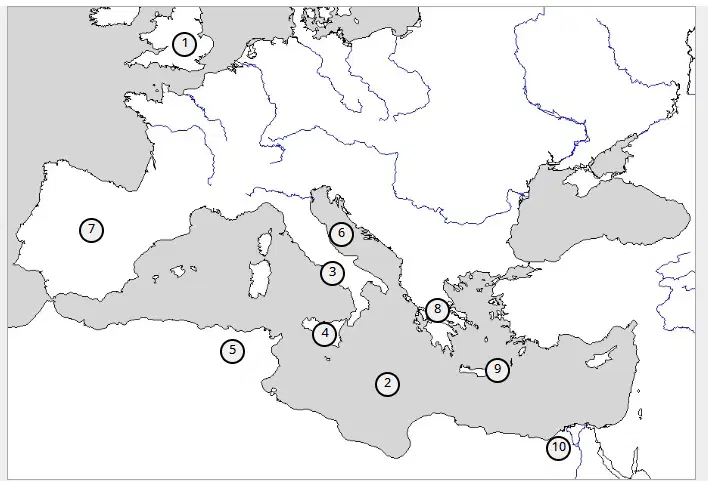
Number 4 on the map is
a)
Crete
b)
Sicily
c)
Sardinia
d)
Rome
25.
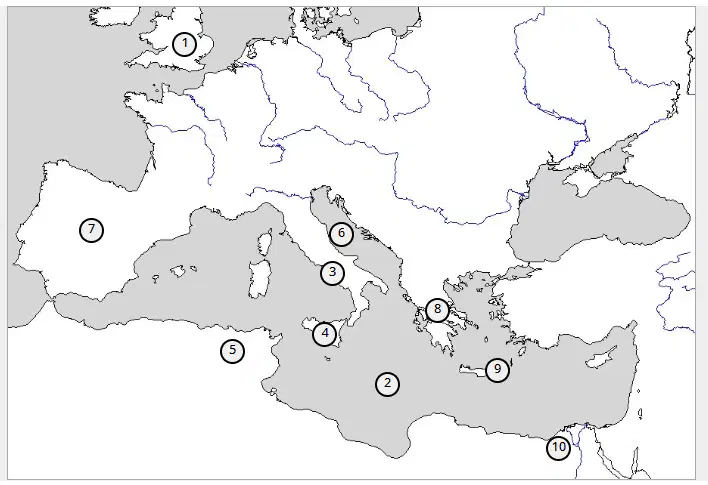
Number 5 on the map is
a)
Crete
b)
Spain
c)
Egypt
d)
Carthage
26.
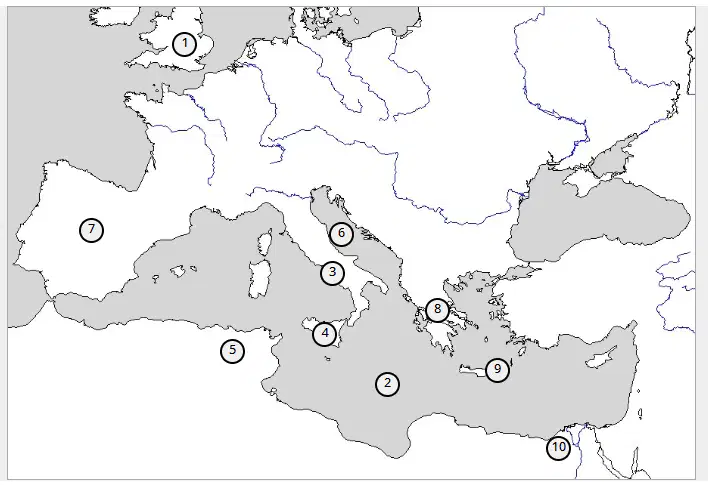
Number 6 on the map is
a)
The Mediterranean Sea
b)
The Tiber River
c)
The Adriatic Sea
d)
The Nile River
27.

Number 7 on the map is
a)
France
b)
Gaul
c)
Spain
d)
Carthage
28.

Number 8 on the map is
a)
France
b)
Greece
c)
Spain
d)
Carthage
29.

Number 9 on the map is
a)
France
b)
Britain
c)
Spain
d)
Crete
30.

Number 10 on the map is
a)
Egypt
b)
Britain
c)
Spain
d)
Crete
31.
Match the term with its correct description
a)
An ordinary Roman citizen
1.
Plebeian
b)
Member of a wealthy family in the ancient Roman Republic.
2.
Patrician
c)
First Roman emperor.
3.
Augustus
d)
General who brought Gaul under Roman control
4.
Julius Caesar
e)
Person who ruled Rome for 6 months during times of crisis.
5.
Dictator
32.
Match the term with its correct description
a)
I Forbi
1.
Veto
b)
Type of government in which citizens select their leaders.
2.
Republic
c)
Roman fighting arena
3.
Colosseum
d)
Romulus built the city along this river.
4.
Tiber
e)
Time of peace and prosperity
5.
Pax Romana
33.
Used by the Romans to bring water into the city.
a)
Arch
b)
Aqueduct
c)
Mosaic
d)
Pax Romana
34.
A curved support structure that distributes weight evenly.
a)
Aqueduct
b)
Arch
c)
Pax Romana
d)
Tiber
100 %

