
 Worksheets
EOC Review PBS Unit 2
Total questions: 48
Worksheet time: 36mins

What are the four main vital signs?
Temperature, pulse, size of pupils, and respirations
Temperature, pain, pulse, and blood pressure
Temperature, pulse, respirations, and blood pressure
Consciousness, temperature, pulse, and respirations
Which of the following is a definition of pulse?
Synapses in the patient's brain that keep blood flowing in the body.
The amount of oxygen being transported to body organs.
The pressure of blood pushing against an artery as the heart beats.
The amount of blood being circulated in the body.
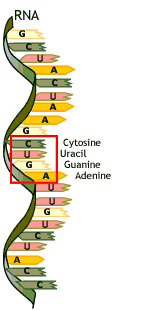
In DNA, adenine bonds with
guanine
cytosine
uracil

The process of creating mRNA from a DNA template is called
translation
transcription
transformation
transduction
A series of three mRNA bases that codes for an amino acid is called a
restriction site
nucleotide
primer

The process of reading mRNA to create a chain of amino acids (protein) is called
translation
transcription
transformation
transduction
This macromolecule is a fat and stores energy as well as making cell membranes.
Nucleic Acids
Carbohydrates
Lipids
Proteins
These macromolecules are a source of quick energy and are commonly known as sugars (like fructose and sucrose).
Nucleic Acids
Proteins
Lipids
Carbohydrates
A glucometer is . . .
wearable, monitors patient vital signs
internal device, monitors blood glucose levels
portable, battery-powered device, delivers insulin
external device, measures blood glucose levels from a fingerstick drop of blood
A CGM (continuous glucose monitoring) is . . .
wearable, monitors patient vital signs
internal device, monitors blood glucose levels
portable, battery-powered device, delivers insulin
external device, measures blood glucose levels from a fingerstick drop of blood

When there is too much glucose in the blood [blank] cells release [blank].
pancreatic, insulin
glycogen, insulin
liver, glycogen
pancreatic, glycogen
What is the difference between type 1 and type 2 diabetes?
Type 2 does not produce insulin.
Type 2 does not produce glucose.
Type 1 does not produce insulin.
Type 2 does produce glucose.
When there is too little glucose in the blood, the __________ releases ___________ which causes glucose to be released from the stored glycogen in the liver.
liver, glucagon
pancreas, insulin
pancreas, glucagon
liver, insulin
Which component of blood is responsible for carrying oxygen?
plasma
erythrocytes
thrombocytes
leukocytes
A feedback loop where the body stops an action
opposite
neutral
positive
negative
A feedback loop where the body continues an action
opposite
neutral
positive
negative
Leukemia is a type of cancer. It is caused by.....
Abnormally high platelet count
Abnormal red blood cell shape
Abnormal number of white blood cells
Abnormal bleeding
What are erythrocytes also called?
Red Blood Cells
White Blood Cells
Platelets
Plasma
What are leukocytes also called?
Red Blood Cells
White Blood Cells
Platelets
Plasma
What are thrombocytes also called?
Red Blood Cells
White Blood Cells
Platelets
Plasma
Insertion, deletion, and substitution are all examples of a change in a genetic sequence which is also referred to as (a)
Gene
Amino Acid
Ribose
Mutation
During transcription, this type of ribonucleic acid is responsible for copying the DNA and brining it out of the nucleus.
tRNA
mRNA
rRNA
dRNA
Which of the following is the complementary mRNA sequence to this DNA strand: AACTGAA
UUGACUU
TTGACTT
AACTGAA
AACUGAA
GTAGTCA

AGU

How many amino acids are coded for by this sequence of nucleotides:
ATG GGA ACT CCA
4
2
6
3


Adenine & Guanine are known as:
purines
pyrimidines
nucleic acids
amino acids

Chromatid
Chromosome
Centromere
trisomy
translocation
inversion
deletion
Full set of chromosomes of a cell arranged with respect to size, shape, and number.
chromatin
karyotype
phenotype
genotype

