
 Worksheets
Nervous System Unit Test
Total questions: 40
Worksheet time: 28mins

What is a Neuron?
A integumentary cell.
A transmitter to transmit messages to cells .
A vessel that brings oxygen-rich blood from your heart to all of your body's cells.
A gland.
What are the two divisions of the nervous system?
Peripheral and Autonomic nervous systems
Central and Peripheral nervous systems
Central and Somatic nervous systems
Sympathetic and Parasympathetic nervous systems
Brain and Spinal cord
Cranial and Spinal nerves
Sensory and Motor systems
Sympathetic and Parasympathetic systems
Which part of the Peripheral Nervous System (PNS) controls involuntary actions?
Autonomic Nervous System
Somatic Nervous System
Organic Nervous System
Reflexive Nervous System
What kind of neuron carries information from our eyes to our brain?
Motor neuron
Sensory neuron
Nerve
Spinal neuron
These neuron processes transmit information from the sensory organs to the central nervous system.
Efferent
Afferent
Sensory neuron
Motor neuron
Interneuron
Afferent neuron
Which part of the nervous system is responsible for the 'fight or flight' response?
Central Nervous System
Somatic Nervous System
Autonomic Nervous System
Parasympathetic Nervous System
Sympathetic and Parasympathetic responses are part of the ____ nervous system.
Somatic
Autonomic
Peripheral
Central
Which system allows the body to conserve energy and is responsible for digestion and urination?
Sympathetic
Limbic
Parasympathetic
Periphreal
The _____ part of the autonomic nervous system is active during resting and digesting.
Sympathetic
Parasympathetic
Peripheral
Central
What does the axon carry?
Impulses away from the cell body.
Impulses to the cell body.
Oxygen to the cell body.
Oxygen away from the cell body.

What does the letter "A" represent for the neuron pictured?

What part of the neuron is "C"?

What part of the neuron is "D"?

What part of the neuron is 4?
Dendrite
Axon terminal
Soma (Cell body)
Myelin sheath

What part of the neuron is 5?
Soma (Cell body)
Dendrite
Axon terminal
Myelin sheath
Soma
The speed of neural conduction between neurons will result in difficulties in speaking, vision, and balance if the ________________ insulating the axons is damaged or removed.
axon
myelin sheath
dendrite
some (cell body)

Which numbers on the graph represents the Resting Potential?


At which stage does Depolarization occur?
1
2
4
5

Which one of the following is the correct sequence of stages for an action potential impulse?
1. The cell membrane becomes depolarized.
2. Sodium channels open and sodium ions diffuse in to the cell.
3. The cell membrane becomes repolarized.
4. Potassium channels open and potassium ions diffuse out of the cell.
3, 2, 4, 1
2, 1, 4, 3
2, 1, 3, 4
1, 2, 4, 3
4, 1, 3, 2
The depolarization of the neuron.
The repolarization of the neuron.
The replacement of potassium ions with sodium ions.
The replacement of potassium ions with calcium ions.
In order to help maintain membrane potential 3 sodium ions can move out of the cell, while 2 potassium ions can enter the cell for each sodium-potassium pump. If you wanted to move 6 potassium ions into the cell, how many pumps would you need?
1
2
3
6

Brain stem
Spinal cord

Brain stem
Spinal cord


Identify the lobe of the brain that is highlighted.
Frontal
Temporal
Occipital
Parietal

Frontal
Temporal
Occipital
Parietal
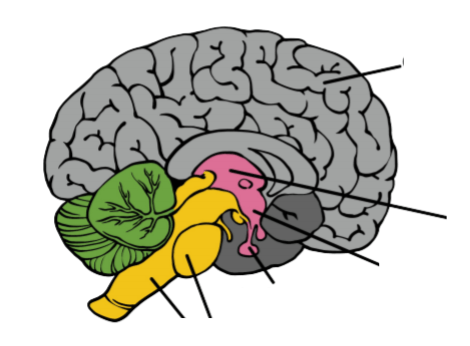
What structure is yellow in this picture. It controls movement of information from brain to rest of body.
Cerebrum
Cerebellum
Brain Stem
What is the largest part of the brain?
Brain stem
Cerebellum
Cerebrum
Pons
myelinated; phosphorylated.
unmyelinated; myelinated.
myelinated; unmyelinated.
phosphorylated; myelinated.
Which structure are the right and left hemispheres of the brain connected by?
Associated fibers
Cerebellum
Corpus callosum
Cerebrum
Frontal lobe
Parietal lobe
Temporal lobe
Occipital lobe
What does Medulla Oblongata control?
Vision and Speech
Hearing
Heart rate and Blood pressure
Respiration
Which brain structure is responsible for fear and anxiety?
Hippocampus
Pons
Midbrain
Amygdala
Which brain structure changes short-term memory to long-term memory?
Hippocampus
Pons
Midbrain
Amygdala
What is known as the "little brain", is attached to the rear of the brain stem, and functions to help you maintain coordination and balance?
Cerebrum
Cerebellum
Corpus callosum
Hypothalamus

