
 Worksheets
Electricity and Electric Charges Quiz
Total questions: 27
Worksheet time: 34mins
What happens when a rubber rod is rubbed with a piece of fur, giving it a negative charge?
Protons are removed from the rod.
Electrons are added to the rod.
Electrons are added to the fur.
The fur is left neutral.
A repelling force occurs between two charged objects when the charges are of
unlike signs.
like signs.
equal magnitude.
unequal magnitude.
Electric charge is
found only in a conductor.
conserved.
found only in insulators.
not conserved.
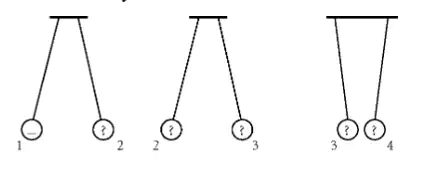
In the diagram shown, the circles represent small balls that have electric charges. Ball 1 has a negative charge, and ball 2 is repelled by ball 1. Next, you see that ball 2 repels ball 3 and that ball 3 attracts ball 4. What is the electric charge on ball 4?
Ball 4 may have either a positive or negative charge.
Ball 4 has a negative charge.
Ball 4 has a positive charge.
It is not possible to determine the charge on ball 4.
The process of charging a conductor by bringing it near another charged object and then grounding the conductor is called
contact charging.
induction.
polarization.
neutralization.
Electric field strength depends on
charge and distance.
charge and mass.
Coulomb constant and mass.
elementary charge and radius.
When an object loses electrons, it acquires a ________ electric charge.
negative
neutral
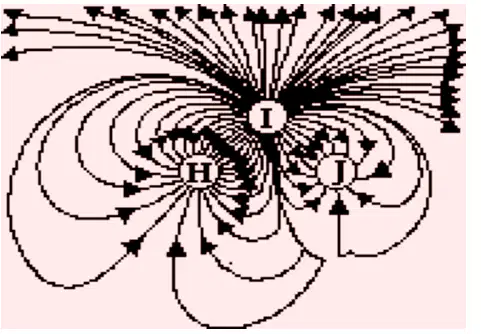
Which charge(s) are negative?
H
I
J
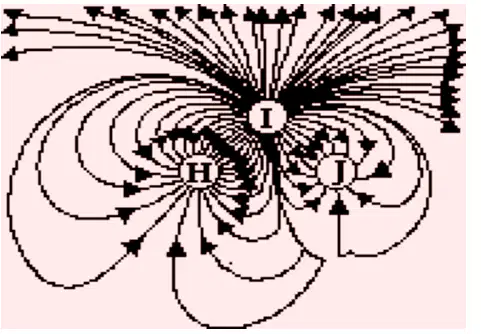
Which charge has the greatest magnitude?
H
I
J
What is the charge of 2.69e+019 electrons?
What is the charge of 2.37e+019 protons?
How many excess protons are in 2.9 C of charge?
How many excess electrons are in –5.4 C of charge?
What is the SI unit for charge?
Amperes per second
Amperes
Voltage
Coulomb
In the Equation of Coulomb's Law F=r2k⋅q1⋅q2 , what does q1 or q2 represent?
Electrical Force
Coulomb's Constant
8.9875⋅109 kgm3s−2C−2
Coulombs of Charge on a given particle or object
Radius between two charged particles
Hair Combs
In the Equation of Coulomb's Law F=r2k⋅q1⋅q2 , what does k represent?
Electrical Force
Coulomb's Constant
8.9875⋅109 kgm3s−2C−2
Coulombs of Charge on a given particle or object
Radius between two charged particles
Hair Combs
When an object gains electrons it becomes __________
Neutral
Positively charged
Negatively charged
Which statement is true of a positively charged object?
Positively charged objects do not contain any electrons.
Positively charged objects do not contain neutrons or electrons.
There is a lack of electrons on a positively charged object.
The protons and the electrons are both positively charged on such objects.
What is the value of the elementary charge (e)?
1.6E-19 C
-1.6E-19 C
+1 C
-1 C

Based on the arrangement of the electric field lines in the diagram, what are the charges?
both charges are the same
the charges are opposite
they are neutral; no charge
What is the electric force between a 2.5 C charge and a negative 1 C charge when they are separated by a distance of 20 m?
1,125,000,000 N
56,250,000 N
0.125 N
0.00625 N
Which of the following is the correct expression for electric field intensity, E , at a point in space?
E=qF
E=F⋅q
E=Fq
E=q2F

