
 Worksheets
Earth Science - Dynamic Earth Unit 5
Total questions: 55
Worksheet time: 35mins
the hypothesis that a single large landmass broke up into smaller land masses to form the continents, which then drifted to their present locations
(a)
the boundary between tectonic plates that are colliding
(a)
the boundary between two tectonic plates that are moving away from one another
(a)
a movement or trembling of the ground that is caused by a sudden release of energy when rocks along a fault move; vibrations of earth's crust
(a)
the theory that explains how large pieces of the lithosphere, called plates, move and change shape; modern day continental drift theory
(a)
an elastic wave in the earth produce by an earthquake
(a)
the boundary between tectonic plates that are sliding past each other horizontally
(a)
any activity that includes movement of magma toward or onto Earth's surface
(a)
continental drift
the hypothesis that a single large landmass broke up into smaller landmasses to form continents, which then drifted to their present locations
the theory that explains how large pieces of the lithosphere move and change shape
a volcanically active area of Earth's surface, commonly far from tectonic boundary
vibrations of earth's crust
convergent boundary
the boundary between tectonic plates that are colliding
the boundary between two tectonic plates that are moving away from one another
the boundary between tectonic plates that are sliding past each other horizontally
divergent boundary
the boundary between tectonic plates that are colliding
the boundary between two tectonic plates that are moving away from one another
the boundary between tectonic plates that are sliding past each other horizontally
transform boundary
the boundary between tectonic plates that are colliding
the boundary between two tectonic plates that are moving away from one another
the boundary between tectonic plates that are sliding past each other horizontally
earthquakes
a movement or trembling of the ground that is caused by a sudden release of energy when rocks along a fault line move
vibrations of Earth's crust
any activity that includes the movement of magma towards or onto Earth's surface
an elastic wave in the earth produce by an earthquake
seismic waves
a movement or trembling of the ground that is caused by a sudden release of energy when rocks along a fault line move
vibrations of Earth's crust
any activity that includes the movement of magma towards or onto Earth's surface
an elastic wave in the earth produce by an earthquake
volcanism
a movement or trembling of the ground that is caused by a sudden release of energy when rocks along a fault line move
vibrations of Earth's crust
any activity that includes the movement of magma towards or onto Earth's surface
an elastic wave in the earth produce by an earthquake
plate tectonics
the theory that explains how large pieces of the lithosphere, called plates, move and change shape
modern day continental drift theory
the hypothesis that a single large landmass broke up into smaller landmasses to form the continents, which then drifted to their present locations
movement of continents
modern day continental drift theory
plate tectonics
pangaea
plate boundaries
continental drift
developer of the continental drift theory
Alfered Wegener
Albert Einstein
Coach Stempihar
Hippocrates
pacific ring of fire
major earthquake zone
not a major earthquake zone
mid-ocean ridges
major earthquake zone
not a major earthquake zone
eurasian-melanesian mountain belt
major earthquake zone
not a major earthquake zone
atlantic ring of fire
major earthquake zone
not a major earthquake zone
the North American, South American, Pacific, African, Eurasian, Australian-Indian, Antarctic plates account for what percentage of Earth's surface?
94%
100%
71%
50%
choose which of the following plates are NOT major plates accounting for the majority of earth's surface
scotia
caribbean
filipino
juan de fuca
eurasian
pushes rock together
compression
tension
shearing
pulls rock apart
compression
tension
shearing
can causes masses of rock to slip
compression
tension
shearing

the downward movement of a plate into the mantle
convergent boudnary
divergent boundary
transform boundary
subduction zone
continental crust is more dense than oceanic crust.
true
false
name of the supercontinent hypothesized by Alfered Wegener
(a)

which type of plate boundary is shown?
convergent
divergent
transform
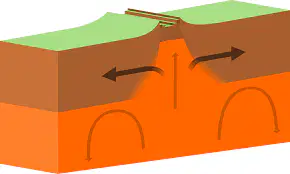
which type of plate boundary is shown?
convergent
divergent
transform

which type of plate boundary is shown?
convergent
divergent
transform
the friction of plates sliding past one another at transform boundaries can cause
earthquakes
seafloor spreading
erosion
volcano formation
elastic rebound theory
rocks are held/locked in place by friction on either side of a fault, when deformation exceeds frictional force holding rocks together, a sudden slip occurs along the fault
states that when the stress in rocks becomes so great, they fracture, separate, and spring back to their original state
occur when rock under stress suddenly shifts along a fault
forces that can change the size and shape of rocks
hypocenter refers to
focus
epicenter
fault line
seismic wave
the place inside earth's crust where an earthquake originates
epicenter
fault
hypocenter
focus
the point on Earth's surface directly above an earthquake's focus (starting point)
focus
hypocenter
epicenter
fault
vibration generated by an earthquake, explosion, or similar energetic source and propagated within the Earth and along its surface
seismic waves
seismograph
earthquakes
volcanism
body waves
p-waves
s-waves
love waves
rayleigh waves
surface waves
p-waves
s-waves
love waves
rayleigh waves
(a) -focus earthquakes cause more damage due to the energy present at the surface
p-waves
compression waves; fastest waves, particles move back and forth in the direction of the wave and are the first recorded waves on the seismograph -- these waves can travel through all 3 states of matter
second recorded waves on seismograph; can only travel through solid material; these waves move in a side-to-side direction perpendicular to the direction of the wave
slowest moving waves; waves are destructive when traveling through loose earth, due to the rising and falling of the crust
surface waves
compression waves; fastest waves, particles move back and forth in the direction of the wave and are the first recorded waves on the seismograph -- these waves can travel through all 3 states of matter
second recorded waves on seismograph; can only travel through solid material; these waves move in a side-to-side direction perpendicular to the direction of the wave
slowest moving waves; waves are destructive when traveling through loose earth, due to the rising and falling of the crust
s-waves
compression waves; fastest waves, particles move back and forth in the direction of the wave and are the first recorded waves on the seismograph -- these waves can travel through all 3 states of matter
second recorded waves on seismograph; can only travel through solid material; these waves move in a side-to-side direction perpendicular to the direction of the wave
slowest moving waves; waves are destructive when traveling through loose earth, due to the rising and falling of the crust
collection of magma in a 'pocket' beneath the surface
magma chamber
conduit
vent
pipe
magma rises from the chamber through a __________, and reaches the surface through a __________.
conduit, vent
vent, conduit
pipe, conduit
conduit, pipe

A
focus
epicenter
fault
seismic wave
B
focus
epicenter
fault
seismic wave
C
focus
epicenter
fault
seismic wave
What do the dotted lines represent?
focus
epicenter
fault
seismic wave
which scale is more accurate when measuring large scale events (M8+)?
moment magnitude
richter
which is the most accurate way to predict volcanic eruptions?
past eruptions
seismographs
which of the following is NOT a major volcanic landform?
cinder cone
stratovolcano
shield cone
caldera
what are the 3 major cones?
cinder
strato
composite
shield

