
Font size
 Worksheets
ASTRO 100 EXAM 2 REVIEW
Total questions: 130
Worksheet time: 1hrs 12mins
Which of the following statements best characterizes the surface of the planet Mars?
The surface is continuously resurfaced by ongoing volcanic activity; consequently, there are almost no visible impact craters.
There are several moving crustal plates rimmed by long mountain chains, deep subduction trenches, and several large rift valleys.
Eighty percent of the surface is rolling plains, with a number of major volcanoes and only two continent-sized uplands.
All of the big volcanoes are in the northern hemisphere, and most of the craters are in the southern hemisphere.
Which planet, other than Earth, has visible water ice on it?
Venus
Jupiter
the Moon
Mars
Mercury
The average age of the surface of Venus has been determined primarily from
Soil analysis by Russian landers.
The amount of weathering of lava flows imaged by the Magellan radar mapper.
Radio-isotope analysis of rocks brought back from Venus by space probes.
The number of impact craters per unit area of surface.
From center to surface, which of the following correctly lists the interior layers of a terrestrial world?
Core, mantle, crust
Mantle, crust, core
Mantle, core, crust
Core, crust, mantle
Which planet has a ring system?
Uranus
Neptune
Jupiter
Saturn
All of the above
What do we mean by accretion in the context of planet formation?
The growth of planetesimals from smaller solid particles that collided and stuck together
The formation of moons around planets
The solidification of ices, rocks, and metal from the gas of the solar nebula
The growth of the Sun as the density of gas increased in the center of the solar nebula
The Caloris Basin on Mercury covers a large region of the planet, but few smaller craters have formed on top of it. From this we conclude that
Only very large impactors hit Mercury's surface in the past.
The Caloris Basin was formed by a volcano.
Erosion destroyed the smaller craters that formed on the basin.
Mercury's atmosphere prevented smaller objects from hitting the surface.
The Caloris Basin formed toward the end of the solar system's period of heavy bombardment.
What is the Great Red Spot?
A region on Jupiter where the temperature is so high that the gas glows with red visible light
A hurricane that comes and goes on Jupiter
A long-lived, high-pressure storm on Jupiter
A place where reddish particles from Io impact Jupiter's surface
Why does increasing the amount a greenhouse gas increase the temperature of a planet?
Greenhouse gases emit visible light.
Greenhouse gases absorb visible light.
Greenhouse gases emit infrared light.
Greenhouse gases absorb infrared light.
What do we mean when we say that the terrestrial worlds underwent differentiation?
They lost interior heat to outer space.
The five terrestrial worlds all started similarly but ended up looking quite different.
When their interiors were molten, denser materials sank toward their centers and lighter materials rose toward their surfaces
Their surfaces show a variety of different geological features resulting from different geological processes.
Planet closest in size Earth is
Venus
the Moon
Mercury
Pluto
Mars
In which of the following physical characteristics are the Earth and Mars most similar to each other?
Number of moons
Length of solar day
Total mass
Planetary diameter
According to modern scientific dating techniques, approximately how old is the solar system?
14 billion years
10,000 years
4.6 billion years
4.6 million years
The planet in our solar system with the highest average surface temperature is ________.
Neptune
Venus
Mercury
Earth
How do asteroids differ from comets?
Asteroids and comets are both made of rocky and icy material, but asteroids are smaller in size than comets.
Asteroids are made of rocky material. Comets are made of icy material.
Asteroids are made of icy material. Comets are made of rocky material.
Asteroids and comets are both made of rocky and icy material, but asteroids are larger in size than comets.
According to current evidence, Pluto is best explained as ________.
A very small Jovian planet
A terrestrial planet that is surprisingly far from the Sun
An escaped moon of Jupiter or Saturn
A large member of the Kuiper Belt
Which of the following signs of water is NOT seen on Mars?
Evidence of permafrost under the Martian surface
Water ice (as opposed to carbon dioxide ice) in the polar caps
Occasional clouds around the large volcanoes
Melt-water pools at the edges of the polar caps
What do we mean by the period of heavy bombardment in the context of the history of our solar system?
The first few hundred million years after the planets formed, which is when most impact craters were formed
The time during which heavy elements condensed into rock and metal in the solar nebula
The time before planetesimals finished accreting into planets, during which many growing planetesimals must have shattered in collisions
The period about 65 million years ago when an impact is thought to have led to the extinction of the dinosaurs
Which of the following is not a general characteristic of the four jovian planets in our solar system?
They are higher in average density than are the terrestrial planets.
They are much more massive than any of the terrestrial planets.
They are composed mainly of hydrogen, helium, and hydrogen compounds.
They lack solid surfaces.
What observational evidence supports the idea that Mercury once shrank by some 20 kilometers in radius?
The presence of many long, tall cliffs
The presence of many impact craters
Mercury's unusually high density
The characteristics of the Caloris Basin
A rock found on Earth that crashed down from space is called ________
An impact
A meteor
A meteorite
An asteroid
Why do some scientists think that comets aren't solely responsible for giving the earth it's oceans or drinking water?
There aren't enough comets in the solar system to give us enough water.
It's impossible for a comet to hit earth
Comets are not ice-water rich
Deuterium isotopes in the water of comets are different from the water found on Earth.
Where are most of the known asteroids found?
In the Kuiper belt
Between the orbits of the Jovian planets
In the Oort cloud
Between the orbits of Mars and Jupiter
Between the orbits of the terrestrial planets
Which of the following best describes the lunar maria?
Mountainous regions on the Moon
Relatively smooth, flat plains on the Moon
Frozen oceans of liquid water on the Moon
Densely cratered regions on the Moon
The processes responsible for virtually all surface geology are ________.
Impact cratering, volcanisms, tectonics, and erosion
Eruptions, lava flows, and outgassing
Convection, conduction, and radiation
Accretion, differentiation, and radioactive decay
The two most important processes in heating the interiors of the terrestrial worlds are:
(1) heat deposited by the process of formation; (2) heat that came from the gravitational potential energy of incoming planetesimals.
(1) heat from convection; (2) heat from thermal radiation.
(1) volcanism; (2) tectonics.
(1) heat deposited by the process of formation; (2) heat released by radioactive decay.
The Huygens probe took numerous pictures as it descended to Titan's surface in 2005. What did the pictures show?
Features or erosion, including what appeared to be dry river valleys and lakebeds
Primitive life forms
A densely cratered surface
Lava flows of molten basalt
What are the main constituents of the jovian planets?
Ammonia and water
Rocky minerals and water, as on Earth
Ammonia and methane
Hydrogen and helium
Nitrogen and methane
What do we mean by the frost line when we discuss the formation of planets in the solar nebula?
It marks the special distance from the Sun at which hydrogen compounds become abundant; closer to the Sun, there are no hydrogen compounds.
It is another way of stating the temperature at which water freezes into ice.
It is the altitude in a planet's atmosphere at which snow can form.
It is a circle at a particular distance from the Sun, beyond which the temperature was low enough for ices to condense.
What atmospheric constituent is responsible for the blue color of Uranus and Neptune?
Hydrogen
Water
Methane
Ammonia
A typical shooting star in a meteor shower is caused by a ________ entering Earth's atmosphere.
Pea-size particle from an asteroid
Boulder-size particle from an asteroid
Microscopic particle of interstellar dust
Boulder-size particle from a comet
Pea-size particle from a comet
The largest asteroid, and probably the only one to be a spherical "world" is
Gaspra
Eros
Ida
Vesta
Ceres
In what ways is Earth different from the other terrestrial planets?
It has oxygen in its atmosphere.
Life can be found almost everywhere.
Most of its surface is covered with liquid water.
Its crust is broken into plates that move around.
All of the above
Olympus Mons is ________.
Huge stratovolcano on Venus
Great canyon on Mars
Large lava plain on the Moon
Huge shield volcano on Mars
Which moon is considered likely to have a deep, subsurface ocean of liquid water?
Triton
Miranda
lo
Europa
The tall of a comet always points
In the direction of the comet's motion.
Toward Earth and never varies.
Away from the Sun and disappears at perihelion.
Away from the Sun and becomes longest and brightest at perihelion.
Toward the Sun and disappears at perihelion.
Why do asteroids and comets differ in composition?
Comets formed from the jovian nebula, while asteroids did not.
Asteroids formed inside the frost line, while comets formed outside.
Comets are much larger than asteroids.
Asteroids are much larger than comets.
Asteroids and comets formed at different times.
According to our theory of solar system formation, what are asteroids and comets?
Chunks of rock or ice that condensed after the planets and moons finished forming
The shattered remains of collisions between planets
Chunks of rock or ice that were expelled from planets by volcanoes
Leftover planetesimals that never accreted into planets
Which of the following is not a characteristic of the inner planets?
They all have substantial atmospheres.
Their orbits are relatively closely spaced.
They all have solid, rocky surfaces.
They have very few, if any, satellites.
They are relatively smaller than the outer planets.
Which two geological processes appear to have been most important in shaping the present surface of Venus?
Volcanoes and tectonics
Impacts and volcanoes
Volcanoes and erosion
Tectonics and erosion
Impacts and tectonics
Suppose you view the solar system from high above Earth's North Pole. Which of the following statements about planetary orbits will be true?
All the planets except Uranus orbit the Sun counterclockwise; Uranus orbits in the opposite direction.
All the planets orbit counterclockwise around the Sun
The inner planets orbit the Sun clockwise while the outer planets orbit the Sun counterclockwise.
The inner planets orbit the Sun counterclockwise while the outer planets orbit the Sun clockwise.
What is Eris?
An extrasolar planet ejected by another solar system and captured by ours
A moon of Pluto
The largest known asteroid
An icy object that orbits in the Kuiper belt about the same size as Pluto
Suppose you could float in space just a few meters above Saturn's rings. What would you see as you looked down on the rings?
Countless icy particles, ranging in size from dust grains to large boulders
A solid, shiny surface, looking much like a piece of a DVD but a lot bigger
Nothing up close; the rings would be so completely invisible that you'd have no way to know they are there. They can be seen only from a distance.
Dozens of large "moonlets" made of metal and rock, each a few kilometers across
Of the four gases CO2, H2O, N2, and O2, which are greenhouse gases?
Only CO2
All four
CO2 and H2O
CO2 and N2
All except O2
What is the main reason Venus is so much hotter than the Earth?
Because it is closer to the Sun
Because it has much more carbon dioxide in its atmosphere
Because it rotates backwards compared to its orbital rotation
Because its clouds have a very high reflectivity
Why are there no impact craters on the surface of Io?
It is too small to have been bombarded by planetesimals in the early solar system.
Any craters that existed have been eroded through the strong winds on Io's surface.
Io's thick atmosphere obscures the view of the craters.
Io did have impact craters but they have all been buried in lava flows.
Jupiter's strong gravity attracted the planetesimals more strongly than Io and thus none landed on its surface.
Which of the following statements is not true?
Objects in the asteroid belt are made mostly of rock and metal.
Objects in the Kuiper belt are made mostly of rock and metal.
Objects in the Oort cloud contain large proportions of ice.
Objects in the asteroid and Kuiper belts orbit the Sun in nearly the same plane as the planets, but objects in the Oort cloud do not.
If Saturn takes about 30 years to orbit the Sun, and its rings were seen edge-on in 2009, when will they appear edge-on next?
2015
2019
2039
2024
2012
Suppose you start with 1 kilogram of a radioactive substance that has a half-life of 10 years. Which of the following statements will be true after 20 years have passed?
You'll have 0.25 kilogram of the radioactive substance remaining.
All the material will have completely decayed.
You'll have 0.75 kilogram of the radioactive substance remaining.
You'll have 0.5 kilogram of the radioactive substance remaining.
When we see a region of a planet that is not as heavily cratered as other regions, we conclude that
The planet formed after the age of bombardment and missed out on getting hit by leftover planetesimals.
The planet is rotating very slowly and only one side was hit by impactors.
The surface in the region is older than the surface in more heavily cratered regions.
The surface in the region is younger than the surface in more heavily cratered regions.
There is little volcanic activity to create craters.
Compared to a star in the middle of the Hertzsprung-Russell diagram, a star in the upper right part of the diagram is
Fainter
Hotter
Larger
Nonexistent because there are no stars that appear in the upper right part of the diagram
Two stars have the same luminosity. One star is spectral class B and the other is spectral class K. From this information, we know that
K-type star is larger than the B-type star
B-type star is larger than the K-type star.
B-type star is hotter but can be larger, smaller, or the same size as the K-type star.
K-type star is hotter but can be larger, smaller, or the same size as the B-type star.
Suppose that two identical stars (having the same total light output) are located such that star A is at a distance of 5 light years and star B is at a distance of 25 light years. How will star B appear, compared to star A?
Star B will be 1/5 as bright as star A.
Star B will be 1/25 as bright as star A.
Star B will be 1/2.2 as bright as star A.
Star B will be 1/20 as bright as star A.
What process provides the power for the Sun?
Fusion of helium into carbon
Fission of uranium to form lead
Emission of neutrinos
Fusion of hydrogen into helium
Spectral lines are of particular importance in astronomy because
Each different element has a characteristic line spectrum.
Such lines can be observed through a diffraction grating.
They are the only light bright enough to be seen over long distances.
Only stars produce bright line spectra.
What is the dominant mechanism by which energy is transported through the inner regions of the Sun?
By hotter gas rising and cooler gas falling (convective transport of energy)
By photons (radiative transport of energy)
By neutrinos streaming outward through the Sun's material (particle transport of energy)
By collisions of faster-moving particles with slower-moving particles (conductive transport of energy)
Suppose a large solar flare is detected in visible light. How long until radio interference arrives?
About four days
Simultaneously
No relation between the two
8 minutes
12 hours later
How much longer can the Sun continue to generate energy by nuclear reactions in its core?
About 5 million years
About 50 billion years
About 500,000 years
About 5 billion years
Which of the following letters representing spectral classification signifies the hottest stellar surface temperature?
G
A
K
B
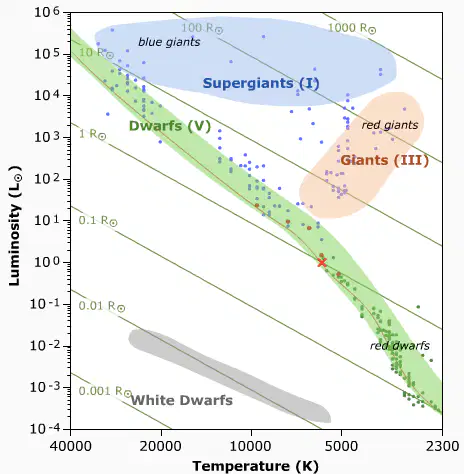
A red supergiant star is found to have a surface temperature of 2,500 K and a luminosity 100,000 times that of the Sun. Use the Hertzsprung-Russell diagram to determine its approximate radius, compared to that of the Sun.
About 10x larger
About 100x larger
About 1,000x larger
Almost the same
The spectral class of the star Enif is K, while that of the Sun is G. Which of the following conclusions can be drawn about Enif from this information?
It is intrinsically fainter than the Sun
It is intrinsically brighter than the Sun.
It is cooler than the Sun.
It is hotter than the Sun.
Sirius, in Canis Major (the large hunting dog of Orion), is the brightest star in the winter night sky. It has a parallax angle of 0.38 arc seconds. Orion's other hunting dog, Canis Minor, has as its brightest star Procyon, with a parallax angle of 0.29 arc seconds. Vega, in Lyra the Lyre (Harp), is the brightest star in the summer night sky. It has a parallax angle of 0.13 arc seconds. Which of these stars is farthest away?
Sirius
Procyon
Vega
It cannot be determined from this information alone.
The spectrum of sunlight, when spread out by a spectrograph, has what characteristic appearance?
A continuous band of color, crossed by innumerable emission lines
A continuous band of color, crossed by innumerable dark absorption lines
A series of separate emission lines, characteristic of many elements, that overlap in certain regions of the spectrum to produce short continuum segments
A continuous and uniform band of color from violet to deep red
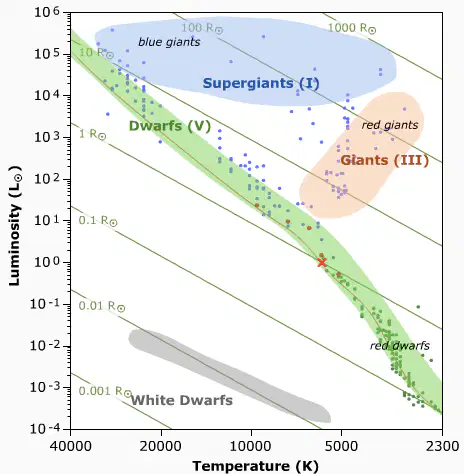
Using the Hertzsprung-Russell diagram , determine which type of star has the following characteristics: A star with surface temperature 10,000 K and luminosity 0.001 times that of the Sun.
Red supergiant
Main sequence
White dwarf
Red giant
The temperature of the outer atmosphere of the Sun
Is very hot, about 10^6 K
about twice as hot as the photosphere, 12,000 K.
Very cool because it is farthest from the heat source.
About the same as that of the photosphere, 5800 K.
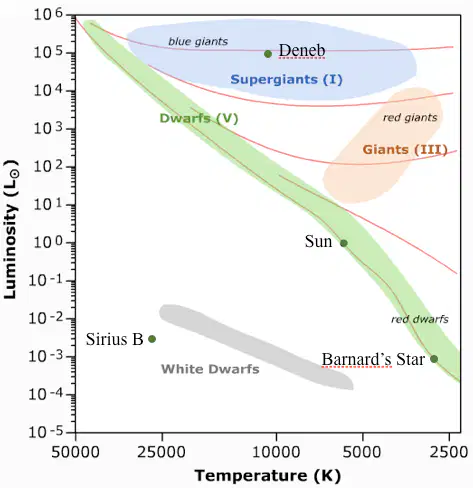
In the Hertzsprung-Russell diagram, which of the following is the correct sequence of stars in order of increasing temperature?
Sirius B, Deneb, Barnard's Star, the Sun
Deneb, the Sun, Sirius B, Barnard's Star
Barnard's Star, The Sun, Deneb, Sirius B
Barnard's Star, Sirius B, the Sun, Deneb
What name is given to the outer atmosphere of the Sun?
Convective Zone
Radiative Zone
Corona
Chromosphere
What causes sunspots?
Magnetic fields below the photosphere pull gas down, creating holes in the photosphere.
Differential rotation on the Sun creates vortices, or eddies, that are cooler and darker than the rest of the solar surface.
Solar flares cause the photosphere to expand and cool in the vicinity of the flare.
Magnetic fields breaking through the photosphere inhibit gas motion where the field is strong.
The photosphere of the Sun is the
Visible surface of the sun
Middle layer of the Sun's atmosphere.
Region of convecting gases below the visible surface of the Sun.
Core of the Sun, where the nuclear energy is generated.
A star in the lower left part of the Hertzsprung-Russell diagram, compared to a star in the middle of the diagram, is
Larger
Cooler
Smaller
Brighter
Measurements indicate that a certain star has a very high intrinsic brightness (100,000 times as bright as our Sun) and yet is relatively cool (3500 K). How can this be?
The star must be quite small.
The star must be very large.
There must be an error in observation because no star can have these properties.
The star must be in the upper part of the main sequence.
How does the number of sunspots on the Sun vary with time?
They vary relatively regularly, with a period of about 11 years.
They vary irregularly, with no periodicity.
They increase and decrease with a precise period of 11.1 years.
They increase for about 11 years and then decrease again over the next 11 years.
The luminosity of a star is a unique measure of its
Total energy output
Velocity of recession away from us
Temperature
Physical size
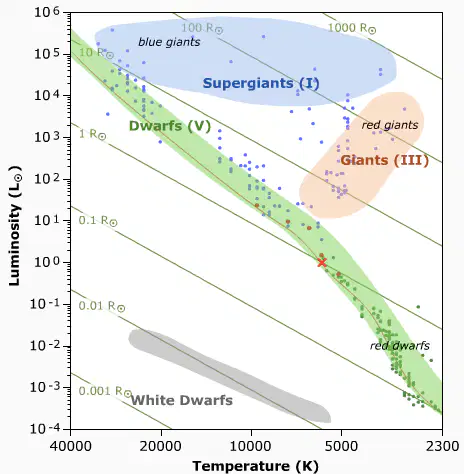
Using the Hertzsprung-Russell diagram, determine which type of star has the following characteristics: Surface temperature of 20,000 K and luminosity 5,000 times that of the Sun.
Cool, red, main-sequence star
Hot, blue, main-sequence star
White dwarf
Red giant
Two stars, P and Q, can be seen in the same region of our sky with the same apparent brightness, but star Q is twice as far away as star P. What is the ratio of the intrinsic brightnesses (luminosities) of these stars (star P-to-star Q)?
4-to-1
2-to-1
1-to-4
1-to-2
Where are the most massive stars to be found in the main sequence of a Hertzsprung-Russell diagram?
Upper-left end
Main-sequence stars all have approximately the same mass, by definition.
In the center
The lower right end
Which of the following particles or types of radiation will provide the most direct information on the energy generation processes that are occurring at the present time in the solar core?
X rays from the solar corona
Protons in the solar wind and from solar flares
Neutrinos
Visible light from the photosphere
The central region of a sunspot is about 1500 K cooler than the surrounding solar photosphere. How will the light from the sunspot compare to the light from the rest of the photosphere?
Both will emit light of the same color and the same intensity (per square meter) because they are both in the photosphere.
The light from the sunspot will be bluer and dimmer.
The light from both will be the same color, but the sunspot will emit less light per square meter.
The light from the sunspot will be redder and dimmer.
How do astronomers measure the masses of stars?
By observing the star's brightness at different wavelengths (colors)
By observing the motion of two stars in a binary star system
By measuring the star's brightness, temperature, and distance
By measuring the star's brightness, and obtaining its radius from its luminosity and temperature
What will be the mass of a star that has a luminosity 1000 times greater than that of the Sun?
100 MSun
5 MSun
0.1 MSun
1000 MSun
A particular star in a binary star system orbits the other in an elliptical orbit with a semimajor axis of 3 AU and a period of 5 years. What is the sum of the masses of the two stars in the system?
Hint: Kepler's Third Law (modified by Newton) is given below.
P2= a3/M1+M2
0.9 MSun
1.1 MSun
13.9 MSun
0.07 MSun
The centers of the granular cells on the surface of the Sun are brighter than the edges of the cells because the
centers are composed of different gases than the edges.
centers are hotter than the edges.
centers are denser than the edges.
centers are cooler than the edges.
How can we characterize the rotation of the Sun?
Differential rotation, with the equator rotating more slowly than the poles
In a banded pattern, with alternating bands of fast and slow rotation to produce the sunspots
Differential rotation, with the equator rotating faster than the poles
Like a solid body, with all parts rotating at the same rate
Atoms in a thin, hot gas (such as a neon advertising sign), emit light
at specific wavelengths or colors, the pattern depending on the element.
only at visible wavelengths.
at all wavelengths, the shape of the continuum spectrum depending on the temperature of the gas.
only at one specific, single wavelength or color.
The average time taken for energy generated in the center of the Sun to reach the surface layers and escape is calculated to be
a few hundred thousand years to 1 million years
about 1 year.
only a few seconds.
about ten million years
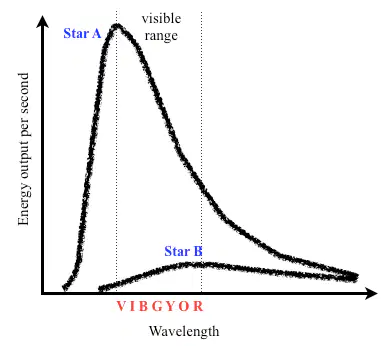
The graph below shows spectral curves for two stars. Which of the statements below best describes how Star A would appear as compared with Star B?
Note: The visible light portion of the spectrum is indicated by the letters "VIBGYOR" (i.e., Violet, Indigo, Blue, Green, Yellow, Orange, Red, which is ROYGBIV backwards).
Star A would appear more red than Star B.
Both stars would appear more red than blue.
Both stars would appear more blue than red.
Star A would appear more blue than Star B.
None of the above.
What are the two physical parameters of stars that are plotted in the Hertzsprung-Russell diagram?
Mass and surface temperature
Luminosity and mass
Radius and mass
Luminosity and surface temperature
What fraction of the stars surrounding the Sun are main-sequence stars?
Almost all of them, about 90%
There are no main-sequence stars close to the Sun
Roughly half of them, about 55%
Very few of them, about 20%
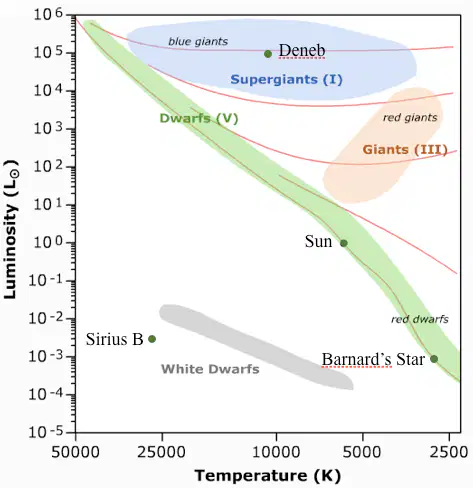
In the Hertzsprung-Russell diagram, which of the following is the correct sequence of stars in order of increasing luminosity?
Deneb, the Sun, Sirius B, Barnard's Star
Sirius B, Deneb, Barnard's Star, the Sun
The Sun, Barnard's Star, Deneb, Sirius B
Barnard's Star, Sirius B, the Sun, Deneb
The granular appearance of the surface of the Sun is evidence of what phenomenon occurring in or on the Sun?
Cells of thermonuclear fusion occuring just under the visible surface
Rapid rotation of the surface layers producing swirls of gas
The concentration and heating of ionized gas by regions of high magnetic fields
Convective motion under the solar surface
If the surface temperatures of white dwarf stars are up to 4 times that of the Sun, why then are white dwarfs intrinsically so faint?
Because they are very small
Because they have very thin atmospheres that do not emit continuum radiation but only line emissions, like a low-density gas
Because they are shrouded in very thick atmospheres
Because they are moving rapidly away from the Sun and their spectra are extremely redshifted, hence they appear faint at visible wavelengths
Solar flares, the violent eruptive events on the Sun, occur most frequently
over single, isolated, but large sunspots.
along the solar equator at positions aligned with Jupiter's position, being caused by tidal disturbance on the Sun.
within solar coronal holes, from which the solar wind originates.
in or above complex sunspot groups.
A white dwarf star is about the same size as
The Sun
Earth
Total solar system
A major city
After a star like the sun fuses all the hydrogen in its core into helium,
it will become a red giant
it will begin fusing hydrogen into helium in a shell around the core.
its core will contract and heat up.
it will leave the main sequence.
all of the above
Why is it that the majority of stars in the sky are in the main-sequence phase of their lives?
Because most stars die at the end of the main-sequence phase
Because this is the longest-lasting phase in each star's life
Because this is the only phase that is common to all stars
Because most stars in the sky were created at about the same time, so these are all in the same phase of their lives
Johannes Kepler observed a supernova about 400 years ago and measurements indicate that this supernova was about 20,000 light years away from the Earth. When did the explosion actually occur?
400 years ago, or about 1600 A.D.
19,600 years ago, or about 17,600 B.C.
20,400 years ago, or about 18,400 B.C.
It is not possible to say when it occurred from the information given.
Why does the core of the Sun contain more helium and less hydrogen than the surface of the Sun?
The hydrogen has been lifted out of the core by the Sun's magnetic field.
Helium is heavier than hydrogen and has sunk toward the center in a process of chemical differentiation.
Helium condenses more easily, so when the Sun was forming the core became helium-rich; vast quantities of hydrogen were added only after the core became massive enough.
Thermonuclear reactions have converted much of the original hydrogen in the core into helium.
The core-collapse phase at the end of the life of a massive star is triggered when
helium flash and thermal pulses have expelled the star's envelope.
density reaches the threshold for electron degeneracy pressure to become important.
nuclear fusion has produced a significant amount of iron in its core.
core becomes as dense as an atomic nucleus.
A black hole is so named because
gravitational field is so high that the wavelength of its emitted light is gravitationally redshifted to radio wavelengths.
it emits no visible light because it is so cold, less than 100 K.
no light can escape from it due to its powerful gravitational field.
it is colder that the rest of the universe; that is, its effective temperature is less than 3 K.
After hydrogen burning ends in a star's core, its position on the Hertzsprung-Russell diagram moves in a direction toward the
Lower right
upper left
Lower left
Upper right
Our Sun will end its life by becoming
a molecular cloud
A black hole
A white dwarf
A pulsar
What is the event horizon of a black hole?
The surface at which any object passing through it will leave with greater energy than it entered
The surface at which all events happen
The infinitesimally small volume at the center of the black hole that contains all of the black hole's mass
The surface from inside of which nothing can escape
What is the last nuclear fusion stage in the life of a low-mass star like the Sun?
Fusion of silicon nuclei to form iron
Fusion of oxygen nuclei to form sulfur
Fusion of helium nuclei to form carbon and oxygen
Fusion of hydrogen nuclei to form helium
How does the temperature of an interstellar cloud affect its ability to form stars?
Higher temperatures help star formation.
Star formation is independent of the temperature of the cloud.
Star formation is too complicated to be able to say how one quantity, such as temperature, affects it.
Colder temperatures help star formation.
I always thought nothing could escape from a black hole, yet astronomers are locating black hole candidates by the X rays they emit. How can X rays be coming from a black hole?
The X rays come from a highly compressed region in an accretion disk outside the event horizon of the black hole.
X rays are not light or matter and can therefore escape from inside the black hole.
If the black hole is rotating, it modifies spacetime around it so much that particles and X rays are created in the vacuum just outside the event horizon.
The X rays are produced by vibrations of the black hole itself and therefore do not come from inside the black hole.
What happens to the surface of a low-mass star after the helium core and shell fusion stages are completed?
It stabilizes at the size of a red giant star, radiation pressure from below balancing gravity from the core, and will slowly cool for the rest of its life.
It is spun off into space to make a spiral structure known as a spiral galaxy.
It is propelled slowly away from the core to form a planetary nebula.
It contracts back onto the core and becomes hot enough to undergo further hydrogen fusion, leading to a very hot and active white dwarf star.
What is a pulsar?
Very hot material orbiting a black hole
A Cepheid variable star with a period of a few days
A pulsating white dwarf star, fluctuating rapidly in brightness
A rapidly rotating neutron star, producing beams of radio energy and occasionally of X rays and visible light
Of all the low-mass red dwarfs (0.08 MSun < M < 0.4 MSun) that have formed since the Universe came into being 14 billion years ago, how many of them are presently on the main sequence?
None of them
A few, less than 20%
Most of them, more than 80%
All of them
Approximately what fraction of its main-sequence lifetime has the Sun completed at the present time?
1/4
Less than 10%
1/2
3/4
Suppose you were far from a planet that had a very strong gravitational field, and an emission line spectrum source on the surface of the planet. When you observe a similar source in your own spaceship, the wavelength of the light is 656.3 nm. What wavelength do you see when you look at the light source on the planet?
Shorter than 656.3 nm
Longer than 656.3 nm
Infinite wavelength since the source is in a gravitational field
656.3 nm, the same as from your light source
The explosion of a supernova appears to leave behind
a rapidly expanding shell of gas and a central neutron star or black hole.
a rapidly rotating shell of gas, dust, and radiation, but no central object.
a rapidly expanding shell of gas and a compact white dwarf star at its center.
nothing; the explosion changes all the matter completely into energy, which then radiates into space at the speed of light.
Why are pulsars not observed inside all supernova remnants?
All supernova remnants do contain pulsars.
Some supernova explosions form white dwarfs instead of the neutron stars necessary for pulsars.
Pulsars slow down and quit producing the pulses in a very short amount of time, before the supernova remnant dissipates.
The pulsar may be tipped so that the beams do not sweep past Earth.
Where does gold (the element) come from?
it is produced during the late stages of core fusion in low-mass stars
it is produced during the late stages of core fusion in high-mass stars
it is produced during the supernova explosions of high-mass stars
it was produced during the Big Bang
Black holes are formed by
lack of any light in a region of space.
supernovae from the most massive stars
supernovae from binary stars.
collapsed dark nebulae.
Giant and supergiant stars are rare because
they do not form as often as main sequence stars.
the giant and supergiant stage is unstable.
the giant and supergiant stage is short compared to the main-sequence stage.
Helium is very rare
supernovae destroy many of the stars before they can become giants and supergiants
How do the stars in a star cluster change with time?
All stars in it evolve at the same rate.
The stars with the greatest heavy-element content evolve the most quickly.
The lowest-mass stars evolve the most quickly.
The highest-mass stars evolve the most quickly.
How do astronomers know that globular clusters are very old?
Their stars have a high abundance of heavy elements.
There are no massive main-sequence stars in globular clusters.
They do not contain any red giant stars.
There are no main-sequence stars in globular clusters.
Which of the following lists, in the correct order, a possible evolutionary path for a star?
Red Giant, Neutron Star, White Dwarf, Nothing
Red Giant, Supernova, Black Hole, Nothing
Red Giant, Supernova, Planetary Nebula, Neutron Star
Red Giant, Planetary Nebula, White Dwarf
Red Giant, Planetary Nebula, Black Hole
A sequence of thermonuclear fusion processes inside massive stars can continue to transform the nuclei of elements such as carbon, oxygen, etc., into heavier nuclei AND also generate excess energy up to a limit beyond which no further energy-producing reactions can occur. The element that is produced when this limit is reached is
Oxygen
Iron
Silicon
Uranium
What major physical process is taking place inside stars that are on the main sequence in the Hertzsprung-Russell diagram?
Hydrogen is being converted to helium in their cores.
Uranium is being split by fission into smaller atoms in their cores.
Helium is being converted to carbon in their cores.
The gas is contracting gravitationally without nuclear reactions taking place.
Where are the most massive stars to be found in the main sequence of a Hertzsprung-Russell diagram?
The upper left end
Main-sequence stars all have approximately the same mass, by definition.
In the center
The lower right end
If you were watching a friend (or better still, an enemy!) who has fallen as far as the event horizon of a black hole, what would you measure as his heartbeat (apart from the effects caused by his adrenaline level)?
It would appear to have slowed down somewhat, but not much, because of the change of the speed of light in the gravity field.
It would appear to be zero; his heart would appear to have stopped.
It would appear to have sped up to an incredible rate.
It would appear to be normal since gravity has no effect on time intervals.
Suppose you were far from a planet that had a very strong gravitational field and you were watching a clock on the surface of the planet. During the time in which your own clock ticks out a time of 1 hour, how much time does the clock on the planet tick out?
Less than 1 hour (but more than zero)
No time at all
More than 1 hour
Exactly 1 hour, the same as yours
The density of a neutron star is
about the same as that of a white dwarf.
about the same as that of the sun.
about the same as that of Earth.
about the same as an atomic nucleus.
about the same as water
What is it that is actually located at the event horizon of a black hole?
An infinitely dense concentration of mass
A magnetic field of immense strength
Nothing specific
A sphere of photons
How does a single white dwarf generate its energy?
It no longer generates energy but is slowly cooling as it radiates away its heat.
Nuclear fusion of hydrogen into helium is producing energy within its core.
Nuclear fission of heavy elements in the central core is releasing energy.
Gravitational potential energy is released as the star slowly contracts.
How is the length of a star's lifetime related to the mass of the star?
Lower-mass stars run through their lives faster and have shorter lifetimes.
The lifetimes of stars are too long to measure, so it is not known how (or if) their lifetimes depend on mass.
A star's lifetime does not depend on its mass.
Higher-mass stars run through their lives faster and have shorter lifetimes.
The escape velocity for material inside a black hole is
Zero
infinite
greater than the speed of light
twice that from a neutron star
If the Sun were replaced by a 1-solar-mass black hole, then the Earth would
enter an elliptical orbit passing close to the black hole, with its farthest distance from the black hole equal to 1 AU.
spiral quickly into the black hole.
head off into interstellar space along a straight-line tangent to its original orbit around the Sun.
Continue to orbit the black hole in precisely its present orbit.
What happens to the core of a star after the start of helium nuclear reactions in its core compared to what it was like before these reactions began?
The core is larger and hotter.
The core is larger and cooler.
The core is smaller and hotter.
The core is smaller and cooler.

