
 Worksheets
Thermo, Kinetics, Equilbrium Practice Assessment
Total questions: 22
Worksheet time: 12mins
Which way does heat energy move within a system?
Heat energy flows from warmer objects to hotter objects in a system.
Heat energy flows from colder objects to even colder objects in a system.
Heat energy flows from colder objects to warmer objects in a system.
Heat energy flows from warmer objects to colder objects in a system.
Which of the following statements correctly describes specific heat capacity?
(multiple
Specific heat capacity for a material can be determined through calorimetry.
Specific heat capacity for a material can vary at different times in different reactions.
Specific heat capacity for a material is needed when determining the heat absorbed or released in a process.
Specific heat capacity for a material is the amount of energy, in joules, needed to raise 1.00 g by 1oC.
A sample of water was heated from 50oC to 75oC. During the process it gained 1050 joules. Calculate the mass of water in the sample. The specific heat of water is 4.18 J/goC.
10.04 g
3,937,500 g
8.4 g
42 g
How much heat energy is absorbed by a 50 g sample of iron when it is heated from 24oC to 96oC? The specific heat of iron is 0.449 J/goC.
538.5 J
1616.4 J
2155.2 J
2694 J
A 155 g sample of an unknown substance was heated from 25oC to 40oC. It absorbed 5230 J of heat energy. What is the unknown substance's specific heat?
0.52 J/goC
0.84 J/goC
1.35 J/goC
2.25 J/goC
Which of the following graphs shows the energy changes occurring in an exothermic reaction?


Which of the following statements correctly describe an endothermic reaction?
Energy is released in the reaction.
Energy is absorbed in the reaction.
Energy is shown on the product side of the reaction.
Energy is shown on the reactant side of the reaction.
Energy of the reactants is greater than the energy of the products.
Use Hess’s Law to calculate the heat of reaction for the following reaction:
2A + 2B → C + 2D
Use the following equations:
2A + C → D H= +125 kJ
2B → 2C + D H= -35 kJ
Hrxn = +160 kJ
Hrxn = +90 kJ
Hrxn = -160 kJ
Hrxn = -90 kJ
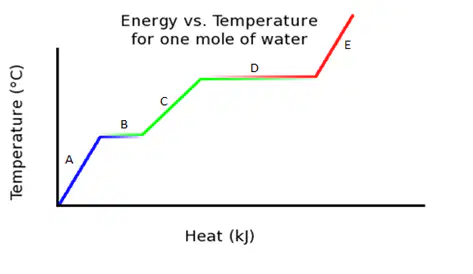
At what position on the heat curve does ice transition into water?
A
B
C
D
E
Which statement correctly describes what is happening in the reaction given below?
H2 (g) + I2 (g) → energy + 2HI (g)
The reaction is exothermic because energy is being released as bonds are broken.
The reaction is endothermic because energy is being absorbed as bonds are broken.
The reaction is exothermic because energy is being released as bonds are formed.
The reaction is exothermic because energy is being released as bonds are formed.
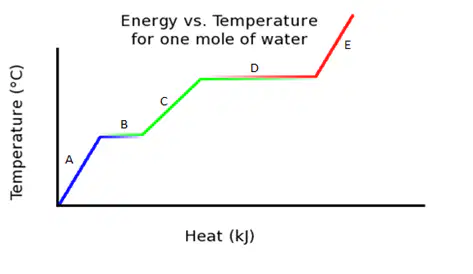
What is occurring at position D on the heating curve ?
Liquid water is increasing temperature.
Water vapor is increasing temperature.
Liquid water undergoes vaporization to become water vapor.
Water vapor is boiling to become liquid water.
Which of the following conditions must reactant particles meet in order to react and form products according to the collision theory?
Reactant particles must collide with each other to react.
Reactant particles must have proper orientation for them to react.
Reactant particles must collide with each other with sufficient energy to react.
Reactant particles must collide with each other with sufficient energy to react.
Why does increasing the temperature of the reactants result in increasing the reaction rate?
The reactant particles have more energy and will collide more frequently.
The reactant particles have less energy and will collide more frequently.
The reactant particles have less energy and will collide more frequently.
The reactant particles have less energy and will collide more frequently.
Which of the following actions would work the best to decrease the rate of reaction?
Increase the temperature of the reactants.
Add a catalyst to the reaction.
Decrease the reactants' surface area.
Increase the reactant concentration.
Which of the following actions would work the best to increase the rate of reaction?
Decrease the temperature of the reactants.
Remove the catalyst.
Increase the reactant concentration.
Decrease the reactant's surface area.
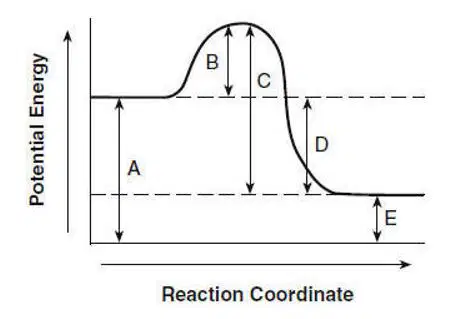
Which statement correctly describes the relationship between A, D, and E on the energy diagram below?
E represents the energy of the reactants, A represents the energy of the products, and D represents the difference in heat between them.
A represents the energy of the reactants, E represents the energy of the products, and D represents the difference in thermal energy between them.
A represents the energy of the reactants, E represents the energy of the products, and D represents the activation energy for the reaction to occur.
E represents the energy of the reactants, A represents the energy of the products, and D represents the energy lost by the reactants.
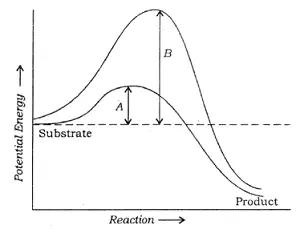
Which section of the graph shows how a catalyst would affect the activation energy of a reaction and why?
Section A because a catalyst would lower the activation energy needed for the reaction to occur.
Section A because a catalyst generates more energy for the reaction to occur which means less energy in the reaction overall.
Section B because a catalyst increases the amount of energy available for the reaction to occur.
Section B because a catalyst increases the activation energy needed for the reaction to occur.
A metal will react with an acid to produce a salt and hydrogen gas. Which of the following setups would be expected to produce the fastest reaction?
A 5 cm ribbon of magnesium added to 1 M HCl.
A 5 cm ribbon of magnesium added to 3 M HCl.
A 5 cm ribbon of magnesium added to 6 M HCl.
A 5 cm ribbon of magnesium added to 12 M HCl.
Calculate the overall energy for:
H2SO4 → SO3 + H2O
Given the following:
H2SO4 → H2S + 2 O2 ΔH = +235.5 kJ
H2S + 2 O2 → SO3 + H2O ΔH = -163 kJ
+72.5 kJ
+398.5 kJ
-72.5 kJ
-398.5 kJ
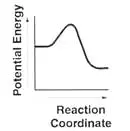
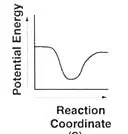
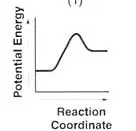
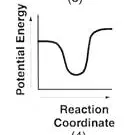
Based on the following descriptions, which energy diagram represents the reaction described?
A. Has energy as a product
B. Has a negative ΔH
C. Has reactants with more energy than the products
D. Releases energy to the surroundings
Below is a chemical reaction at equilibrium in a sealed, rigid container:
N2 (g) + 3 H2 (g) ↔ 2 NH3 (g) + energy
Which direction will the equilibrium shift if the concentration of NH3 is increased by adding more NH3 to the container at constant temperature?
To the right and the concentrations of N2 and H2 will decrease.
To the right and the concentrations of N2 and H2 will increase.
To the left and the concentrations of N2 and H2 will decrease.
To the left and the concentrations of N2 and H2 will increase.

The image shows a chemical reaction in which the reactant is pink while the product is blue:
Which of the following actions would make the blue solution turn pink again?
add more Cl-
remove water
add more [CoCl4]2-
change the pressure

