
 Worksheets
Ch. 3 Ecosystems Quizizz
Total questions: 30
Worksheet time: 15mins
Name
Class
Date
1.
Which of the following descriptions about the organization of an ecosystem is correct?
a)
Communities make up species, which make up populations.
b)
Populations make up species, which make up communities.
c)
Species make up communities, which make up populations.
d)
Species make up populations, which make up communities.
2.
The simplest grouping of more than one kind of organism in the biosphere is
a)
a population.
b)
a community.
c)
an ecosystem.
d)
a species.
3.
The lowest level of environmental complexity that includes living and nonliving factors is the
a)
biome.
b)
community.
c)
ecosystem.
d)
biosphere.
4.
In which way are plants in a sunny mountain meadow and sulfur bacteria in a deep-sea volcanic vent alike?
a)
They both use photosynthesis to make their own food.
b)
They both produce carbohydrates and oxygen.
c)
They both use chemosynthesis to produce their own food.
d)
They both produce carbon and hydrogen.
5.
A model of the complex feeding interactions among organisms in a community from producers to decomposers is called a
a)
food web.
b)
ecosystem.
c)
food chain.
d)
population.
e)
Option 5
6.
What animals eat both producers and consumers?
a)
herbivores
b)
omnivores
c)
chemotrophs
d)
autotrophs
7.
A bird stalks, kills, and then eats an insect. Based on its behavior, which pair of ecological terms describes the bird?
a)
herbivore, decomposer
b)
producer, heterotroph
c)
carnivore, consumer
d)
autotroph, herbivore
8.
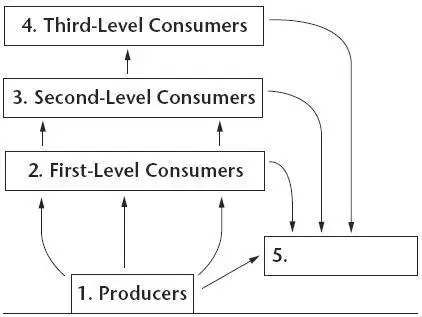
What goes in Box 5 of the food web in Figure 3–2?
a)
herbivores
b)
scavengers
c)
carnivores
d)
decomposers
9.
What are the three kinds of ecological pyramids?
a)
producer, consumer, and decomposer
b)
energy, nutrient, and trophic
c)
energy, biomass, and numbers
d)
biotic, abiotic, and nutrient
10.
A word that means the same thing as consumer is
a)
producer.
b)
autotroph.
c)
heterotroph.
d)
carbohydrate.
11.
Each of the following is an abiotic factor in the environment EXCEPT
a)
plant life.
b)
soil type.
c)
rainfall.
d)
temperature.
12.
Which is a biotic factor that affects the size of a population in a specific ecosystem?
a)
average temperature of the ecosystem
b)
type of soil in the ecosystem
c)
number and kinds of predators in the ecosystem
d)
concentration of oxygen in the ecosystem
13.
What is at the base of all ecological pyramids?
a)
consumers
b)
decomposers
c)
producers
d)
scavengers
14.
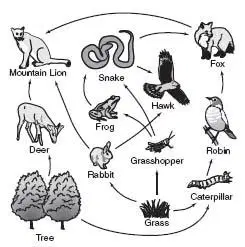
Which of the following is a food chain in the food web shown in Figure 3–4?
a)
tree, rabbit, hawk, snake
b)
grass, grasshopper, snake, hawk
c)
grass, caterpillar, robin, hawk
d)
tree, deer, mountain lion, fox
15.
These animals eat both plant and animal matter.
a)
Herbivores
b)
Omnivores
c)
Carnivores
d)
Detritivores
16.
An ecologist who is studying a group of ecosystems that have similar climates and are home to similar organisms is studying a community.
a)
True
b)
False
17.
Ecologists use tools such as binoculars and microscopes to model changes in the environment.
a)
True
b)
False
18.
Ecologists can make predictions using ecological models
a)
True
b)
False
19.
Producers release carbon dioxide into the atmosphere during the process of photosynthesis.
a)
True
b)
False
20.
Animals that feed on plants are called producers.
a)
True
b)
False
21.
The passage of energy from one organism to another according to a particular feeding sequence is called a food chain.
a)
True
b)
False
22.
In an ecological pyramid, the biomass of living things increases at each higher level.
a)
True
b)
False
23.
Only about 10 percent of the energy in a trophic level is available to organisms at the next trophic level.
a)
True
b)
False
24.
Oxygen is important for ecosystems because it is used by plants during photosynthesis.
a)
True
b)
False
25.
Seawater, sand on a beach, pebbles in the sand, and broken seashells are all examples of abiotic factors at a seashore.
a)
True
b)
False
26.
The study of interactions among organisms and between organisms and their physical surroundings is called
a)
ecology
b)
herbivores
c)
50
d)
chemicals
e)
5
27.
Autotrophs capture energy from sunlight or ____________________ to produce food.
a)
chemicals
b)
herbivores
c)
50
d)
ecology
e)
5
28.
Plant-eating animals such as cows are called ____________________.
a)
herbivores
b)
50
c)
ecology
d)
chemicals
e)
5
29.
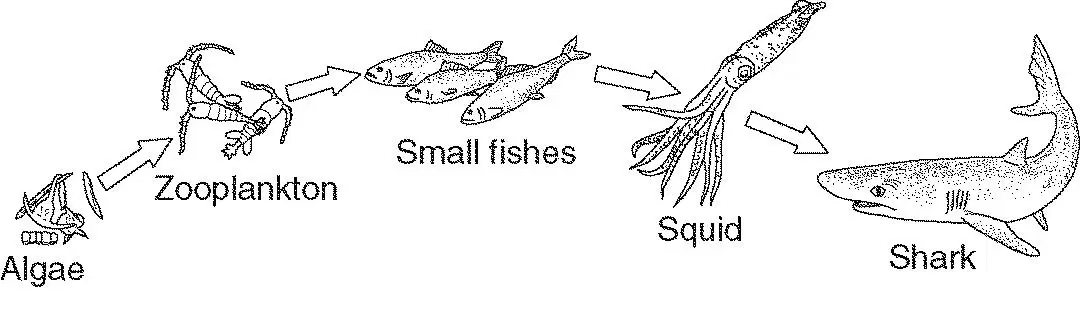
In Figure 3–1, small fishes, squid, and sharks are ____________________, but zooplankton are not.
a)
carnivores
b)
herbivores
c)
50
d)
ecology
e)
chemicals
30.
In a four-level energy pyramid, if the first level contains 5000 calories of energy, the third level will contain approximately ____________________ calories.
a)
50
b)
herbivores
c)
ecology
d)
chemicals
e)
5
100 %

