
 Worksheets
Science MAP Review - 6th Grade
Total questions: 63
Worksheet time: 2hrs 39mins
A feature that allows an organism to survive its environment is called what?
Evolution
Adaptation
Trait
Survivability factor

The picture shows flowers with an unusual shape. Which beak shape would best allow a bird to reach the nectar inside the flower?
Long and thin
Short and thick
Short and thin
Long and thick
It is estimated that fewer than 100 Florida panthers are still living. Florida now has a protected habitat for the panther. How will the protected habitat affect the panthers?
The panthers will probably become extinct.
Panthers will no longer be adapted to living in Florida.
The Florida panther population will decrease in the near future.
The panther population may increase now that they are being conserved in a protected habitat.

The apple snail lives in ponds, lakes, and rivers. The apple snail is the largest snail found in the freshwaters of North America. The illustration shows an apple snail. How is the structure labeled X an adaptation for the apple snail?
The apple snail uses this structure to find food.
The apple snail uses this structure to reproduce.
The apple snail uses this structure to digest its prey.
The apple snail uses this structure to protect itself from predators.
Which is an example of a physical trait?
a baby crying in the crib
a squirrel gathering and saving nuts
a horse has four legs
geese fly south for the winter
A dog has black fur with brown spots, a good sense of smell, a chipped tooth, and four legs. Which of these characteristics is an acquired physical trait?
black fur with brown spots
good sense of smell
chipped tooth
four legs

Freckles are an _____________.
acquired trait
inherited behavior
inherited trait
acquired behavior
When organisms respond to light as a stimulus, we call it...
thigmotropism
hydrotropism
phototropism
geotropism
When organisms respond to water or moisture as a stimulus, we call it...
thigmotropism
hydrotropism
phototropism
geotropism
All cells -----
come from other dead cells
come from other living cells
crystallize out of the air
1-Photosynthesis is the process in which plants make their own
A.oxygen
B.carbon dioxide
C.water
D.food
Which part of a plant -anchors a plant in soil?
leaf
seed
roots
stem
The excretory system helps ___________ wastes in the body.
bring in
get rid of
The main function of the respiratory system is to take in ______________ through the lungs and get rid of carbon dioxide and water.
oxygen
saliva
water
carbon dioxide
What kind of tissue makes your body move?
nerve tissue
connective tissue
muscle tissue
epithlial tissue
A/an ___________________ is a group os tissues that work together to perform a specific job.
organ
cell
skin

What is the Function and Structure of the Nucleus?
Structure: The Jelly-like material that is within the cell and is enclosed by the cell membrane.
Function: Converts light energy into chemical energy
Structure: A large, oval-shaped structure that is enclosed in a membrane.
Function: Contains the genetic material responsible for controlling the activities of the cell

What is the Function and Structure of the Cytoplasm?
Structure: The Jelly-like material that is within the cell and is enclosed by the cell membrane.
Function: Gives support to the organelles within the cell.
Structure: A porous, thin tissue that forms the outer surface of the cytoplasm.
Function: Contains the genetic material responsible for controlling the activities of the cell
What is the main difference between prokaryotic and eukaryotic cells?
Prokaryotic cells are found only in multicellular organisms
Eukaryotic cells are found only in unicellular organisms
Eukaryotic cells have a nucleus and prokaryotic cells do not
Prokaryotic cells have DNA and eukaryotic cells do not
A chemical change
changes the physical properties of an object, but does not create a new substance.
creates a new substance and cannot be undone.
A physical change...
changes the physical properties of an object, but does not create a new substance.
creates a new substance and cannot be undone.

Is this an example of a physical or chemical change?
physical
chemical

Is this an example of a physical or chemical change?
physical
chemical

Is this an example of a physical or chemical change?
physical
chemical

Is this an example of a physical or chemical change?
physical
chemical
The process of changing from liquid to a solid is called...
melting
condensation
melting
freezing

Liquids have definite ...
odor
volume
shape

The drops of water that appear on the outside of a glass of cold juice on a warm day are an example of?
Sublimation: A solid turning into a gas.
Condensation: A gas changing to a liquid.
Evaporation: A liquid changing to a gas.
Deposition: A gas changing to a solid.

What phase of matter is shown in the diagram?
solid
liquid
gas
physical changes
A complete electrical circuit or path through which electricity or current can pass or flow
open circuit
circuit
closed circuit
current
Material that allows electric current or thermal energy to pass through easily
conductor
insulator
flow
circuit

Look at the diagram. What is the term for "B"?
Wire
Switch
Resistor
Voltage source/Battery
An example of a conductor of electricity is
rubber
plastic
glass
copper

There are 3 Main Fossil Fuels. We Know Them As --
Carbon Dioxide, Oxygen, Nitrogen
Cookies, Nutella, Granola
Coal, Oil, Natural Gas
Canyons, Oceans, Nymph

Coal is often burned to produce
pollution
water power
better roads
electricity

Hydroelectric power produces electricity using.....
Wind
Sunlight
Moving water
Dung

Wind power involves structures with
long pipes that extend deep into mines
panels to absorb sunlight
turbines that spin with the air
dams to block water

Which of the following are RENEWABLE sources of energy?
Check all that apply.
RENEWABLE = we won't run out of it
coal
moving water
wind
oil
the sun
Energy due to motion is ____________ energy.
Potential
Energy
Kinetic
Friction

What kind of energy is in a stretched rubber band?
Potential
Kinetic
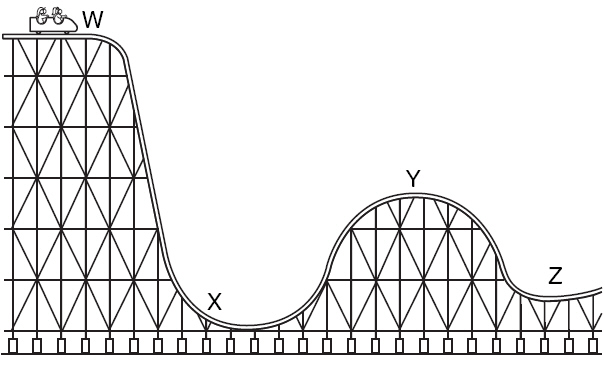
At which point is potential energy greatest?
W
X
Y
Z
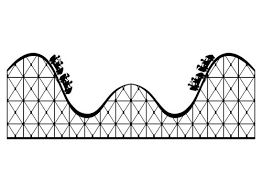
When a roller coaster is at the bottom of a hill it has
high potential energy
high kinetic energy
low kinetic energy
equal amounts of kinetic and potential energy
How many planets are in our Solar System?
7
8
9
The inner planets (Mercury, Venus, Earth, and Mars) are made of--
rocks
gas
helium
What is the third planet from the Sun?
Mercury
Venus
Earth

A
B
C
D
A
B
C
D

A
B
C
D
What is true of a new moon?
The moon appears invisible
You can see about half the moon
The moon looks like a pizza pie
Its the second phase of the moon
Which layer of the earth is the thickest?
Core
Mantle
Crust
Inner core
The crust is broken into many large pieces called (a) plates.
What layer of the Earth does convection occur in?
The Core
The Crust
The Mantle
The Mantle is divided into ____________.
Lithosphere and Asthenosphere
Inner and outer
Oceanic and Continental
Metamorphic rock transforms to sediment by ______?
melting and cooling
cementation and compaction
Weathering and erosion
heat and pressure
Igneous rocks form from the __________ of magma or lava.
Pressure
Cooling
Heat
Which of the following is an igneous rock?
Gneiss
Shale
Limestone
Pumice
The force that holds the planets in orbit around the sun is called—
gravity
motion
friction
pressure
When an electric motor is plugged in and the switch is turned on, the coils in the motor rotate fast. Over time the body of the electric motor becomes warm. Which energy conversion is correct for an electric motor?
Electrical energy → Motion energy + Heat energy
Electrical energy → Heat energy
Electrical energy → Motion energy
Electrical energy → Heat energy + Light energy
According to Newton's second law of motion, a/an ________ force will cause an object to move in the direction of the force.
balanced
unbalanced
equal
Yoda

