
 Worksheets
Thermodynamics
Total questions: 41
Worksheet time: 41mins
The change of one state of matter to another is called
Osmosis
Phase Change
Matter
Energy
Transition from a solid to a liquid
Condensation
Melting
Freezing
Evaporation
Transition from a liquid to a gas
Condensation
Freezing
Evaporation
Melting
Transition from a liquid to a solid
Freezing
Sublimation
Melting
Evaporation
Gas condenses to a liquid
Evaporation
Melting
Freezing
Condensation
Change of a solid directly into a gas
Deposition
Melting
Sublimation
Freezing
Change of a gas directly into a solid
Sublimation
Condensation
Evaporation
Deposition
When an object undergoes phase change, its mass
increases
stays the same
decreases
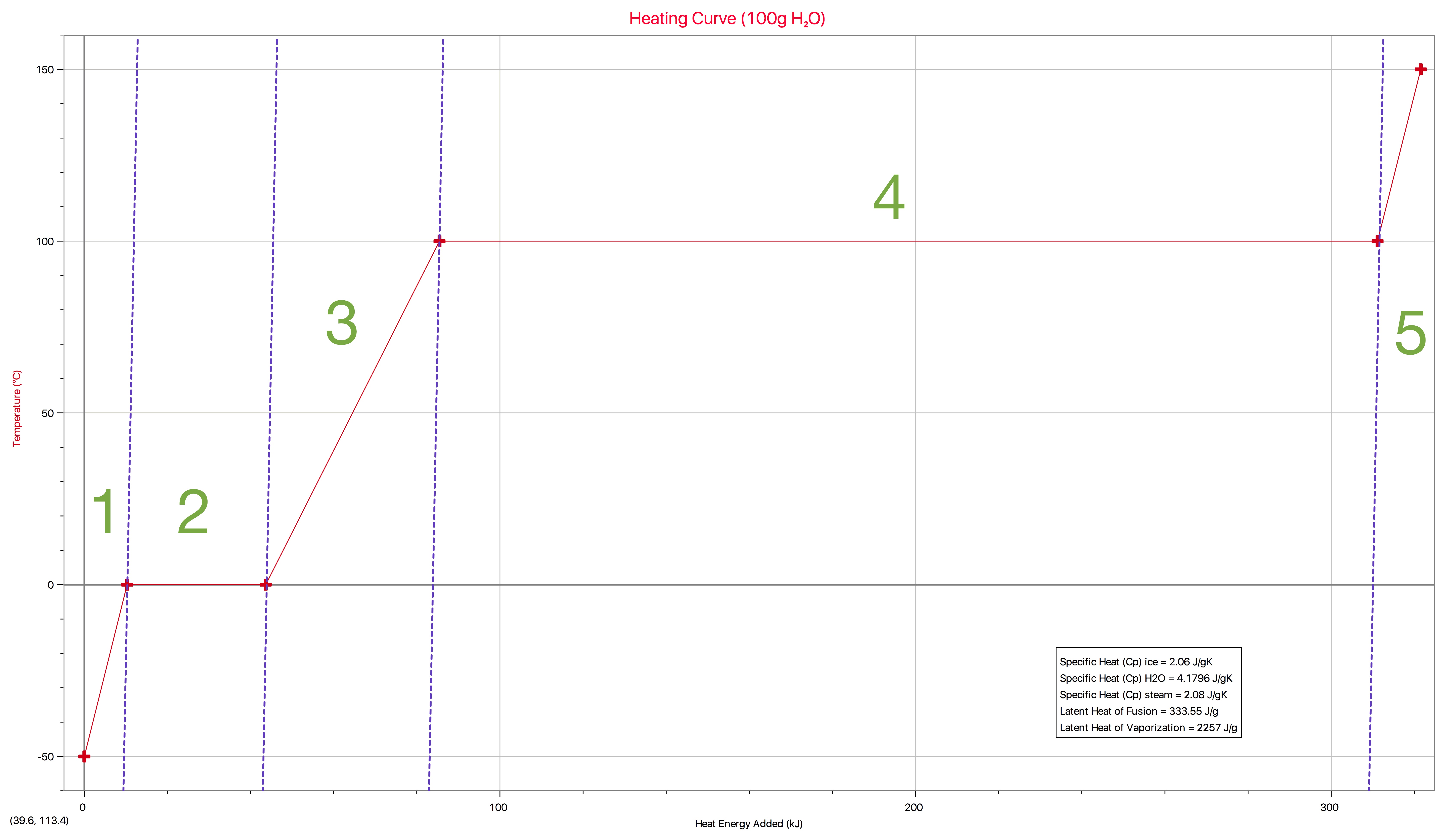
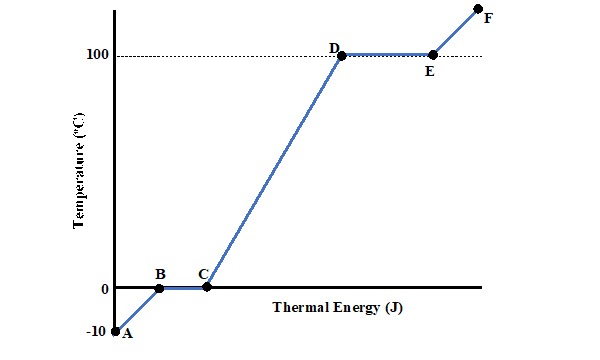
Between which two points is the solid cooling?
A <---- B
B <----> C
C <---- D
D <----> E
E <---- F
Between which two points is the gas heating up?
A ----> B
B <---- C
C ----> D
D ----> E
E ----> F
Between which two points is the gas condensing?
A <---- B
B <---- C
C <---- D
D <---- E
E <---- F
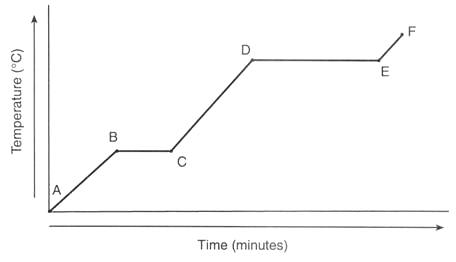


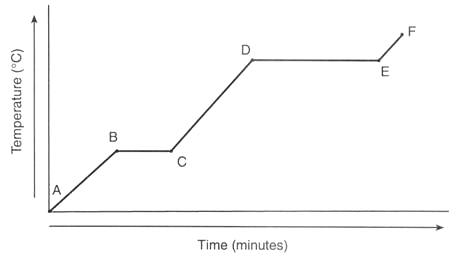
What is happening to the particles in the substance between points A and B?
Melting
Freezing
Speeding Up
Slowing Down

Where on the graph are phase changes taking place?
1
2
3
4
5

Do molecules generally move faster at 45 C or 106 C?
45 C because molecules have more energy than in 106C
106 C because molecules have more energy than in 45C
106 C because molecules have less energy than in 45C
45C because molecules have less energy than in 106 C
DON'T RUSH, YOU HAVE TIME.
Water droplets condensing on the inside of a window on a cold day. Is this process exothermic or endothermic?
Gases condense to form liquids. Gases are moving faster than liquids, the air around the window has a higher temperature/kinetic energy. Releasing energy to get water droplets, which is is Exothermic
Gases condense to form liquids. Gases are moving faster than liquids, the air around the window has a higher temperature/kinetic energy. Releasing energy to get water droplets, which is is Endothermic
Gases condense to form liquids. Gases particles are moving slower than liquids. Releasing energy to get water droplets, which is is Endothermic
Gases condense to form liquids. Gases particles are moving slower than liquids. Releasing energy to get water droplets, which is is Exothermic
Specific Heat is..
the temperature initial minus temperature final
the amount of heat/energy required to raise 1 gram of a substance by 1°C (or K) aka "C"
the temperature final minus temperature initial
the item in a system with given weight in grams
READ CAREFULLY! YOU HAVE TIME!
A substance with a low specific heat requires less energy to heat up and a substance with high specific heat require more energy to heat up and heats up slower
TRUE
FALSE
YOU HAVE TIME!
How much energy is needed to raise the temperature of a 20.0g piece of copper from 15.0 degrees Celsius to 25.0 degrees Celsius? (The specific heat of copper is 0.385 J/g C)
20 X (25-15) =70 J
20 X .385 X (25-15)= 77 J
20 X .385 X (15-25)= 62 J
20 X .385 X (15-0)= 77 J
Is this phase change representing an exothermic or endothermic reaction?
GAS to LIQUID
Exothermic
Endothermic
Is the phase change representing an exothermic or endothermic reaction?
SOLID to LIQUID
Endothermic
Exothermic


The unit for HEAT (thermal energy)
Calories
Cal/gram degree Celsius
Degrees Celsius
Thermal energy always travels from ______ temperatures to ______ temperatures.
Higher / Lower
Lower / Higher
Higher / Higher
Temperature is ...
the measure of the average kinetic energy of the molecules of an object
The amount of thermal energy it takes to raise one gram of a substance by one degree Celsius.
An object’s internal energy
The 1st law of Thermodynamics
Energy can not be created or destroyed. It just changes forms.
Energy can only be created by the sun
Some energy is lost to the environment.
2nd law of thermodynamics
Every time energy changes form, some of it is lost to the environment
Energy can't be created or destroyed
All energy generates heat

To freeze water …
energy must be added to the water
energy must be removed from the water
40-49.
Answer the questions below after watching the video
What is a common misconception about 'chemicals'?
Chemicals are always harmful
Chemicals can only be found in laboratories
All substances, including organic lettuce, are made of chemicals
Only synthetic substances are chemicals
According to Einstein, what is the relationship between energy and mass?
Mass and energy are the same thing
Energy can be converted into mass only
They are completely unrelated
Mass can be converted into energy only
What does gravitational potential energy depend on?
The temperature of the object
The object's position or arrangement
The object's speed
The chemical composition of the object
What is the first law of thermodynamics?
Energy cannot be created or destroyed
Energy can be created but not destroyed
Energy is always lost when work is done
The total entropy of the universe always increases
What does the study of thermodynamics primarily focus on?
The motion of particles in a system
The conversion of mechanical energy into electrical energy
Heat, energy, and their ability to do work
The chemical composition of substances
What is the definition of 'work' in physics?
Any task that requires effort
The process of converting energy into heat
Force applied over a distance causing movement
The transfer of energy by thermal interactions
What is 'heat' in the context of energy transfer?
The temperature difference between two systems
Energy transferred through thermal interactions
A measure of the total kinetic energy of particles in an object
A form of light energy
What happens when the internal energy of a system increases?
The system's temperature decreases
ΔE is positive, indicating energy gain
The system's mass increases
ΔE is negative, indicating energy loss
What characterizes an exothermic reaction?
Conversion of all chemical energy into work
No change in the system's energy
Release of heat to the surroundings
Absorption of heat from the surroundings
What is the role of energy in chemical reactions?
It is only released, never absorbed
It can be either absorbed or released, affecting the reaction's direction
It remains constant, ensuring the reaction's speed
It is irrelevant to the process of chemical reactions
Celsius Scale
water freezes at 0 degrees and boils at 100 degrees
water boils at 212 degrees and freezes at 32 degrees
Water boils at 273 degrees and boils at 373 degrees

