
NEW
Font size
 Worksheets
Quiz - Cognitive Development
Total questions: 20
Worksheet time: 21mins
1. What did Alfred Binet consider the most important aspect of intelligence?
a. Memory
b. Reasoning
c. Vocabulary
d. Judgment
2. How did Alfred Binet define intelligence?
a. In terms of a single score representing overall mental ability.
b. The ability to memorize large amounts of information.
c. Focused on mathematical and logical reasoning skills.
d. In terms of judgment, practical sense, initiative, and adaptability.
3. What are the three parts of Binet's concept of general intelligence?
a. Understanding of emotions, reasoning ability, and creativity
b. Goal of the mental processes, capability to display adaptable solutions, and ability to demonstrate selectivity of judgment and critical analysis of choices
c. Musical aptitude, spatial awareness, and long-term memory
d. Ability to recall facts, vocabulary knowledge, and processing speed

4. What was the first intelligence test called?
a. The Stanford-Binet Intelligence Scale
b. The Wechsler Adult Intelligence Scale (WAIS)
c. The Binet-Simon Scale
d. The Kaufman Assessment Battery for Children (KABC)
5. Why did Binet and Simon revise the Binet-Simon Scale in 1908?
a. To make the test more difficult for all age groups.
b. To improve the test's reliability and validity.
c. To identify children with specific learning disabilities.
d. To measure creativity and artistic expression.
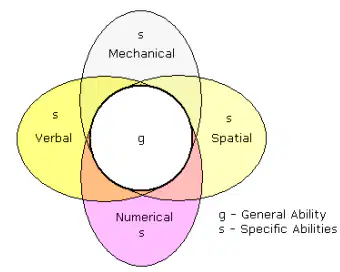
6. What did Charles Spearman discover about scores on mental aptitude tests?
a. Scores varied greatly across all individuals.
b. Scores showed no correlation between different tests.
c. Individuals who scored high on one test tended to score similarly on others.
d. Scores were more influenced by cultural background than intelligence.
7. What is the "g" factor in Spearman's two-factor theory of intelligence?
a. A specific skill or ability related to a particular task.
b. A measure of an individual's creativity and artistic expression.
c. The general cognitive ability underlying most other mental abilities.
d. A factor that determines an individual's learning style.
8. According to Spearman, how does the "s" factor differ from the "g" factor?
a. The "s" factor is specific to certain tasks and can be learned or improved.
b. The "s" factor is less important than the "g" factor in determining intelligence.
c. The "s" factor is a universal ability present in everyone to the same degree.
d. The "s" factor represents a person's knowledge base and academic skills.
9. According to Louis Leon Thurstone, what did he DISAGREE with about intelligence?
a. It can be measured.
b. It's influenced by multiple factors.
c. It's a single general ability.
d. It can be improved through training.
10. What is the PRIMARY purpose of Thurstone's Primary Mental Abilities Test?
a. To diagnose learning disabilities.
b. To assess a single general intelligence factor.
c. To measure seven distinct mental abilities.
d. To predict academic achievement in specific subjects.
11. Which of the following is NOT one of Thurstone's Primary Mental Abilities?
a. Emotional Intelligence
b. Musical Intelligence
c. Verbal Comprehension
d. Reasoning Ability
12. According to Sternberg's Triarchic Theory, what type of intelligence allows someone to come up with a new solution to a problem?
a. Analytical Intelligence
b. Creative Intelligence
c. Practical Intelligence
d. Emotional Intelligence
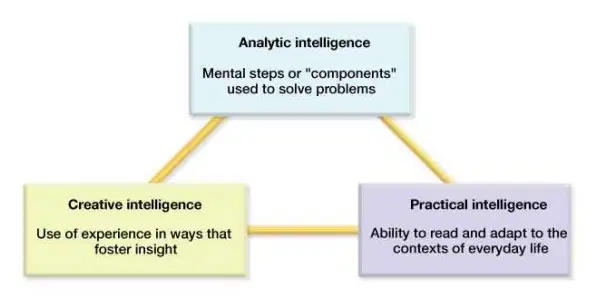
13. What is the main focus of Analytical Intelligence in Sternberg's theory?
a. Adapting to new situations
b. Evaluating information and solving problems
c. Applying knowledge and skills in practical settings
d. Incorporating analytics into the discussion
14. Which phrase describes someone who uses Analytical Intelligence?
a. The "street smart"
b. The "arts smart"
c. The "book smart"
d. The “word smart”
15. According to Atkinson and Shiffrin's theory, information travels through how many main stages in the memory process?
a. Two
b. Three
c. Four
d. Five
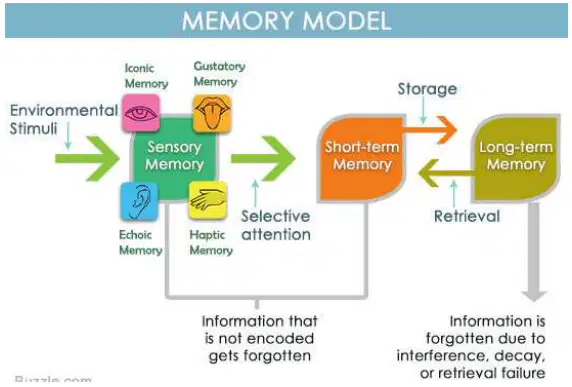
16. What is the role of "Metacognition" in the Cognitive Information Processing Theory?
a. It creates the information stores in the memory.
b. It directly processes and transforms information.
c. It controls and regulates the movement of information between stores.
d. It represents the sensory input we receive from the environment.
17. Atkinson and Shiffrin's model identifies three types of information storage. Which of the following is NOT one of them?
a. Long-term memory
b. Emotional memory
c. Sensory memory
d. Working memory (short-term)
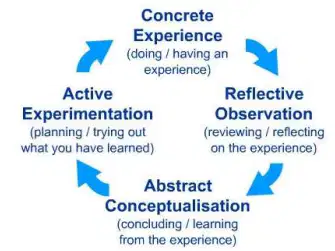
18. According to Kolb's theory, what is the most important aspect of the learning cycle?
a. Starting at the "Concrete Experience" stage.
b. Completing all stages in a specific order.
c. The ability to move between all four stages effectively.
d. Focusing heavily on abstract conceptualization.
19. What happens during the "Reflective Observation" stage in Kolb's cycle?
a. The learner actively tests new ideas in a real-world setting.
b. A new or reinterpreted experience is encountered.
c. The learner reflects on inconsistencies between experience and understanding.
d. Abstract concepts are formed or modified based on learning.
20. In which order do the stages of Kolb's learning cycle typically occur?
a. Concrete Experience > Reflective Observation > Active Experimentation > Abstract Conceptualization
b. Active Experimentation > Abstract Conceptualization > Concrete Experience > Reflective Observation
d. Reflective Observation > Concrete Experience > Active Experimentation > Abstract Conceptualization
c. There is no specific order, learners can enter at any stage.

