
 Worksheets
23/24 Causes of the Civil War Complete
Total questions: 68
Worksheet time: 35mins
"Cotton Gin increased
demand for plantations
and slave labor."
Which region does this accurately describe: the North or the South?
The North
The South
"Mostly Agriculture
Non-food cash crops"
Which region does this accurately describe: the North or the South?
The North
The South
"Cities and towns were
growing."
Which region does this accurately describe: the North or the South?
The North
The South
"Wealth measured in land
and slaves."
Which region does this accurately describe: the North or the South?
The North
The South
What crop caused a large demand for enslaved workers?
Cotton
Indigo
Wheat
Corn
Slaves were considered __________________.
Property
Free American citizens
True or False: Even though it was illegal, many enslaved people married and raised families.
True
False
What were slave codes?
laws created to control enslaved people to prevent rebellions
laws created to stop enslaved people from wearing nice clothes
laws created to allow enslaved people to recieve an education
laws created to prevent the abuse of enslaved people by the plantation owners
Which of the following best describes the term "sectionalism"?
The division of land into sections for sale or development
Loyalty to one's local area or region rather than to the country as a whole
The practice of dividing schools into sections based on academic ability
A political strategy that involves dividing and conquering
What was the primary goal of the Missouri Compromise of 1820?
To resolve conflicts between Northern and Southern states over tariffs
To maintain a balance of power between slave states and free states in the Senate
To abolish slavery throughout the United States
To expand the territory of the United States westward
What significant line was established by the Missouri Compromise?
The Mason-Dixon Line
The Equator Line
The 36°30' latitude line north of which slavery was restricted and south of slavery was permitted
The Prime Meridian
What was the effect of the Missouri Compromise on the state of Maine?
Maine was admitted as a slave state
Maine's admission was delayed
Maine was admitted as a free state
Maine was divided into two states
Which book helped to influence public opinion against slavery during the time of the Compromise of 1850?
"Pride and Prejudice" by Jane Austen
"Moby Dick" by Herman Melville
"The Scarlet Letter" by Nathaniel Hawthorne
"Uncle Tom's Cabin" by Harriet Beecher Stowe
What was a key provision of the Compromise of 1850 regarding the territories of New Mexico and Nevada?
They were required to enter the Union as slave states
They were given the choice to decide if they would allow slavery
They were automatically designated as free states
They were not allowed to join the Union
Why did the debate over slavery intensify again in 1849?
California wanted to secede from the Union.
California wanted to enter the United States as a free state.
Southerners demanded more territory for slavery expansion.
A new fugitive slave law was proposed.
What was a major suggestion by Senator Henry Clay regarding the new territories?
Slavery would be completely abolished.
All new territories would automatically become slave states.
California would be a free state and the slave trade would be illegal in Washington, D.C.
The slave trade would be expanded to all new territories.
What was the outcome of the Compromise of 1850?
It led to the immediate end of slavery in the United States.
It resulted in California entering as a free state and divided the rest of the Mexican Cession into two territories.
It caused a civil war between the northern and southern states.
It established slavery in all new territories.
What was the effect of the Fugitive Slave Act, part of the Compromise of 1850?
It abolished the Underground Railroad.
It decreased tensions between the North and South.
It led to some Northerners refusing to obey the law and helped runaway slaves find their way to freedom.
It was unanimously supported across all states.
What was the main idea behind Senator Douglas' proposal for the Kansas-Nebraska Act of 1854?
To immediately abolish slavery in the new territories
To allow the residents of the territories to decide on the issue of slavery
To enforce stricter federal control over new territories
To promote industrial development in Kansas and Nebraska
What term describes the concept that allowed people in Kansas and Nebraska to decide for themselves whether to allow slavery?
Manifest Destiny
Popular Sovereignty
Federalism
Abolitionism
Why did pro-slavery supporters cross the border from Missouri into Kansas?
To engage in peaceful protests against slavery
To vote in favor of slavery in Kansas
To establish educational institutions
To trade goods with Kansas residents
What was the outcome when pro-slavery and anti-slavery groups clashed in Kansas?
The pro-slavery group was defeated
Bleeding Kansas where people were killed
A peaceful resolution was achieved
The anti-slavery group gained control
What event did newspapers refer to as "Bleeding Kansas"?
The peaceful protests in Kansas
The election of Senator Douglas
The violent conflicts between pro-slavery and anti-slavery groups in Kansas
The signing of the Kansas-Nebraska Act
What was the primary goal of the Wilmot Proviso?
To expand slavery into new territories
To ban slavery in any lands the United States might acquire from Mexico
To support the spread of slavery into western territories
To create the Free Soil Party
Why did many Northern Democrats leave the party in 1854?
They supported the spread of slavery into new territories
They opposed the spread of slavery into new territories
They wanted to join the Whigs and Free-Soilers
They agreed with the Southern Democrats
What was the main focus of the Republican Party when it was formed?
To maintain slavery in existing states
To spread slavery into new territories
To stop the spread of slavery into new territories
To support Southern economic interests
What was the Abolition Movement primarily aimed at?
Sending freed African Americans to Africa
Establishing economic reforms in the South
Ending all forms of slavery and its expansion
Creating educational reforms in Liberia
What significant impact did Harriet Beecher Stowe's novel "Uncle Tom's Cabin" have on public opinion?
It was largely ignored by the public
It supported the existence of slavery
It portrayed slavery as a cruel and brutal system
It promoted the economic benefits of slavery
Why did Dred Scott believe he should be free?
He was born in a free state
He had never lived in a slave state
His owner had granted him freedom
He had lived in free territories
Why did the Supreme Court say Dred Scott did not have the right to go to court?
Because he was not a citizen and therefore could not sue
Because he did not live in a free state
Because he was not originally from the United States
Because the case was too old
What were enslaved people considered as per the Supreme Court decision?
Citizens with limited rights
Property
Free individuals in certain states
Protected under the 5th Amendment
Why couldn't Congress or voters ban slavery according to the Supreme Court?
Because it would mean taking someone's property
Because slavery was essential for the economy
Because the states had individual rights
Because it was protected under freedom of speech
What did the Supreme Court ruling make southerners believe?
That slavery would soon be abolished
That nothing could stop the spread of slavery
That the North would secede
That slavery was morally justified
The Republican party was established on the belief of
Destroying the South
Helping slavery spread
Opposing slavery
Going to war
What role did the Underground Railroad play during the period leading up to the Civil War?
It was a real railroad used for transporting goods between the North and South.
It was a network of secret routes and safe houses used to help enslaved people escape to free states and Canada.
It was a communication system used by the Confederate army.
It was a series of political meetings aimed at finding a peaceful end to slavery.
What did the Kansas-Nebraska Act, introduced by Stephen Douglas, do?
Established the principle of popular sovereignty over the issue of slavery
Abolished slavery in the new territories
Declared the Missouri Compromise unconstitutional
Created the states of Kansas and Nebraska with no regard to slavery
What was the main topic of discussion in the debates between Abraham Lincoln and Stephen A. Douglas in 1858?
Economic policies
Slavery
Women's rights
State rights
What was Abraham Lincoln's position on slavery in the new territories as a congressman?
He supported laws to allow slavery in new territories
He supported laws to ban slavery in new territories
He was indifferent to slavery in new territories
He supported laws to expand slavery into all territories
What significant action did Abraham Lincoln take on January 1st, 1863, when he gave the Emancipation Proclamation?
He declared war on the Confederate states
He resigned from the presidency
He freed all the slaves in Confederate-controlled territory
He passed a law increasing taxes
Which party nominated Abraham Lincoln as their candidate for the 1860 presidential election?
Democratic Party
Republican Party
Whig Party
Libertarian Party
What was the outcome of the 1854 election following the debates between Lincoln and Douglas?
Lincoln won the election
Douglas won the election but Lincoln gained a reputation of a clear thinker and could argue with persuasion
The election was declared invalid
No clear winner was declared
What was the primary reason Southern states seceded from the Union in 1861?
They wanted to form their own nation with no influence from the North.
They did not trust the Republicans to protect the rights of slave owners.
They wanted to adopt a new currency.
They were against industrialization.
Which statement best describes the reaction of the Republicans to the compromise proposed by the Southern states after they seceded?
Republicans accepted the compromise to avoid conflict.
Republicans modified the compromise to allow some spread of slavery.
Republicans refused to accept the compromise, promising to stop the spread of slavery.
Republicans ignored the compromise completely.
Who was chosen as the President of the Confederate States of America?
Abraham Lincoln
Jefferson Davis
Robert E. Lee
Ulysses S. Grant
"Industrial revolution: Increased factories in the Northeast.
Manufacturing (making goods)." Which region does this accurately describe: the North or the South?
North
South
"Mostly Agriculture. Cash crops." Which region does this accurately describe: the North or the South?
North
South
Why did slave owners need slaves?
To represent them in the House of Representatives
To provide transportation to and from the different farms
Demand for plantations and slave labor
To run the machines in the factories
Which statement below would someone who believes in Popular Sovereignty agree with?
Slavery should be allowed everywhere, no excuses!
Slavery should NOT be allowed anywhere, no excuses!
Slavery should be decided by the people living in the territory.
What were the two main causes of the Civil War?
Slavery and States Rights
War with the British and French
War of 1812 and Revolutionary War
Treaty of Paris and Proclamation of Neutrality
What did the Missouri Compromise create?
Created a border line to determine if new territories would ban slavery or allow slavery
Established California as a free state
Created the Fugitive State Act
Banned the slave trade in Washington DC
North of the 36’30° border line slavery was _____________________
Allowed
Banned
South of the 36’30° border line slavery was _____________________
Allowed
Banned
__________ worked to end the practice of slavery.
Abolitionists
Confederates
Federalist
Anti-Federalist
Who were famous Abolitionists?
Frederick Douglass, William Lloyd Garrison, and Harriet Tubman
Thomas Jefferson, George Washington, and John Adams
Alexander Hamilton, Edmund Randolph, and James Madison
Andrew Jackson, Henry Knox, and John Adams
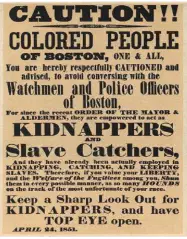
What cause would have resulted in the creation of this poster?
Wilmot Proviso
Kansas-Nebraska Act
Fugitive Slave Act
Lincoln-Douglas Debates
What were the two requirements of the Fugitive Slave Act?
The North had to maintain neutrality over slavery and the south would not attack the north
Anyone who helped a runaway slave could be fined or imprisoned and runaway slaves would be sent back
The South would defend the north if the British attacked and the North would defend the south too
Who wrote Uncle Tom’s Cabin?
Harriet Tubman
Harriet Beecher Stowe
Robert E Lee
Fredrick Douglas
Why was the book Uncle Tom's Cabin written?
To make a lot of money
To fuel animosity between the north and south
To start the Civil War
To help inform the public about the brutal and cruel system of slavery
According to the ruling, what was Dred Scott NOT?
Citizen
Property
According to the ruling, what was Dred Scott CONSIDERED?
Citizen
Property
According to the ruling, what protected slavery?
Declaration of Independence
Kansas-Nebraska Act
Proclamation of Neutrality
Constitution
How did Lincoln feel about secession?
It was part of states rights and therefore was legal
It was illegal under all circumstances and was treason
It was allowed in the Constitution
Which statement would Abraham Lincoln agree with?
Slavery should be allowed everywhere, no excuses!
The novel Uncle Tom’s Cabin should be banned everywhere!
States that seceded are breaking the law. We must protect the Union!
We need to maintain being neutral and not get involved in the conflicts of other countries
How did the southern states react to Abraham Lincoln being elected President?
They choose to support him no matter what
They try to get the Spanish help them fight in their war
They attack the French and Texas
They seceded from the Union
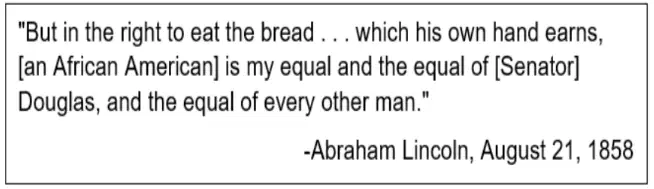
Which BEST reflects Lincoln’s opinion from the quote?
All men are guaranteed certain rights and freedoms
Slavery should be made legal in all states and territories
African Americans should have all of the same rights as white men
Each state should decide for itself whether slavery would be allowed

