wayground logo

Free Printable Worksheets

Font size

S
M
L
XL
Worksheets

Classification & Dichotomous Key

Total questions: 35

Worksheet time: 53mins

Name
Class
Date
1.
What is the purpose of a dichotomous key?
a)
to find a common ancestor
b)
to show the evolution of organisms
c)
to show relationships between organisms
d)
to identify organisms
2.
From the table, which two animals are MOST CLOSELY related
a)
House Cate and Red Fox
b)
Red Fox and Dog
c)
Dog and Wolf
d)
Wolf and Gopher
3.
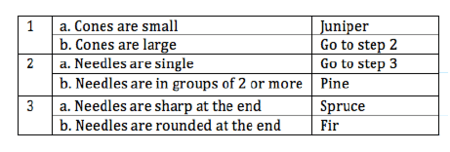
A dichotomous key for trees is provided. Hikers found a tree that has large brown cones and single sharp needles. What species of tree have the hikers found?
a)
Juniper
b)
Pine
c)
Spruce
d)
Fir
4.
What step do we always start with when using dichotomous keys?
a)
1
b)
2
c)
3
d)
4
5.
When using a dichotomous key to identify organisms, what do we look at?
a)
physical features
b)
weather patterns
c)
environment
d)
diet
6.
The 8 levels of classification, most broad to most specific.
a)
Domain, Genus, Family, Order, Class, Phylum, Kingdom, Species
b)
Domain, Species, Kingdom, Genus, Phylum, Family, Class, Order
c)
Domain, Kingdom, Phylum, Class, Order, Family, Genus, Species
d)
Order, Kingdom, Species, Domain, Phylum, Family, Class, Genus
7.
Term given to describe the 2 name naming system is:
a)
dichotmous key
b)
binomial nomenclature
c)
2 scientific names
d)
binomial key
8.
The first part of a scientific name is an organism's _______________ and the second part is its ________________.
a)
species, genus
b)
phylum, order
c)
class, spices
d)
genus, species
9.
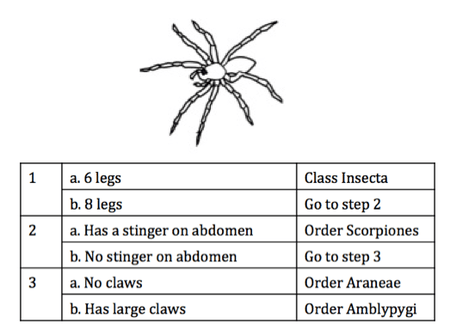
An illustration and a dichotomous key are given. What is the correct classification for this organism?
a)
Class Insecta
b)
Order Amblygygi
c)
Order Araneae
d)
Order Scorpiones
10.
A table of arachnid and insect characteristics is shown. Which characteristic could be used to distinguish between
arachnids and insects?
a)
Jointed legs
b)
Body segments
c)
Presence of eyes
d)
Presence of antennae
11.
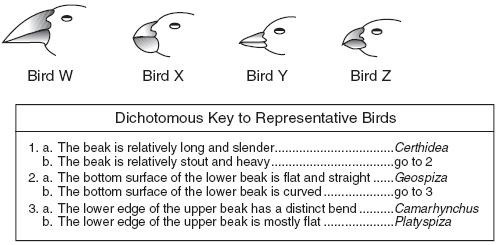
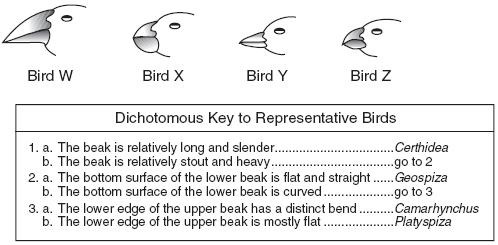
What is the name of bird W?
a)
Certhidea
b)
Geospiza
c)
Camarhynchus
d)
Platyspiza
12.
What is the name of bird Z?
a)
Certhidea
b)
Geospiza
c)
Camarhynchus
d)
Platyspiza
13.
Using this dichotomous key, identify the name of the circled Fish, J.
a)
peacock flounder
b)
band-tail puffer
c)
trumpet fish
d)
spotted goat fish
14.

Identify the fish

a)

Sebastes serriceps

b)

Sebastes nebulosus

c)

Naucrates ductor

d)

Seriola lalandi

15.

You find a species that seems to be unicellular and is eating smaller cells around it. It has organelles and a nucleus. Which kingdom is it MOST likely a part of?

a)

Fungi

b)

Bacteria

c)

Protists

d)

Plants

16.

Which one is NOT a difference between plants and fungi?

a)

Plants use cellulose but fungi use chitin

b)

Plants are autotrophs but fungi are heterotrophs

c)

Plants have cell walls but fungi don't

d)

Plants make their own food and fungi decompose their food

17.

You identify a small living organism that is eating something at your feet. It's visible but pretty tiny, you take it to a lab and find that it has cell walls made of chitin. Which is its domain and kingdom?

a)

Prokaryote, Fungi

b)

Eukaryote, Fungi

c)

Prokaryote, Plant

d)

Eukaryote, Plant

18.

Which is NOT a eukaryote?

a)

Plants

b)

Animals

c)

Archaea

d)

Protists

19.

Which of the following pairs of organisms from the table shown to the left would be the most closely related?

a)

Desert iguana and Box turtle

b)

Chuckwalla and Bush anole

c)

Box turtle and Bush anole

d)

Desert iguana and Chuchwalla

20.

Which of the following taxonomic groups would contain organisms with the greatest amount of genetic similarities?

a)

Domain

b)

Kingdom

c)

Phylum

d)

Class

21.

Which of the following groups of fungi would be the most closely related?

a)

Fungi in the same phylum

b)

Fungi in the same kingdom

c)

Fungi in the same order

d)

Fungi in the same class

22.

Which of the following sets of animals would contain the least closely related organisms?

a)

Animals in the same phylum

b)

Animals in the same genus    

c)

Animals in the same class

d)

Animals in the same family

23.

Which of the following taxonomic groups would contain the most related set of animals?

a)

Domain

b)

Species

c)

Family

d)

Order

24.

Which of the following taxonomic groups would contain plants with the greatest amount of variety and differences?

a)

Kingdom

b)

Phylum

c)

Order

d)

Family

25.

Which of the following sets of insects would be the most closely related?

a)

Insects in the same class

b)

Insects in the same family

c)

Insects in the same order

d)

Insects in the same species

26.

Which of the following sets of animals would be the most closely related?

a)

Animals in the same order

b)

Animals in the same genus

c)

Animals in the same class

d)

Animals in the same family

27.

An example of an unicellular organism would be:

a)

monkey

b)

bacteria

c)

spider

d)

human

28.

What kingdom do unicellular, prokaryotic organisms that live in extreme environments?

a)

Animal

b)

Archaebacteria

c)

Eubacteria

d)

Plant

29.
___ shows the relationship between species
a)
Classification
b)
Visible similarity
c)
Family history
d)
Biology
30.
Which term means "True Nucleus" or cell(s) with a nucleus?
a)
Eukaryotes
b)
Prokaryotes
c)
Multi-cellular
31.

A coyote's scientific name Canis Latrans. What genus is he in?

a)

Canis

b)

Latrans

c)

Neither

d)

Both

32.
Things that are classified together ___________.
a)
are not related to each other.
b)
share a similar evolutionary history.
c)
are larger organisms.
d)
have a different evolutionary history
33.
Organisms that belong to the same _________ share the MOST DNA.
a)
family
b)
kingdom
c)
genus
d)
species
34.

Which organism is most closely related to Quercus rubrum?

a)

Acer rubrum

b)

Quercus macrophylla

35.

Which of the following taxa contain the fewest members?

a)

phyllum

b)

family

c)

genus

d)

class