
Font size
 Worksheets
Spaced Out Review
Total questions: 55
Worksheet time: 40mins
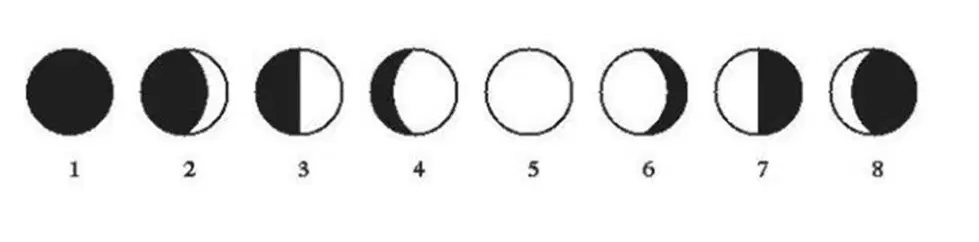
What is the phase of the moon depicted in position 1 in the sequence shown in the image?
Full Moon
New Moon
First Quarter
Third Quarter
What is the phase of the moon depicted in position 4 in the sequence shown in the image?
Full Moon
Waxing Gibbous
First Quarter
Third Quarter
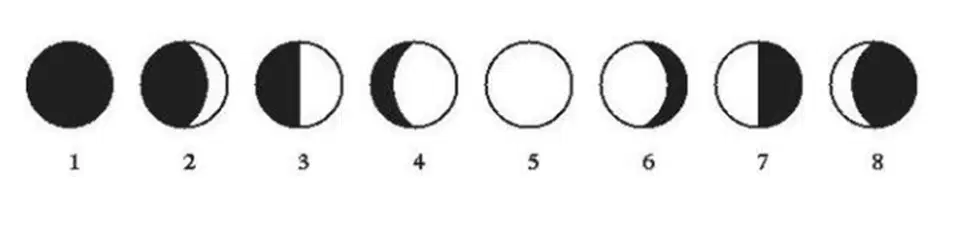
Which phase of the moon is shown at position 5 in the sequence?
Full Moon
New Moon
First Quarter
Third Quarter
Which phase of the moon is shown at position 3 in the sequence?
Full Moon
New Moon
First Quarter
Third Quarter
Which phase of the moon is shown at position 8 in the sequence?
Waning Crescent
Waxing Crescent
First Quarter
Third Quarter
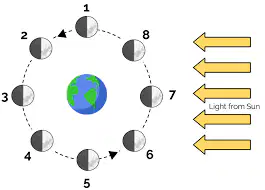
What is the correct label for the moon phase at position 2 in the circular diagram?
Waxing Crescent
Waning Gibbous
Waxing Gibbous
Waning Crescent
What is the correct label for the moon phase at position 7 in the circular diagram?
New Moon
Waning Gibbous
full moon
Waning Crescent
What is the correct label for the moon phase at position 1 in the circular diagram?
1st Quarter
Waning Gibbous
3rd Quarter
Waning Crescent
What is the correct alignment for a lunar eclipse as per the diagram?
Sun, Earth, Moon
Moon, Sun, Earth
Earth, Moon, Sun
Sun, Moon, Earth
At what moon phase would you see a lunar eclipse?
Full Moon
New Moon
First Quarter
Last Quarter
At what moon phase would you see a solar eclipse?
New Moon
Full Moon
First Quarter
Last Quarter
What does the term "geocentric" mean?
Everything revolves around the Moon
Everything revolves around the Earth
Everything revolves around the Sun
Everything revolves around Mars
What does the term "heliocentric" mean?
Everything revolves around the Moon
Everything revolves around the Earth
Everything revolves around the Sun
Everything revolves around Mars
How is distance from the sun typically measured?
Light years
Kilometers
Astronomical Units (AU)
Miles
What does the Goldie Locks syndrome describe?
A condition where a planet is too hot
A condition where a planet is too cold
A condition where a planet is neither too hot nor too cold
A condition related to planetary rings
Where in our solar system is the Milky Way galaxy located?
Outer Rim of the Orion Arm
Inner Rim of the Orion Arm
Outer Rim of the Sagittarius Arm
Inner Rim of the Sagittarius Arm
Which planet does not have an atmosphere?
Mercury
Venus
Earth
Mars
The more massive the planet, the more ______ it has.
gravity
atmosphere
moons
rings
What is the primary reason Venus is considered the hottest planet in our solar system?
Its proximity to the Sun
Its size
Its atmosphere trapping heat
Its volcanic activity
Which planet is known for having a bluish appearance due to methane in its atmosphere?
Mars
Neptune
Jupiter
Saturn
What characteristic prevents moons from having atmospheres?
Their distance from the sun
Their small size
Their composition
Their orbital speed
Which planet is the largest and has the most moons, totaling 63?
Mars
Saturn
Jupiter
Neptune
What causes some planets to have seasons?
Their moons
Their tilt
Their distance from the Sun
Their rotation speed
What are the two types of tails that comets have?
Gas and rocks
Dust and ice
Fire and ice
Dust and gas
Which direction do the two tails of a comet always face?
Towards the sun
Away from the sun
Towards Earth
In the direction of its orbit
What is the name of the belt where most asteroids are found between the inner and outer planets?
Kuiper Belt
Asteroid Belt
Oort Cloud
Van Allen Belt
Name the planets in order from the Sun
Mars, Venus, Earth, Mercury, Jupiter, Saturn, Uranus, Neptune
Earth, Mars, Venus, Jupiter, Mercury, Saturn, Uranus, Neptune
Mercury, Venus, Earth, Mars, Jupiter, Saturn, Uranus, Neptune
Neptune, Uranus, Saturn, Jupiter, Mars, Earth, Venus, Mercury
What is the term for a rocky body that orbits the Sun, primarily found in the asteroid belt between Mars and Jupiter?
Comet
Asteroid
Meteor
Moon
Which planet in the Solar System is known for its extensive ring system?
Jupiter
Saturn
Uranus
Neptune
The smallest planet in the solar system
Mercury
Jupiter
Saturn
Uranus

What is Pluto now classified as?
A Hobbit Planet
A Worf Planet
A Dwarf Planet
A Moon
What planet is the ony planet to have a poisonous atmosphere made of sulfuric acid?
Venus
Earth
Mars
Neptune
_________________ rotates at a nearly 90-degree angle from the plane of its orbit
Saturn
Neptune
Earth
Uranus
Which planet is the only planet with liquid water?
Earth
Venus
Mars
Saturn
WHY does the Sun create a LARGER gravitational field than the Earth?
The Sun has more magnetism than the Earth and this creates a larger gravitational field
The Sun is hotter than the Earth and this creates a larger gravitational field.
No one knows why
The Sun has more MASS than the Earth, so it creates a larger gravitational field than the earth does.
Most asteroids are found in between the inner and outer planets in the ____________.
lunar
asteroid
Ptolemy
comet
What eclipse is the order Sun-Moon- Earth
Solar Eclipse
Lunar Eclipse
Umbra
Penumbra
This Eclipse happens during a full moon
Solar Eclipse
Lunar Eclipse
Umbra
Penumbra
Darker part of an eclipse
Solar Eclipse
Lunar Eclipse
Umbra
Penumbra
Lighter part of an eclipse
Solar Eclipse
Lunar Eclipse
Umbra
Penumbra

What type of eclipse is this an example of?
Lunar Eclipse
Solar Eclipse
A force which tries to pull two objects towards each other is
gravity
inertia
mass
speed
Gravity is based on an object's
mass
size
roundness
brightness
What keeps the planets in orbit around the sun?
gravity and inertia together
gravity
inertia
neither gravity or inertia
What is a meteorite?
a space rock that completely burns up in Earth's atmosphere
A space rock that enters the atmosphere and hits Earth's surface
a space rock in space
comets
objects made of frozen gases; may have tails
meteors
small rocky spheres when they enter our atmosphere
asteroids
Many of these are found in a belt between Mars and Jupiter.
meteoroid
small rocky spheres in space
meteorite
small rocky spheres when they fall onto Earth
Place the outer planets in order from CLOSEST to the sun from FARTHEST.
Jupiter
Saturn
Uranus
Neptune
Order the planets from largest to smallest:
Jupiter
Neptune
Venus
Mercury

Which of the following are listed from smallest to largest?
solar system, universe, galaxies
planet, solar system, universe, galaxies
planet, solar system, galaxies, universe
dwarf planets, moons, planets, comets,
What are the 4 inner planets?
Mercury, Jupiter, Saturn, Pluto
Earth, Venus, Mars, Neptune
Mercury, Venus, Earth, Mars
Jupiter, Saturn, Neptune, Uranus

