
 Worksheets
Unit 3 module 3 lesson 2 lesson check
Total questions: 20
Worksheet time: 3600secs
Where is water stored?
on Earth’s surface
in the atmosphere
underground
all of the above
When water evaporates, it enters the _______.
biosphere
geosphere
hydrosphere
Water vapor is released by plants through their leaves. This process is called _____.
transpiration
respiration
evaporation
photosynthesis
The natural locations where water is stored are called _____.
Oceans
Lakes
Rivers
Where is water found in the gaseous state?
ocean, lakes and streams
glaciers
atmosphere
polar caps
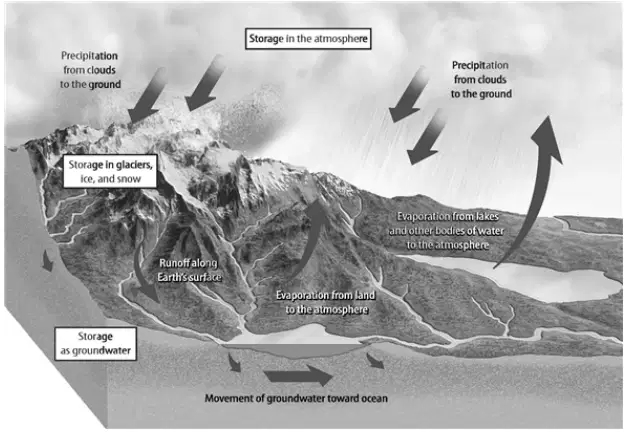
Use the diagram to answer the following question: Water evaporates into the ________ from bodies of water and plants.
Biosphere
Geosphere
Hydrosphere
As water travels through the water cycle, it remains in storage areas for periods of time. These storage areas are called which of the following?
receptacles
reservoirs
condensation
hydrosphere
__________ is the opposite of evaporation.
Evaporation
Crystallization
Water evaporates from ______.
bodies of water
from trees
from humans
all of the above
The process of water vapor changing to a liquid is called ______.
evaporation
precipitation
condensation
convection
When water droplets in a cloud combine, become too heavy, and fall to the ground as rain, snow, sleet, or hail, we are experiencing _____.
evaporation
condensation
precipitation
transpiration
Which of the following is NOT part of the water cycle?
nitrogen fixation
evaporation
condensation
precipitation
What drives the movement of water in the water cycle?
sunlight and gravity
gravity and electricity
sunlight and magnetism
electricity and magnetism
Where is groundwater stored?
in lakes and rivers
in oceans
in ice caps at the poles
in cracks and pores beneath Earth’s surface
During the process of __________, a liquid turns into a crystalline solid.
Condensation
Evaporation
How does transpiration contribute to the water cycle?
It increases the amount of water in the soil.
It decreases the amount of water in the atmosphere.
It releases water vapor into the atmosphere from plants.
It converts water vapor directly into ice crystals.
What is the primary source of energy that drives the water cycle?
Wind
The Moon
The Sun
Geothermal heat
What role does temperature play in the evaporation process?
Higher temperatures decrease evaporation rates.
Temperature has no effect on evaporation.
Lower temperatures increase evaporation rates.
Higher temperatures increase evaporation rates.
Describe how condensation contributes to cloud formation.
Condensation freezes water vapor, forming ice clouds.
Condensation turns water vapor into liquid droplets, which accumulate to form clouds.
Condensation causes water vapor to dissipate, clearing the sky.
Condensation heats up water vapor, causing it to rise and disperse.
What is the process called when water vapor cools and changes back into liquid droplets?
Condensation
Evaporation
Precipitation
Sublimation

