
 Worksheets
Evolution and Natural Selection End of Unit Review
Total questions: 110
Worksheet time: 55mins
Which scientist gets credit for creating the theory of evolution?
Isaac Newton
Lamarck
Charles Darwin
Alfred Wallace
Species adapt to their environment through
Natural selection
Sexual selection
Changes in the environment
Speciation
For what reason did Darwin conclude the Galapagos finches had different sized beaks?
To attract females
To compete
To eat various sized foods
For grooming purposes
To be considered a species, you must be able to produce offspring.
True
False
Natural selection means the biggest, strongest, and fastest organisms survive.
True
False
The rock pocket mouse population started off with white fur. After a volcanic eruption, many more dark mice survived and reproduced. What caused the mouse population to have dark fur?
The ash from the volcano
They adapted to their environment
Their parents must have had dark fur
A mutation
In order for evolution to occur, there must be mutations in the gene pool because they
Are usually related to the environment in which they appear
Are usually beneficial to the organism in which they appear
Usually cause species of organisms to become extinct
Contribute to new variations within the organisms
Natural selection is a major cause of evolution because
Organisms with mutations usually survive and reproduce
Only organisms with desired characteristics are allowed to reproduce
Organisms with beneficial traits will adapt to their environment and survive to reproduce
Humans breed plants and animals to select useful traits
Two organisms share 97% of their DNA. Therefore, we can conclude that they
Are closely related evolutionarily
Do not share a close common ancestor
Have the same genotype
Organisms which have similar bone structure are called
Homologous structures
Heterozygous structures
Vestigial structures
Stabilizing structures
In whales, the pelvis and femur bones have no function. This is an example of a
Homologous structures
Heterozygous structures
Vestigial structures
Stabilizing structures
Which of the following is an example of geographic distribution?
The fossil record
Galapagos turtles with different length necks
Rock pocket mouse
The flu virus
What type of natural selection takes place when individuals at the upper and lower ends of the curve have higher fitness than individuals near the middle?
Destabilizing selection
Disruptive selection
Directional selection
Stabilizing selection
Frogs with longer tongues are able to catch more food. Frogs with short tongues can’t catch as much food and don’t usually survive. Which type of selection do the frogs experience?
Destabilizing selection
Disruptive selection
Directional selection
Stabilizing selection
What is the formation of a new species called?
Directional selection
Genetic equilibrium
Speciation
Temporal isolation
What kind of isolation occurs when two populations are capable of interbreeding but have differences in courtship rituals or other types of mating behavior?
Geographic isolation
Temporal isolation
Ecologic isolation
Behavioral isolation
Two populations kept separate by a river are characterized by
Geographic isolation
Temporal isolation
Ecologic isolation
What situation occurs when two or more species reproduce at different times?
Geographic isolation
Temporal isolation
Ecologic isolation
Behavioral isolation
When lions prey on a herd of antelope, some antelope are killed and some escape. Which part of Darwin's concept of natural selection might describe this situation?
Survival of the fittest
A common ancestor
Reproductive isolation
An adaptation
Darwin called the ability of an organism to survive and reproduce in its environment
Diversity
Adaptation
Fitness
Evolution
The embryos of many animals are very similar during the early stages of development. What does this suggest?
They all have homologous structures
They all have vestigial structures
They all were created through artificial selection
They share a common ancestor
What is the difference between macroevolution and microevolution?
Microevolution is changes in genes, and macroevolution is the formation of new species
Macroevolution is changes in genes, and microevolution is the formation of new species
Microevolution is when organisms share a common ancestor and in macroevolution they don’t share a common ancestors
Macroevolution is when organisms share a common ancestor and in microevolution they don’t share a common ancestor.
What is evolution?
The loss of a species (a species dies out)
The change of traits in a species over time
The predation of one species on another species
The conversion of a carnivore (meat eater) into an herbivore (plant eater)
According to evolution, what happens to the frequency of traits in a population of species over time?
The frequency of traits randomly changes
The frequency of traits never changes
The frequency of advantageous traits increases over time
The frequency of advantageous traits decreases over time
Which statement below best describes the rate of evolution?
Evolution is always a slow process
Evolution is usually a slow process, but it can occur quickly as well
Evolution is usually a fast process, but it can occur slowly as well
Evolution is always a fast process
What is a common ancestor?
A selective pressure that led the formation all the species on Earth
An organism from which all organisms on Earth descended from
An organism which all organisms on Earth strive to become
An organism that lives on a different planet as well as Earth
Which of the following is NOT a postulate of Darwin’s Theory of Natural Selection?
There is little to no variation among the individuals in a species
Individuals compete with each other for resources
Competition can lead to death of individuals
Individuals who survive are more likely to reproduce and pass traits to offspring
What is an adaptation?
A characteristic that an organism acquires during its life
A favorable trait, which helps an organism survive
An unfavorable trait, which is detrimental to the survival of an organism
A characteristic that makes an organism “less fit”
What is a source of variation in a sexually reproducing species?
Mutations
Recombination
Both a and b
Neither a or b
Which of the following is a resource that organisms compete for?
Water
Space
Mates
All of the above
Why do organisms compete with each other for resources?
There is an unlimited supply of resources
There is a limited supply of resources
Organisms produce more offspring than can survive
Both b and c
Competition is important because:
It improves the success of a species as a whole
It makes an individual better adapted to the environment
It ensures that there are enough resources for everyone in an environment
It helps species reproduce
Fossils are an important piece of evidence for evolution because:
They show that organisms have changed over time on Earth
They demonstrate that organisms have become more complex
They suggest there are similarities between ancient organisms and present organisms, suggesting that all living things are somehow related
All of these choices are correct
What can we learn about from fossils?
What an organism looked like
How the organism moved around the environment
What the organism ate
All of the above
What piece of information does the fossil record NOT tell us?
It tells us about species that once lived but are now extinct
It tells us about species that have existed for a long period of time
It tells us about the emergence of species that have been on Earth for a short time
It tells us about species that are likely to emerge in the future
What is the strongest piece of evidence that supports evolution?
The fossil record
Embryology similarities
Genetic similarities
Anatomical similarities
What is considered to be the greatest threat to species today and is the main cause of endangerment of species?
Lack of genetic variation
Extreme natural events
Loss of habitat
Invasive species
Which of the following is NOT an example of artificial selection?
Antibiotic resistant bacteria
Seedless fruit
Domesticated animals
Breeding cows with high milk output
Which scientist gets credit for creating the theory of evolution?
Lamarck
Charles Darwin
Alfred Wallace
Isaac Newton
For what reason did Darwin conclude the Galapagos finches had different sized beaks?
To attract females
To compete
To eat various sized foods
For grooming purposes
Species adapt to their environment through
Natural selection
Sexual selection
Changes in the environment
Speciation
Natural selection means the biggest, strongest, and fastest organisms survive.
True
False
To be considered a species, you must be able to produce offspring.
True
False
The rock pocket mouse population started off with white fur. After a volcanic eruption, many more dark mice survived and reproduced. What caused the mouse population to have dark fur?
The ash from the volcano
They adapted to their environment
Their parents must have had dark fur
A mutation
In order for evolution to occur, there must be mutations in the gene pool because they
Contribute to new variations within the organisms
Are usually related to the environment in which they appear
Are usually beneficial to the organism in which they appear
Usually cause species of organisms to become extinct
Natural selection is a major cause of evolution because
Only organisms with desired characteristics are allowed to reproduce
Organisms with beneficial traits will adapt to their environment and survive to reproduce
Organisms with mutations usually survive and reproduce
Humans breed plants and animals to select useful traits
Two organisms share 97% of their DNA. Therefore, we can conclude that they
Do not share a close common ancestor
Are closely related evolutionarily
Have the same genotype
Have the same phenotype
Organisms which have similar bone structure are called
Vestigial structures
Stabilizing structures
Homologous structures
Heterozygous structures
In whales, the pelvis and femur bones have no function. This is an example of a
Vestigial structures
Stabilizing structures
Homologous structures
Heterozygous structures
Which of the following is an example of geographic distribution?
Galapagos turtles with different length necks
The fossil record
Rock pocket mouse
The flu virus
What type of natural selection takes place when individuals at the upper and lower ends of the curve have higher fitness than individuals near the middle?
Directional selection
Stabilizing selection
Destabilizing selection
Disruptive selection
Frogs with longer tongues are able to catch more food. Frogs with short tongues can’t catch as much food and don’t usually survive. Which type of selection do the frogs experience?
Directional selection
Stabilizing selection
Destabilizing selection
Disruptive selection
What is the formation of a new species called?
Directional selection
Genetic equilibrium
Speciation
Temporal isolation
What kind of isolation occurs when two populations are capable of interbreeding but have differences in courtship rituals or other types of mating behavior?
Ecologic isolation
Behavioral isolation
Geographic isolation
Temporal isolation
Two populations kept separate by a river are characterized by which type of isolation?
Ecologic isolation
Behavioral isolation
Geographic isolation
Temporal isolation
What situation occurs when two or more species reproduce at different times?
Ecologic isolation
Behavioral isolation
Geographic isolation
Temporal isolation
When lions prey on a herd of antelope, some antelope are killed and some escape. Which part of Darwin's concept of natural selection might describe this situation?
Reproductive isolation
An adaptation
Survival of the fittest
A common ancestor
Darwin called the ability of an organism to survive and reproduce in its environment what?
Diversity
Fitness
Adaptation
Evolution
The embryos of many animals are very similar during the early stages of development. What does this suggest?
They all have homologous structures
They all have vestigial structures
They share a common ancestor
They all were created through artificial selection
What is the difference between macroevolution and microevolution?
Microevolution is changes in genes, and macroevolution is the formation of new species
Macroevolution is changes in genes, and microevolution is the formation of new species
Microevolution is when organisms share a common ancestor and in macroevolution they don’t share a common ancestor.
Macroevolution is when organisms share a common ancestor and in microevolution they don’t share a common ancestor.
What is evolution?
The loss of a species (a species dies out)
The change of traits in a species over time
The predation of one species on another species
The conversion of a carnivore (meat eater) into an herbivore (plant eater)
Which statement below best describes the rate of evolution?
Evolution is always a slow process
Evolution is usually a slow process, but it can occur quickly as well
Evolution is usually a fast process, but it can occur slowly as well
Evolution is always a fast process
What is a common ancestor?
A selective pressure that led the formation all the species on Earth
An organism from which all organisms on Earth descended from
An organism which all organisms on Earth strive to become
An organism that lives on a different planet as well as Earth
Which of the following is NOT a postulate of Darwin’s Theory of Natural Selection?
There is little to no variation among the individuals in a species
Individuals compete with each other for resources
Competition can lead to death of individuals
Individuals who survive are more likely to reproduce and pass traits to offspring
What is an adaptation?
A characteristic that an organism acquires during its life
A favorable trait, which helps an organism survive
An unfavorable trait, which is detrimental to the survival of an organism
A characteristic that makes an organism “less fit”
Which organisms are more likely to survive, reproduce and pass their traits to offspring?
Organisms that are well-adapted to the environment
Organisms that are not well-adapted to the environment
Organisms that are less fit
Organisms that reproduce very quickly
What is a source of variation in a sexually reproducing species?
Mutations
Recombination
Both a and b
Neither a or b
Which of the following is a resource that organisms compete for?
Water
Space
Mates
All of the above
Why do organisms compete with each other for resources?
There is an unlimited supply of resources
There is a limited supply of resources
Organisms produce more offspring than can survive
Both b and c
What do fossils tell us?
They show that organisms have changed over time on Earth
They demonstrate that organisms have become more complex
They suggest there are similarities between ancient organisms and present organisms, suggesting that all living things are somehow related
All of the above
Which structures do NOT imply evolutionary relationships?
Homologous structures
Analogous structures
Vestigial structures
All of the structures above imply evolutionary relationships
Which structure implies “loss of function” or evolutionary divergence from a species with a past function (that is no longer needed)?
Homologous structures
Analogous structures
Vestigial structures
All of the above
What can we learn about from fossils?
What an organism looked like
How the organism moved around the environment
What the organism ate
All of the above
What is the strongest piece of evidence that supports evolution?
The fossil record
Embryology similarities
Genetic similarities
Anatomical similarities
Changes in the sequence of nucleotides in a gene can cause:
The gene to be transformed (thus altering a trait)
The gene to be turned off (thus a trait is no longer expressed)
A new gene to be created (thus causing the expression of a new trait)
All of the above
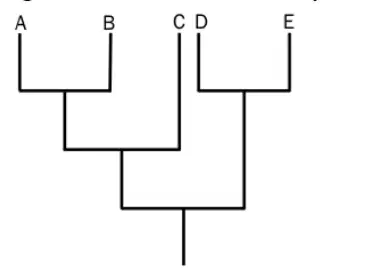
According to the phylogenetic tree, which species is most similar to species E?
A
B
C
D
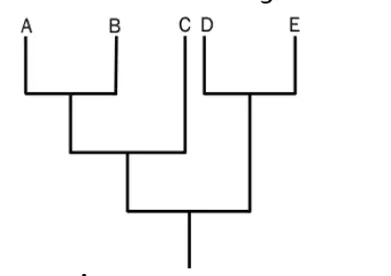
According to the phylogenetic tree, which organism has existed for the longest time?
A
B
C
D
What is considered to be the greatest threat to species today and is the main cause of endangerment of species?
a. Lack of genetic variation
b. Extreme natural events
c. Loss of habitat
d. Invasive species
Which of the following is NOT an example of artificial selection?
a. Antibiotic resistant bacteria
b. Seedless fruit
c. Domesticated animals
d. Breeding cows with high milk output
What is the definition of adaptation?
a trait that is beneficial to an organism.
one of two or more forms that a gene could take.
a rod-shaped structure within a cell’s nucleus that is composed of DNA and proteins.
change in the inherited traits of a population of organisms that occurs over many generations.
What is the definition of allele?
a trait that is beneficial to an organism.
one of two or more forms that a gene could take.
a rod-shaped structure within a cell’s nucleus that is composed of DNA and proteins.
change in the inherited traits of a population of organisms that occurs over many generations.
What is the definition of chromosome?
a trait that is beneficial to an organism.
one of two or more forms that a gene could take.
a rod-shaped structure within a cell’s nucleus that is composed of DNA and proteins.
change in the inherited traits of a population of organisms that occurs over many generations.
What is the definition of evolution?
a trait that is beneficial to an organism.
one of two or more forms that a gene could take.
a rod-shaped structure within a cell’s nucleus that is composed of DNA and proteins.
change in the inherited traits of a population of organisms that occurs over many generations.
What is the definition of trait?
a characteristic of an organism.
one of two or more forms that a gene could take.
a rod-shaped structure within a cell’s nucleus that is composed of DNA and proteins.
change in the inherited traits of a population of organisms that occurs over many generations.
What is the definition of Gene?
a segment of DNA that determines or helps to determine a trait.
the genetic makeup of an organism
a change in a gene. beneficial and/or harmful
the process by which favorable inherited traits become more common over time.
What is the definition of Genotype?
a segment of DNA that determines or helps to determine a trait.
the genetic makeup of an organism
a change in a gene. beneficial and/or harmful
the process by which favorable inherited traits become more common over time.
What is the definition of phenotype?
a segment of DNA that determines or helps to determine a trait.
the physical appearance of an organism
a change in a gene. beneficial and/or harmful
the process by which favorable inherited traits become more common over time.
What is the definition of mutation?
a segment of DNA that determines or helps to determine a trait.
the genetic makeup of an organism
a change in a gene. beneficial and/or harmful
the process by which favorable inherited traits become more common over time.
What is the definition of natural selection?
a segment of DNA that determines or helps to determine a trait.
the genetic makeup of an organism
a change in a gene. beneficial and/or harmful
the process by which favorable inherited traits become more common over time.
What is speciation?
The process by which new species are created.
The migration of a species from one habitat to another.
The extinction of a species.
The process by which a species changes color.
How does adaptation affect a species' survival?
It decreases a species' ability to survive and reproduce.
It has no effect on a species' survival.
It increases a species' ability to survive and reproduce in its environment.
It only affects a species' coloration and patterns.
What is an example of a vestigial structure?
The wings of a bird.
The appendix in humans.
The beak of a finch.
The tail of a monkey.
Which of the following best describes evolutionary patterns?
The random distribution of traits within a population.
The predictable changes in the environment over time.
The gradual changes in species over long periods of time.
The immediate changes in an organism's traits in response to a threat.
Which of the following is an example of adaptation?
A bear hibernating in winter.
A plant producing more seeds in a drought.
A chameleon changing its color to blend in with its surroundings.
All of the above.
What is natural selection?
The process by which individuals with beneficial traits produce more offspring, leading to changes in the traits of living organisms over time.
The ability of an organism to change its color in response to environmental changes.
A random process that results in the survival of the fittest individuals.
The process by which individuals acquire traits through use and disuse.
Which of the following is a mechanism of speciation?
Genetic drift
Gene flow
Natural selection
All of the above
What is the significance of the fossil record in studying evolution?
It provides direct evidence of organisms that lived in the past.
It shows that organisms have not changed over time.
It is only useful for studying plants.
It disproves the theory of natural selection.
How does gene flow affect a population?
It decreases genetic variation between populations.
It increases genetic variation within a population.
It has no effect on genetic variation.
It only affects the population's size.
What evidence supports the theory of evolution?
The fossil record.
Comparative anatomy.
Genetic evidence.
All of the above.
Why is genetic variation important for natural selection?
It ensures that all members of a species are identical.
It provides a mechanism for species to become extinct.
It provides the raw material for evolution, allowing populations to adapt to changing environments.
It decreases the survival rate of a species.
What role does mutation play in evolution?
It decreases genetic variation within a population.
It is the only source of new alleles.
It always results in beneficial traits.
It increases an organism's lifespan.
Which of the following best describes adaptive radiation?
Rapid evolution of many species from a single ancestor
Slow evolution of one species into another
The extinction of multiple species at the same time
The migration of a species across different continents
What is speciation?
The process by which new species are created from existing ones.
The decrease in the population size of a species.
The migration of a species from one area to another.
The extinction of a species.
What is natural selection?
The process by which species adapt to urban environments.
The process by which traits become more or less common in a population due to consistent effects upon survival or reproduction.
The intentional breeding of organisms to produce desired traits.
The random mutation of genes within an organism's DNA.
What does the fossil record provide evidence for?
The immutability of species over time.
The existence of modern technology in ancient times.
The gradual change of species over time.
The sudden appearance of new species without predecessors.
Which of the following is NOT considered evidence of evolution?
The geographic distribution of species
The similarity in DNA sequences among different species
The presence of vestigial structures
The consistency of fossil types in all geological layers
Which type of speciation occurs when a geographic barrier separates a population into two groups?
Sympatric speciation
Allopatric speciation
Peripatric speciation
Parapatric speciation
What is convergent evolution?
The process where two different species evolve similar traits.
The process where two similar species evolve different traits.
The process where a species splits into two distinct species.
The process where a species remains unchanged over time.
Which of the following is an example of a homologous structure?
The wings of a butterfly and the wings of a bird.
The flippers of a penguin and the arms of a human.
The tails of a fish and the tails of a monkey.
The beaks of different types of birds.
What does phylogeny refer to?
The study of animal behavior in different environments.
The study of plant growth and development.
The evolutionary history and relationships among species.
The genetic manipulation of organisms in a laboratory.

