
 Worksheets
Unit 9 Test Quizziz
Total questions: 27
Worksheet time: 14mins
Name
Class
Date
1.
__________ bonds involve the sharing electrons between two atoms.
a)
ionic
b)
hydrogen
c)
covalent
d)
polar
2.
__________ bond involve the transfer of electrons from one atom to another creating charged atoms that are attracted to each other.
a)
ionic
b)
hydrogen
c)
covalent
d)
polar
3.
When an atom gains electrons, it becomes a
a)
cation
b)
dogion
c)
anion
d)
onion
4.
When an atom loses electrons, it becomes a
a)
cation
b)
pawsion
c)
anion
d)
onion
5.
An element in group 17 will
a)
gain 1 electron
b)
lose one electron
c)
gain 7 electrons
d)
neither gain or lose because it is inert
6.
An element in group 15
a)
has 15 valence electrons, and will gain 3 more.
b)
has 5 valence electrons, and will gain 5 more
c)
has 15 valence electrons and will lose 7 electrons.
d)
has 5 valence electrons, and will gain 3 more.
7.
The octet rule states
a)
that atoms are trying to get a full outershell of electrons
b)
that some atoms will lose electrons to have a full outershell
c)
that some atoms will gain electrons to have a full outershell
d)
all of the above
8.
Electrons in the outermost shell of an atom
a)
are called valence electrons
b)
are the only part of the atom involved in bonding
c)
all of the above
d)
none of the above
9.
Sodium (Na) typically forms a
a)
+1 ion
b)
-1 ion
c)
+2 ion
d)
-2 ion
10.
Which of the following is Cl (chlorine) most likely to form an ionic bond with?
a)
Na (sodium)
b)
S (sulfur)
c)
C (carbon)
d)
Ne (neon)
11.
An element has 9 protons and 10 electrons. What element is this?
a)
Neon
b)
Fluorine
c)
Oxygen
d)
Potassium
12.

How many TOTAL ELECTRONS does the ion below have?
a)
18 electrons
b)
16 electrons
c)
14 electrons
d)
2 electrons
13.

How many TOTAL PROTONS does the ion below have?
a)
20
b)
19
c)
18
d)
1
14.

An ion has 15 protons and 18 electrons. Which is the correct ionic symbol for it?
a)
A
b)
B
c)
C
d)
D
15.
NaCl is
a)
an ionic compound
b)
a covalent compound
c)
a new element
d)
bonded with hydrogen bonds
16.

The compound below is
a)
ionic
b)
covalent
c)
polar covalent
d)
nonexistent
17.
The type of bond connecting oxygen and hydrogens in water are
a)
ionic bonds
b)
covalent bonds
c)
polar covalent bonds
d)
hydrogen bonds
18.
Oxygen has a stronger pull on the electron it shares with hydrogen.
a)
True
b)
False
19.
In a water molecule the oxygen end has a slightly ____ charge, while the hydrogen end is slightly _____.
a)
negative, positive
b)
positive negative
c)
negative, negative
d)
positive, positive
20.
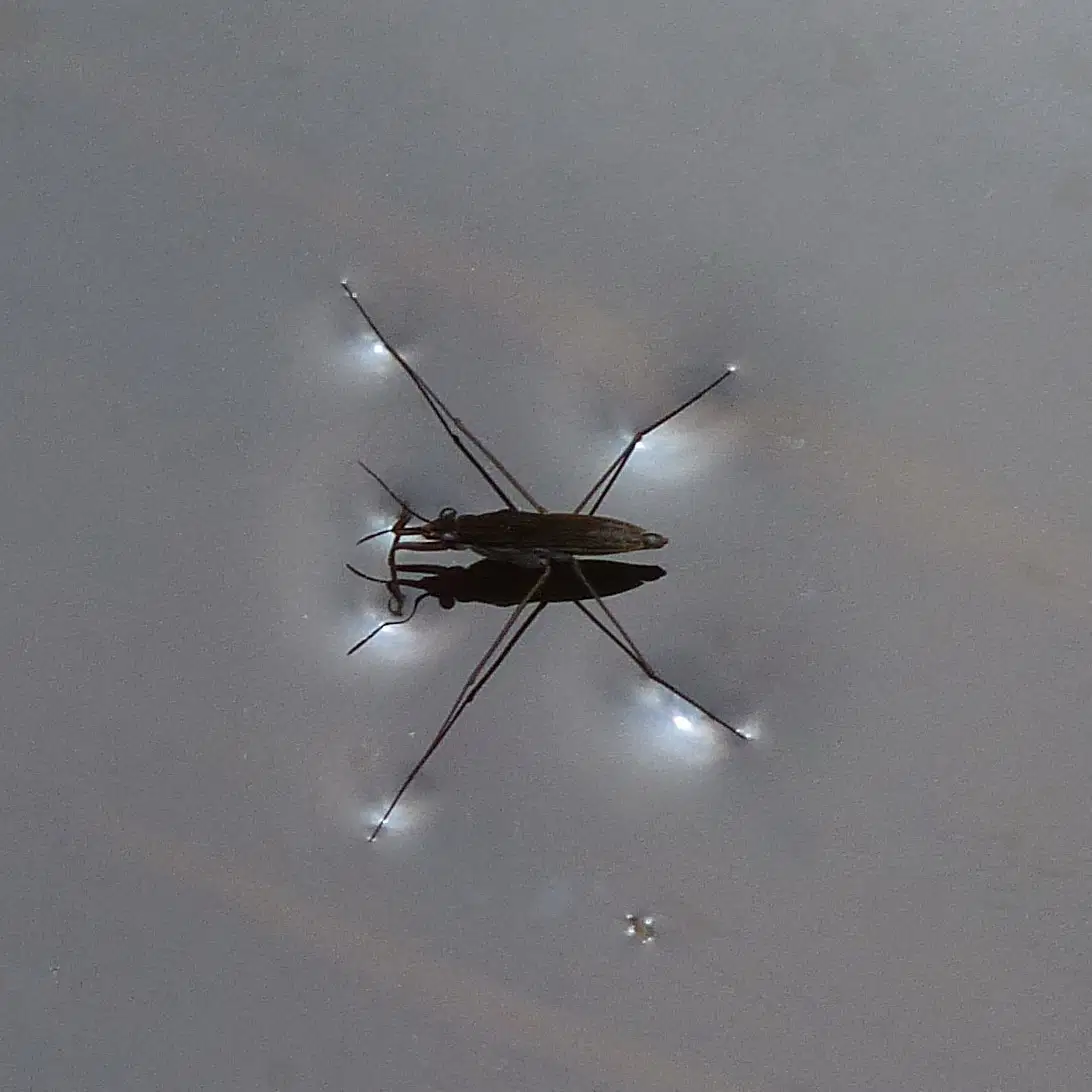
Which property of water allows the water strider below to remain on top of the water?
a)
high density
b)
surface tension
c)
high specific heat capacity
d)
low density
21.
_______ is when water molecules stick to other water molecules
a)
cohesion
b)
adhesion
c)
crystal lattice formation
d)
polar covalent bonds
22.
Water droplets sticking to a glass window pane is due to
a)
cohesion
b)
adhesion
c)
crystal lattice formation
d)
polar covalent bonds
23.
The type of bond between water molecules is called a/an
a)
ionic bond
b)
covalent bond
c)
polar covalent bond
d)
hydrogen bond
24.
The modern periodic table (the one we use) is arranged according to
a)
increasing atomic mass
b)
increasing atomic number
c)
alphabetical order
d)
decreasing atomic mass
25.
How many valence electrons will boron have?
a)
5
b)
2
c)
3
d)
13
26.
How many energy levels will lithium have?
a)
1
b)
2
c)
3
d)
4
27.

Which of the following images is the correct Lewis Dot Structure for Lithium?
a)
A
b)
B
c)
C
d)
D
100 %

