

wayground logo

Free Printable Worksheets

Font size

S
M
L
XL
Worksheets

2nd Semester FINAL review

Total questions: 100

Worksheet time: 54mins

Name
Class
Date
1.

In a command economy, economic decisions are made by the

a)

consumers.

b)

market.

c)

government.

d)

producers.

2.

What type of economy does North Korea have?

a)

Market

b)

Command

c)

Market

d)

Mixed

3.

Most democratic nations have _______ economies.

a)

mixed

b)

market.

c)

traditional.

d)

command.

4.

Poor decisions made about how to organize farming in North Korea have resulted in many years of

a)

drought

b)

labor strikes

c)

starvation

d)

protests

5.

Every country must answer these basic questions when developing its own economic plan EXCEPT

a)

what goods or services will be produced?

b)

how will goods or service be produced?

c)

will this make our country rich?

d)

Who will consume the goods or service?

6.

How does a traditional economy exchange goods?

a)

By stealing

b)

By the government telling the people what to exchange

c)

By paying for goods

d)

By bartering- trading without using money

7.

The economies of China, India, and Japan can all best be described as:

a)

traditional

b)

market

c)

command

d)

mixed

8.

If you were opening a shoe store where you set the prices based on buyer and seller interaction you would be practicing which type of economy?

a)

Command

b)

Traditional

c)

Market

d)

Democratic

9.

Premier Kim Jong-un has spent a great deal of North Korea’s money on:

a)

education

b)

military

c)

medical care

d)

foreign trade

10.

Which country's economy has grown steadily since WWII ended?

a)

China

b)

India

c)

Japan

d)

North Korea

11.

What is the least free economy we have studied?

a)

China

b)

India

c)

North Korea

d)

Japan

12.

Which is the freest economy we have been studying?

a)

China

b)

India

c)

Japan

d)

South Korea

13.

Who has the largeset and fastest growing economy in the world?

a)

China

b)

India

c)

South Korea

d)

Japan

14.

Scenario: India may only export 10,000 cotton sheets to Japan. What trade barrier is this?

a)

tariff

b)

quota

c)

embargo

d)

physical trade barrier

15.

Scenario: If South Korea refuses to trade with any countries that support terrorism. What trade barrier is this?

a)

tariff

b)

quota

c)

embargo

d)

physical trade barrier

16.

Scenario: Importers selling rice from Vietnam will be charged a 10% tax when their product enters South Korea. What trade barrier is this?

a)

tariff

b)

quota

c)

embargo

d)

physical trade barrier

17.

Tariffs and quotas are alike because they both __________________.

a)

restrict or limit trade between countries.

b)

completely stop trade between countries.

c)

increase trade between countries.

d)

make trading a lot easier between countries.

18.
Government policies that restrict or stop the flow of goods and services among countries.
a)
Trade
b)
Shortage
c)
Trade Barrier
d)
Scarcity
19.
Trading without anyone forcing you to do so.
a)
Voluntary Trade
b)
Embargo
c)
Trade Barrier
d)
Import
20.
Why would a country impose a tariff or quota on imported goods?
a)
to raise the price of imported goods and encourage people to buy local
b)
to raise the price of imported goods to help other countries make more money
c)
to be mean
d)
to help the country of the imported goods make a larger profit
21.
What is the definition of economic specialization?
a)
Producing all goods and services needed for a country’s growth, so that trade with other countries is not needed.
b)
Producing those goods a country can make easily so they can trade them for goods made by others that cannot be produced locally
c)
Directly swapping goods from one country to another withouthaving to use money
d)
Trying to avoid investing in industry and technology because ofthe expense involved.
22.
Government policies that restrict or stop the flow of goods and services among countries.
a)
Trade
b)
Shortage
c)
Trade Barrier
d)
Scarcity
23.

Traditional Economy

a)

economic decisions are made based on the government

b)

economic decisions are made by the people & government

c)

economic decisions are made based on custom and on the habit of how such decisions were made in the past

d)

economic decisions are made by the people

24.

Command economy

a)

decisions are based made by government planners

b)

decisions are based on tradition

c)

decisions are based on supply & demand

d)

decisions are based on supply, demand and by the government

25.

Market economy

a)

decisions are made by individuals who decide what to produce and what to buy

b)

decisions are made by government planners

c)

decisions are made by mixed economies

d)

decisions are made through generational traditions

26.

What is human capital ?

a)

skills and education workers have

b)

taxes collected from a country's workers

c)

money paid to workers for producing goods

d)

the amount of goods sold in foreign trade in a year

27.

Gross Domestic Product is the total value of all final goods and services produced in a country in a single year.

a)

True

b)

False

28.
Why do the individual voters have more power in a democracy than they do in an autocracy or an oligarchy?
a)
Kings are always cruel rulers.
b)
The people play a role in deciding who rules.
c)
All of the power stays in the hands of the local governments.
d)
The voters in democratic countries always choose qualified leaders
29.
A "president" got rid of elections, but rules with his military
a)
Unitary
b)
Autocracy
c)
Democracy
d)
Oligarchy
30.
India's leaders are elected
a)
Unitary
b)
Autocracy
c)
Democracy
d)
Oligarchy
31.
Government run only by a few people. Sometimes a government in which a small group exercises control especially for corrupt and selfish purposes. The citizen has a very limited role. 
a)
Democracy
b)
Autocracy
c)
Oligarchy
d)
Republic
32.
Government in which the supreme power is vested in the people and exercised by them directly or indirectly through a system of representation usually involving periodically held free elections. 
a)
Democracy
b)
Autocracy
c)
Oligarchy
d)
Dictatorship
33.
A system of government in which the leader is elected by the citizens and is constitutionally independent of the legislature. 
a)
Autocracy
b)
Oligarchy
c)
Parliamentary democracy
d)
Presidential democracy
34.

What is the main DIFFERENCE between a presidential democracy and a parliamentary democracy?

a)

A President controls a country and a Prime Minister controls a state.

b)

A Prime Minister does not belong to a political party while a President always does.

c)

A Prime Minister has more power than a President.

d)

A President is elected directly by the citizens, while a Prime Minister is elected by the Legislature.

35.

How are a democracy, oligarchy, and autocracy DIFFERENT?

a)

the sharing of power between the different levels of government

b)

the election of the three branches of government

c)

the role of the citizen

d)

the law making process

36.

In a parliamentary system, who is the head of government?

a)

Prime Minister

b)

President

c)

Monarch

d)

Dictator

37.
Which type of leader is a member of the country's legislature?
a)
king
b)
president
c)
prime minister
d)
dictator
38.
Mary leads her country. She was elected by the people. She has a lot of power but there are other branches of government that keep her power in check. What type of government does this describe?
a)
Presidential Democracy
b)
Parliamentary Democracy
c)
Constitutional Monarchy
d)
Dictatorship
39.
In this type of democracy, the law-making body (legislature) chooses the leader.
a)
presidential
b)
republic
c)
dictatorship
d)
parliamentary
40.
Representative democracy where the executive branch is part of the legislative branch
a)
Direct democracy
b)
Presidential democracy
c)
Parliamentary democracy
d)
Republic
41.

European countries were interested in colonizing Africa because______, SS7G1

a)

Africa was rich in mineral resources.

b)

Africa was far away from Europe.

c)

Africa was already colonized by the United States.

d)

Africa was smaller than Europe.

42.

Citizens of _______ have some say in choosing leaders since their government is a presidential democracy. SS7CG1.a

a)

Kenya

b)

Ethiopia

c)

Madagascar

d)

Somalia

43.
Which feature is marked with a "H"?
a)
Andes Mountains
b)
Himalaya Mountains
c)
Atlas Mountains
44.
Which country is marked with a "C"?
a)
Kenya
b)
Nigeria
c)
Sudan
d)
Egypt
45.
Which feature is marked with a "B"?
a)
Nile River
b)
Congo River
c)
Niger River
d)
Jordan River
46.
Which country is marked with a "B"?
a)
South Sudan
b)
Sudan
c)
South Africa
d)
Egypt
47.
Which country is marked with a "A"?
a)
Sudan
b)
Egypt
c)
South Sudan
d)
Nigeria
48.
Which feature is marked with a "D"?
a)
Sahel 
b)
Sahara Desert
c)
Savanna
d)
Tropical Rain Forest
49.
Which country is marked with a "F"?
a)
Nigeria
b)
Egypt
c)
Kenya
d)
Sudan
50.
Which feature is marked with a "E"?
a)
Sahel 
b)
Sahara Desert
c)
Kalahari Desert
d)
Gobi Desert
51.
Which country is marked with a "D"?
a)
Egypt
b)
Sudan
c)
South Africa
d)
South Sudan
52.
Which feature is marked with a "A"?
a)
Nile River
b)
Congo River
c)
Niger River
d)
Jordan River
53.
Which country is marked with a "G"?
a)
Democratic Republic of the Congo (DRC)
b)
Egypt
c)
Sudan
d)
Nigeria
54.
Which feature is marked with a "K"?
a)
Savanna
b)
Tropical Rain Forest
c)
Sahara
d)
Sahel
55.
Which feature is marked with a "J"?
a)
Savanna
b)
Sahara 
c)
Sahel
d)
Tropical Rain Forest
56.
Which feature is marked with a "C"?
a)
Congo River
b)
Nile River
c)
Jordan River
d)
Niger River
57.

What tends to be a shared quality among individuals of the same ethnic group but NOT necessarily

among members of the same religious group?

a)

a similar set of beliefs

b)

a common ancestry

c)

a common moral code

d)

a similar set of rituals

58.

Which of the following statements about ethnic groups and religious groups is correct?

a)

Both ethnic and religious groups are defined by political borders.

b)

Members of an ethnic group usually belong to different religious groups.

c)

Individuals belonging to the same religious group do not always share an ethnicity.

d)

Member of both ethnic and religious groups all come from the same backgrounds.

59.

Why did Europeans first become interested in Africa?

a)

To discover platinum

b)

Trade routes

c)

To start slavery

d)

Because they thought Africa was nice

60.

Imperialism is a system were a strong country takes wealth and raw materials from another country.

a)

False

b)

True

61.

When Europeans returned to Africa for more resources, they brought back the manufactured goods and sold them to Africans.

a)

True

b)

False

62.

Nationalism is a strong sense of pride in one's nation.

a)

True

b)

False

63.

Did any Africans attend the Berlin Conference? Was this fair?

a)

Yes; Yes

b)

Yes; No

c)

No; No

d)

No; Yes

64.

At the Berlin Conference, the European leaders discussed Africa’s land and how it should be divided.

a)

True

b)

False

65.
 After Nelson Mandela was freed from prison in 1990, what did he and President F. W. de Klerk do?
a)
He became locked in a struggle for control of the country.
b)
He presented competing arguments to the United Nations.
c)
He developed a two-state solution to South Africa's problems.
d)
He worked together on rewriting the South African constitution. 
66.
Which is NOT a primary goal of the Pan-African movement?
a)
Worldwide African unity
b)
Increase agricultural production in Africa
c)
Decreased violence in African communities
d)
Creating a sense of “belonging” for all Africans
67.
How has the Pan-African movement had an impact on the world?
a)
Economies in African countries use it to trade with other countries.
b)
It has led to more civil wars and political corruption in Africa.
c)
Because it is so small, the movement has not had an affect outside of Africa.
d)
It has tried to unify citizens in African countries and African citizens around the world.
68.
*Seeks to unify African citizens
*Tries to make African countries more independent
 *Believes Africans across the continent share common bonds and connections
The statements in the list above describe which idea?
a)
Apartheid
b)
African Culture
c)
The Pan-African movement
d)
The European partitioning of Africa
69.
"We enter into a covenant that we shall build a society in which all South Africans, both black and white, will be able to walk tall, without and fear in their hearts, assured of their inalienable right to human dignity – a rainbow nation at peace with itself and the world."
Nelson Mandela, Inaugural Address, Pretoria 9 May 1994.

Why was Nelson Mandela’s inaugural address so focused on racial issues?
a)
Race was the only issue of importance at the time
b)
He was a major leader in the anti-apartheid movement
c)
He was elected by a group demanding that apartheid continue
d)
South Africa was, for the first time, a majority white country
70.
The modern day political boundaries, civil wars, and conflicts found in Africa can often be traced back to which of the following event?
a)
European partitioning and colonization
b)
Ancient African trading empires
c)
European cooperation in the late 1800s
d)
Asian invasions in the 1800s
71.
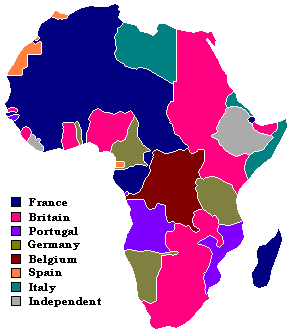
Which conclusion is accurate based on the map above?
a)
A  the partitioning of Africa into colonies creates uneven and artificial political boundaries
b)
A  European countries divided Africa because there were no civilizations there in 1914
c)
A  modern African countries probably enjoy these boundaries because they all follow rivers
d)
A  there were so many European countries that had colonies in Africa, there was little conflict
72.
Why are civil wars commonplace in some African countries?
a)
African cultures have evolved over time into naturally warring cultures
b)
There is usually no agreement as to what to do with resources in Africa
c)
Much like the Civil War in the United States, slavery is the major reason
d)
The boundaries of countries were set without reason by European countries
73.
Apartheid in South Africa resulted mainly from which historical event? 
a)
Pan-Africanism
b)
Creation of Israel
c)
British colonization
d)
the Cultural Revolution
74.
Kenya gained independence in 1963 after a rise in the beliefs of the citizens that they had much common ground, should govern themselves, and could express their culture better on their own.  This intense belief in one’s country is known as which philosophy?
a)
Nepotism
b)
Capitalism
c)
Nationalism
d)
Confucianism
75.
How did nationalism affect countries like South Africa, Nigeria, and Kenya in the 1900s?
a)
It led to greater demand for independence
b)
Nationalism reduced conflicts within these countries
c)
It prevented these countries from gaining independence
d)
European countries used it to further their colonization of these countries
76.
Which two countries had the GREATEST number of colonies in Africa in the late 1800s?
a)
China and Japan
b)
Spain and Portugal
c)
Great Britain and France 
d)
Great Britain and the United States
77.
South Africa’s first free election that was open to all races occurred in ________.
a)
1964
b)
1994
c)
1999
d)
2013
78.
Which describes FW de Klerk's role in ending apartheid in South Africa?
a)
He lifted many bans that were rooted in racial segregation and freed the leader of the ANC.
b)
A system of laws that brought equality to races
c)
He forced millions of people to leave their impoverished homelands.
d)
He started the National Party in South Africa.
e)
He imprisoned the leader of the ANC and created many segregation bans.
79.
In the Hindu religion the Ganges River is considered holy, and ritual bathing in its waters is practiced by an estimated 60,000 people per day. What is the MOST LIKELY effect of this practice?
a)
Such use of the river has raised major health risks for the population of the area.
b)
Tourism in the area has increased, and many new settlements are being established along the river.
c)
The government has passed laws to restrict access to the water to discourage pollution and contamination
d)
The government of India has worked to dam the river flow so people can practice ritual bathing without contaminating the water.
80.

Huang He (Yellow River)

a)

2

b)

4

c)

6

81.

Chang Jiang (Yangtze) River

a)

2

b)

4

c)

6

82.

Gobi Desert

a)

1

b)

2

c)

3

d)

4

83.

Himalayan Mountains

a)

1

b)

2

c)

3

d)

4

84.

Korean Peninsula

a)

1

b)

2

c)

3

d)

4

85.

Taklimakan Desert

a)

1

b)

2

c)

3

d)

4

86.

What Asian country is number 1?

a)

Japan

b)

China

c)

Vietnam

d)

South Korea

87.

What Asian country is number 2?

a)

Japan

b)

China

c)

India

d)

South Korea

88.

What Asian country is number 3?

a)

Vietnam

b)

South Korea

c)

North Korea

d)

Japan

89.

What Asian country is number 4?

a)

Vietnam

b)

Japan

c)

South Korea

d)

North Korea

90.

What Asian country is number 5?

a)

Vietnam

b)

Japan

c)

South Korea

d)

North Korea

91.

What Asian country is number 6?

a)

Japan

b)

Indonesia

c)

India

d)

Vietnam

92.
What was the purpose of the Ganges Action Plan that begun in 1980's?
a)
To try and clean up the river
b)
To bring an end to the cremations
c)
Replanting trees along the rivers
d)
To end using the river for drinking water
93.
A recent air quality study conducted by the World Health Organization showed that 7 of 10 of the world's most polluted cities are in China. What is the MOST LIKELY effect of such pollution on the people of China?
a)
The Chinese population is moving from urban to rural areas to escape the pollution.
b)
Respiratory and heart disease related to air pollution are the leading causes of death in China.
c)
The Chinese government is cooperating with the United Nations to solve the pollution problem.
d)
The water sources of the nation are being severely damaged as a result of the air pollution.
94.
What country has polluted their water sources by tossing cremated remains into the river?
a)
India
b)
Japan
c)
North Korea
d)
China
95.
Why are there not a lot of cities along the banks of the Yellow River in China?
a)
Violation of the Hindu religion
b)
It is in the desert
c)
Constant flooding
96.

What are some causes of flooding in India and China?


Select ALL that apply.

a)

typhoons, monsoons, and tropical storms

b)

urban development

c)

rapid runoff from the Yangtze and Ganges Rivers

d)

large number of cars

97.

What are some causes of pollution in the Yangtze River?


Select ALL that apply.

a)

sewage runoff

b)

industrial runoff

c)

agricultural runoff

d)

All of the above

98.

What are some effects of pollution in the Ganges River?


Select ALL that apply.

a)

health issues and death

b)

a lack of drinkable water

c)

a negative impact on the economy

d)

a sleeping disorder

99.

In India, air pollution is a very serious problem. What is the primary cause of the serious indoor air pollution problem in India?

a)

Improper sanitary procedures

b)

Lack of green cleaning products

c)

Too many people in the cities

d)

Cooking and heating with coal and animal waste

100.
True or False: There is a high population density in the area of the Himalayan Mountains and the Taklimaken Desert.
a)
True
b)
False
