
 Worksheets
Observing Children
Total questions: 45
Worksheet time: 23mins
What vital information can be obtained by observing children?
Needs, Interests, Abilities, Learning styles
Preferences, Hobbies, Skills, Educational background
Health, Nutrition, Exercise habits, Sleep patterns
Family background, Socioeconomic status, Cultural beliefs, Personal values
What can observing children at play help you discover about them?
Their educational background
Their interests
Their favorite foods
Their vacation preferences
Why is it important to observe children according to the text?
To assess their developmental levels
To plan their meals
To schedule their day
To choose their clothes
What does observing children allow you to understand about their behavior?
Their strategies to attain goals
Their ability to follow rules
Their reading skills
Their mathematical abilities
According to the text, what does observing children help an observer learn about?
The children's family history
The children's personalities
The children's academic grades
The children's future careers
What benefit does observing children provide in terms of their skills?
Helps identify skills they need to practice
Helps choose sports they should play
Helps decide the books they should read
Helps select the games they should play

What is the first step in the Assessment Process diagram shown?
Assess Data
Set Goals and Inform Curriculum
Observe and Collect Data
Review Assessment
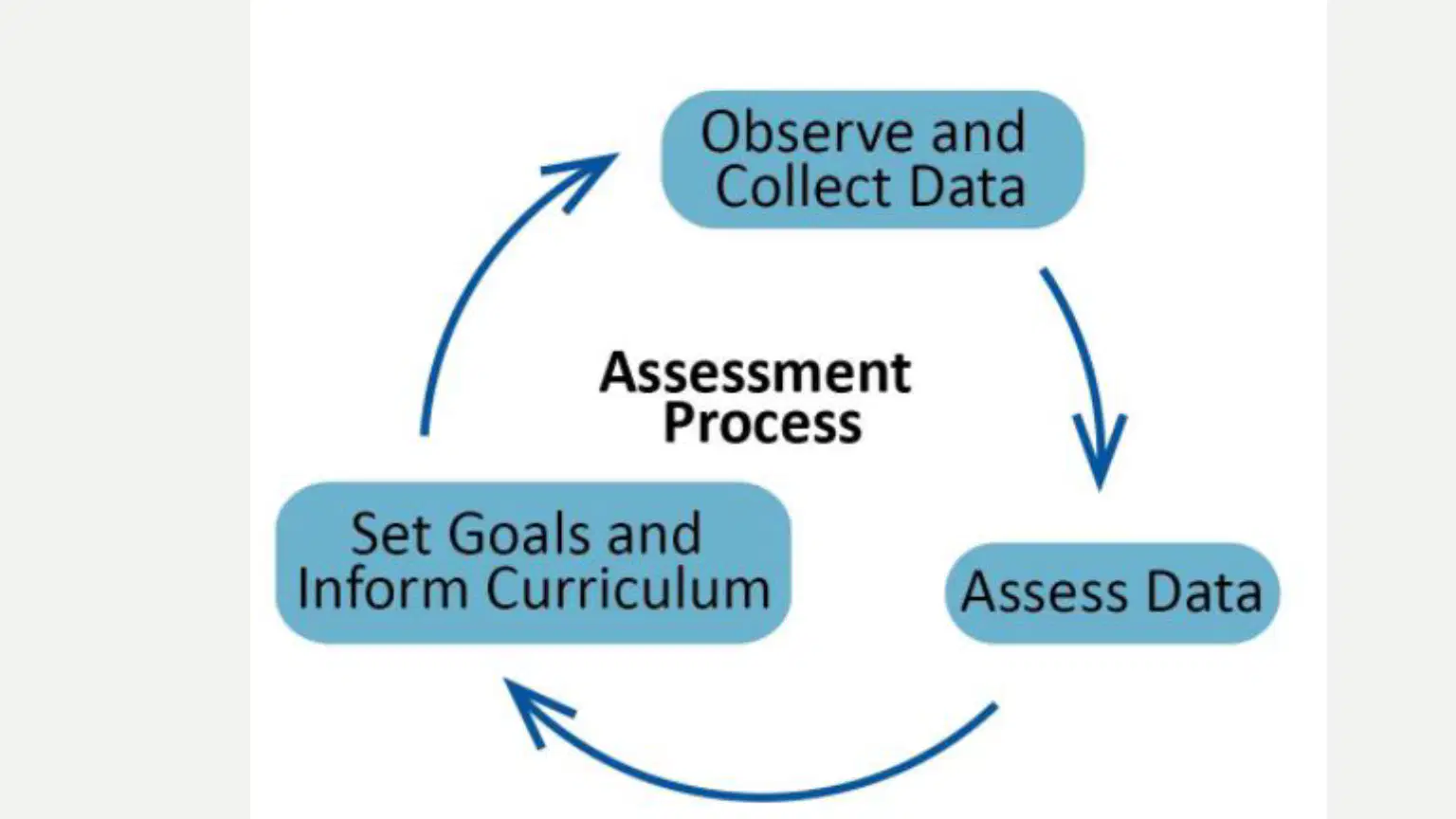
According to the diagram, what follows after assessing the data?
Observe and Collect Data
Set Goals and Inform Curriculum
Review Goals
Plan Curriculum Changes

What is the purpose of setting goals and informing the curriculum in the Assessment Process?
To collect more data
To finalize the assessment
To guide the next steps of data observation
To start the assessment process
What is considered one of the oldest and best methods for learning about children?
Experimentation
Observation
Survey
Hypothesis
What does observation of a young child involve besides looking at their actions?
Ignoring the details of the child's behavior
Recording details of the child's behavior in a structured manner
Guessing the reasons behind the child's behavior
Only watching the child from a distance
What is the purpose of assessing the implications of a child's actions during observation?
To punish the child
To plan future observations
To understand the underlying reasons and implications of the behaviors
To entertain the observer
What is considered the best method for learning about preschooler's behavior besides direct observation?
Make them take a Paper and Pencil Test
Just Ask them
Observation is the best method
None of the above
What is the first step in learning about children's behavior according to the text?
Analyze notes
Take notes
Observe their behavior
Compare against past observations
What does a child care worker or teacher do after taking notes on children's behavior?
Immediately discuss with parents
Analyze the notes to compare against past observations, figure out problems, and share with families
Ignore the notes
Store the notes for future reference
What does the Latin origin of the word "Assessment" mean?
To measure and evaluate
To sit beside and get to know
To test knowledge
To observe from a distance
What is the primary process involved in assessment as described in the image?
The process of testing and grading
The process of observing, recording, and documenting children's growth and behavior
The process of interviewing and questioning
The process of teaching and instructing
What is a key characteristic of authentic assessment in educational settings?
It must be completed within a ten-minute session.
It is most accurate when done quickly.
It should be conducted over time in play-based situations.
It requires a written exam to be effective.
Which of the following is NOT true about authentic assessment?
It cannot be done in one ten-minute session.
It is less accurate than traditional testing.
It must be done over time.
It is considered the most accurate form of assessment.
What is the process of collecting information or data known as in educational contexts?
Evaluation
Analysis
Assessment
Interpretation
What does evaluation involve in the context of education?
Gathering data only
Reviewing information and finding value in it
Simply testing students
Organizing data
What is Susie doing when she watches Joey stack blocks?
Evaluating Joey's social skills
Assessing Joey's fine motor development
Teaching Joey how to stack blocks
Playing games with Joey
What does Susie conclude after reading her notes about Joey?
Joey is advanced in fine motor development
Joey needs help with his social skills
Joey is slightly behind in his fine motor development compared to other children
Joey is excellent in stacking blocks

What is the primary purpose of assessment in education according to the image?
To grade students
To inform teachers about children's developmental needs
To discipline students
To entertain students

How is the information collected from assessments used according to the image?
For administrative purposes
For planning lessons
For planning school events
For creating sports teams
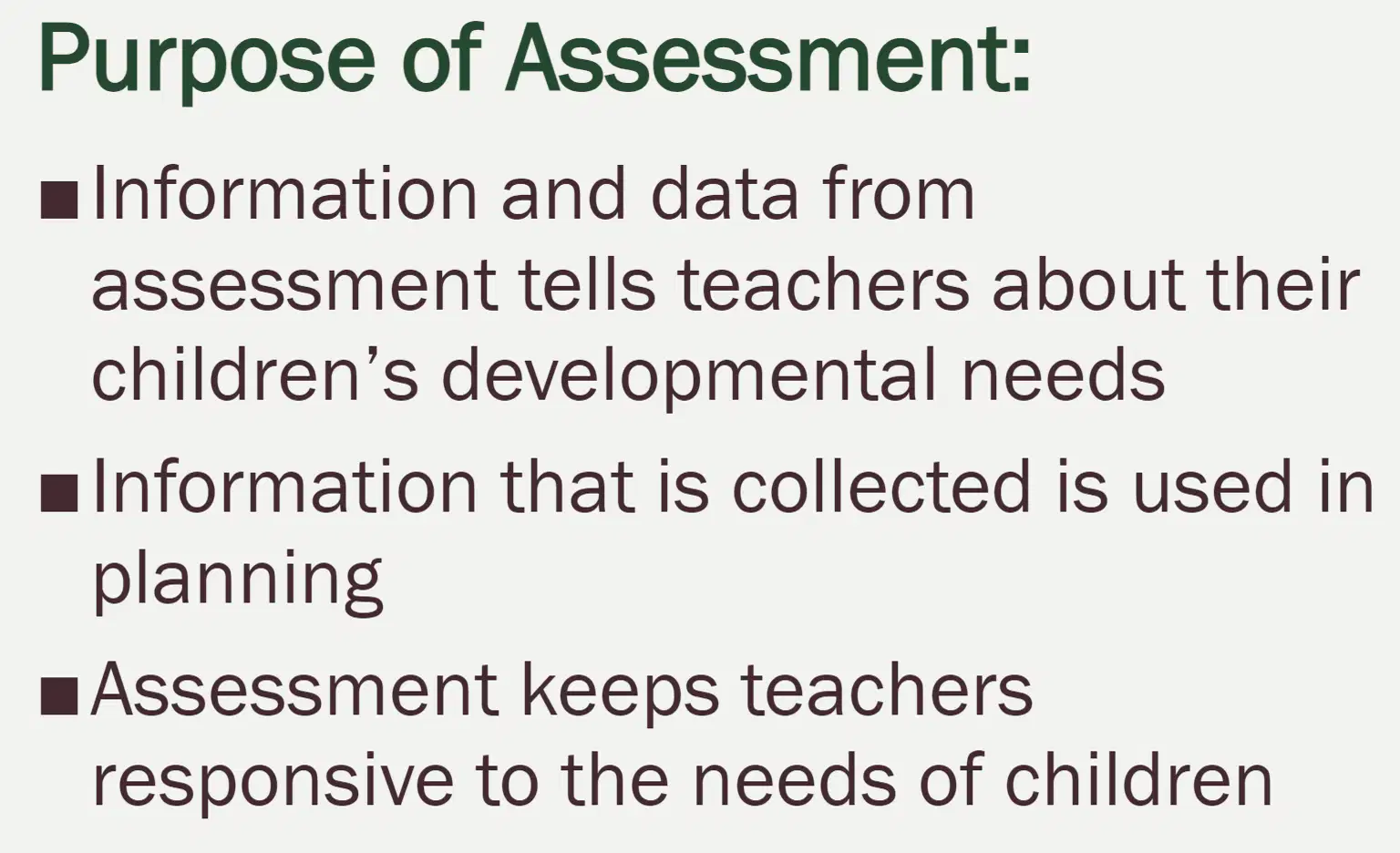
According to the image, what does assessment help teachers to be?
More authoritative
More responsive to the needs of children
Less involved
More focused on teaching skills
What is one of the purposes of assessment according to the image?
To schedule exams
To learn about the children's strengths
To assign homework
To plan field trips
According to the image, what does assessment help a teacher understand about students?
Their favorite subjects
Their learning styles
Their home environment
Their vacation preferences
Which of the following is NOT listed in the image as something that assessment reveals about students?
Weaknesses
Strengths
Learning styles
Future careers
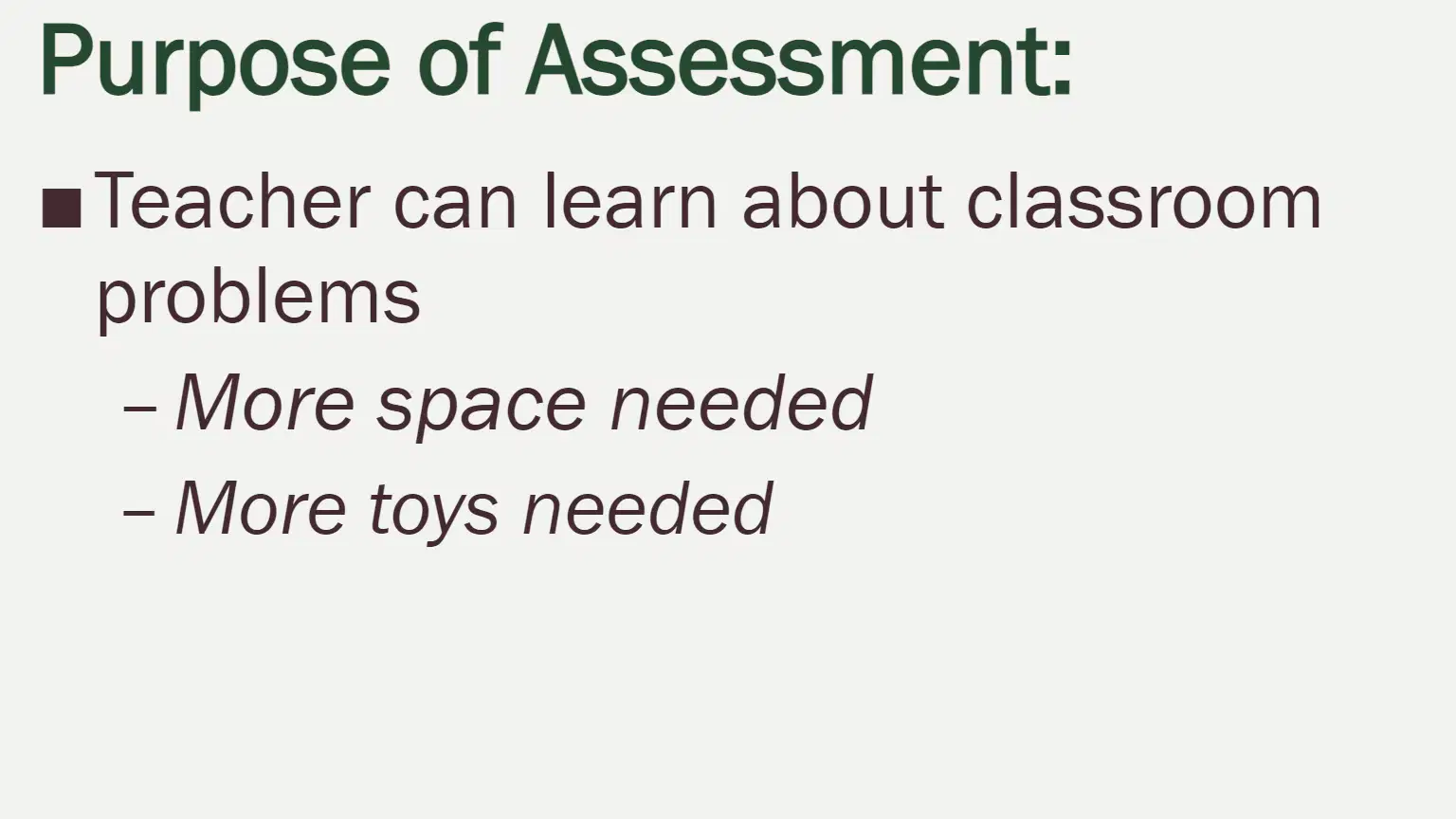
What can a teacher learn about from classroom assessments according to the image?
Student preferences for lunch
Need for more classroom space
Types of books needed in the library
Need for more sports equipment

According to the image, what is one of the classroom needs identified through assessment?
More computers
More books
More toys
More desks
What is one purpose of assessment in education as mentioned in the material?
To increase standardized test scores
To identify students with special needs
To reduce the number of students in class
To enhance sports activities
Which type of impairment is mentioned as a special need that assessments help to identify?
Cognitive impairments
Vision impairments
Mobility impairments
Dietary impairments
What kind of problem besides hearing and vision impairments is identified by assessments according to the text?
Mathematical problem
Emotional or behavior problem
Scientific reasoning problem
Language problem
According to the material, why can it be hard to notice special needs in students?
Because students hide their problems
Because of focusing on individual performance
Because of focusing on the large group
Because teachers lack training
What is one purpose of assessment in education as mentioned in the material?
To discipline students
To allow teachers to gain information about children for use during parent conferences
To schedule school events
To grade student performance
According to the material, what can assessments provide during parent conferences?
General feedback about class performance
Specific evidence about the child
Information about school policies
Details on upcoming school activities
What do parents like to hear about during parent conferences as per the learning material?
School financial plans
Updates on school infrastructure
About their child
Information about teachers
What could be a consequence if a teacher never took time to observe children or conduct assessments?
She would adapt her teaching methods based on student feedback.
She would keep on teaching without changing anything.
She would improve the learning environment.
She would use more interactive teaching tools.
When should initial assessments typically be conducted in an educational setting?
End of the year
Middle of the year
Beginning of the year
After every term
What type of data is primarily collected during initial assessments?
Final exam scores
Entry data
Graduation rates
Teacher evaluations
What is the purpose of ongoing assessments in an educational context?
To prepare for final exams
To assign final grades
To monitor progress throughout the year
To evaluate teacher performance
____________________ is when a childcare worker recognizes and notes an identifiable performance or behavior and uses checklists, anecdotal records, etc.
Observation
Screening
Interpretation
Intervention
Which of the following activities is most beneficial for a child's physical development?
Watching educational videos
Listening to music
Engaging in outdoor play
Reading picture books
What is the primary purpose of pretend play in early childhood development?
To improve physical coordination
To enhance social skills
To develop cognitive abilities
All of the above

