
NEW
Font size
 Worksheets
Modernized Vehicle Inspections Quiz
Total questions: 69
Worksheet time: 35mins
What is the primary purpose of vehicle inspections as mentioned in the document?
To ensure the vehicle looks presentable
To prevent accidents and ensure safety
To comply with manufacturer's guidelines
To increase fuel efficiency
According to the VI Study Guide, which of the following is NOT a reason for conducting vehicle inspections?
To save lives and protect the motoring public
To improve personal driving skills
To identify changes or tampering with the equipment
To comply with federal and state law and company policy
What must be checked for all metal parts during a vehicle inspection?
They must be visually appealing
They must be cracked, bent, or broken
They must not be cracked, bent, or broken
They must be loosely fitted
What is required for all reservoirs during a vehicle inspection?
They must be empty
The level of fluid must be below the add fill line
The level of fluid must be between the add and fill line
They must be removed and cleaned
What should be checked under the "In-Vehicle/Engine Start" section during a Class A vehicle inspection?
Tires and rims
Air or hydraulic brake check
Fuel tanks and DEF tank
Passenger seating
Which of the following is NOT part of the "Lights Operations Check" for a Class A vehicle?
All external lights
Lenses
Heater and defroster
Horn(s)
According to the checklist, what must you do with the items on the CDL Vehicle Inspection checklist during the test?
Only name the items
Name, point to or touch, and fully explain what you are inspecting
Check off items silently
Inspect only visually without explanations
What is the purpose of the fire extinguisher in an in-vehicle inspection?
To be used as a door stop
To extinguish fires
To signal other drivers
To check engine oil level
During an in-vehicle inspection, what should be the condition of the driver, passenger, and hood mirrors?
Cracked and obstructed
Clean, clear, and adjusted to the driver
Decorated with stickers
Folded and stored away
What is checked in the windshield during an in-vehicle inspection?
Presence of decorative items
Cracks, cleanliness, and obstructions
Color and tint of the windshield
Stickers only
What should the air pressure gauges indicate during an in-vehicle inspection?
50 to 70 psi
120 to 140 psi
200 to 220 psi
300 to 320 psi
How should the heater/defroster be demonstrated during an in-vehicle inspection?
By turning the control knob to the defrost/foot well position and pointing out the air source
By keeping the control knob at the minimum setting
By only activating the defroster
By turning off the vehicle
What is the purpose of performing a Parking Brake (Tug) Test on a vehicle?
To check the vehicle's alignment
To ensure the vehicle does not move or roll when parked
To test the vehicle's battery life
To verify the functionality of the vehicle's headlights
During the Parking Brake Test, what should you do after pushing the red button (trailer brake released)?
Push the yellow button (parking brake released)
Turn off the engine
Check the rearview mirror
Accelerate to 10 mph
What is the correct procedure to test the Service Brake (Brake Pedal)?
Push both the parking brake and trailer brake buttons in, drive the truck to 10 mph, then check alignment
Push both the parking brake and trailer brake buttons in, ease off the clutch, and get the truck to 5 mph
Only push the parking brake button and accelerate
Push the trailer brake button and check the brake lights
What will cause an automatic failure in the brake test?
Not checking the mirrors frequently
Touching the brake buttons after the initial setup
Driving over 5 mph during the test
Not using the clutch properly
What is the maximum air pressure drop allowed during the 60-second test period in the Leak Test as per the G.L.A.B. tests instructions?
3 psi
4 psi
5 psi
6 psi
During the Governor Cut-Out test, what should the idle speed be raised to in order to listen for the governor cut-out (purge)?
900-1000 rpm
800-900 rpm
1000-1100 rpm
700-800 rpm
For the Buttons Test (Emergency Brakes), at what pressure should both brake buttons pop out?
Between 45 and 20 psi
Between 50 and 30 psi
Between 40 and 25 psi
Between 55 and 35 psi
What is the required action if the low air warning alarm does not activate at or above 55 psi during the Low Air Warning Alarm Test?
Continue the test as normal
Immediately stop the test and notify the examiner
Restart the entire test sequence
Note the issue but complete the test
What should be checked for visible damage during the walk-up inspection of a vehicle's front?
Engine oil level
Steering wheel alignment
Lenses of the head lights
Tire pressure
What is the correct coolant level in the coolant reservoir?
Below minimum
Between add & full
Above maximum
At the minimum mark
When checking the power steering reservoir, what should be ensured?
The reservoir is empty
The hoses are not secured
There are no indications of leaks
The fluid is below the refill mark
What should be done to check the oil level using the dipstick?
Push it in and leave it
Check the color of the oil
Pull it out, wipe it off, and insert it again to check the level
Shake the dipstick
What should be listened for when inspecting hoses in the engine compartment?
Radio interference
Audible or visual air leaks
Engine noise
Horn functionality
How should the steering gear box and hoses be maintained?
Loosely to allow flexibility
Without checking for leaks
Securely and without leaks
Only visually inspected
What is a critical check for steering linkage components?
They should be painted
They should be loose and flexible
They should not be worn or cracked and must be lubricated
They should be replaced every year
What should be ensured about the leaf springs in the front suspension of a vehicle?
They should be shifted regularly.
They should be cracked to ensure flexibility.
They should not be shifted, cracked, or otherwise broken.
They should be lightly oiled.
What is a critical aspect to check regarding the brake hoses and lines?
They should be loosely fitted to allow movement.
They should be cracked and bent.
They should be properly mounted and secured without cracks or leaks.
They should show visible signs of leaking to ensure lubrication.
What minimum condition should the tire tread depth meet, according to the document?
Less than 1/32 of an inch in all major grooves.
More than 4/32 of an inch in all major grooves.
Exactly 1/2 inch in all major grooves.
No specific depth is necessary.
According to the document, what indicates that lug nuts and studs might be too tight?
Missing lug nuts.
Rust trails on the lug nuts.
Loose lug nuts.
Visible cracks around the lug nuts.
What should be ensured about the lenses and reflectors on the side of a vehicle?
They should be dirty and obstructed
They should be the proper color, clean, clear, and not missing or broken
They should be loosely attached
They should be of varying colors and designs
What is crucial to check regarding the vehicle's mirrors/traffic monitoring device?
They should be adjusted only once a year
They should be mounted with temporary fittings
All mounting hardware is securely mounted and mirrors are free of obstructions
Mirrors do not need to be cleaned regularly
What should be verified about the vehicle's batteries?
Batteries should show signs of excessive corrosion
Connections should be loose
Battery box door or cover is not important
Connections are tight and show no signs of excessive corrosion, and battery box door or cover is secured
What is necessary to ensure about the vehicle's fuel tanks?
Tanks should have visible leaks
Caps do not need to be tight
Tanks are securely mounted, caps are tight, with no visible leaks
Fuel tanks should be mounted loosely to avoid pressure
What should be checked regarding the vehicle's frame?
Frame rails & cross members should have loose or missing nuts/bolts
It's acceptable for the locking pins to allow movement of the cradle assembly
Frame should have cracks and broken welds
Check frame rails & cross members for any loose or missing nuts/bolts, and ensure locking pins do not allow movement of the cradle assembly
What color should the lenses and reflectors on the rear of a trailer be if they are in proper condition?
Red and uncracked
Blue and clean
Green and damaged
Yellow and securely mounted
What is essential to check about the mounting of reflectors on the rear of a trailer?
They are loosely fitted
They are securely mounted
They are removable
They are internally illuminated
What should be checked for in the air lines and electric connectors of a tractor to ensure proper function?
Color and length of the lines
Abrasions, bubbles, cuts, and dry rot
Temperature of the lines
Smoothness of the lines
Before reattaching the tractor's air lines and electric connectors, what is important to check regarding the rubber grommets?
Their color
Their flexibility
Cuts or tears
Their length
For the electrical connectors on both the tractor and trailer, how many pins should be present and not broken or bent?
5
6
7
8
What must be ensured about the debris in the electrical connectors on the tractor and trailer?
It is minimal
It is non-conductive
It does not block the plug
It is visible
What should be checked on the apron of a trailer to ensure it is in good condition?
Paint color and cleanliness
Rust, broken welds, and missing bolts
Tire pressure and alignment
Electrical wiring and lights
What is crucial to inspect on the 5th Wheel Skid Plate of a trailer?
The color and design of the skid plate
The presence of pivot pins and their connection to the truck
The branding and model number
The placement of decals and stickers
What should be ensured about the Slide rail Locking pin on a trailer?
It is aesthetically pleasing
It is in the locked position and free from cracks or breaks
It is easily removable
It is the original manufacturer part
What must be verified about the Release Arm & Safety Latch on a trailer?
It matches the trailer’s color
It is not cracked, bent, or broken and all hardware is tight
It has a modern design
It is covered under warranty
What is the required minimum clearance between the back of the tractor and the front of the trailer according to the document?
Two feet
Three feet
Four feet
Five feet
According to the document, what should be ensured about the kingpin?
It should be loosely mounted
It should be visibly bent or cracked
It should be securely mounted and not bent or cracked
It should have visible rust
What should be observed about the locking jaws if the truck is attached to a trailer?
They should be loosely fitted
They should be firmly locked around the king pin
They should be visibly damaged
They should be painted
What condition should the reflector tape be in according to the document?
Missing or loosely attached
Cut, torn, or frayed
Securely mounted and not cut, torn, or frayed
Faded and not visible
What should be ensured about the landing gear's gear box, supports, and braces?
They should be damaged and missing parts
They should be loosely attached
They should not be damaged and should have no missing parts
They should be unsecured
What should you check on both the tractor and the trailer during an outside light operations check?
Only the headlights and brake lights
Only the headlights, high-beam lights, and turn signals
Headlights, high-beam lights, turn signals, flashers, clearance lights, taillights, and brake lights
Only the taillights and clearance lights
When inspecting a combination vehicle's lights, what is the exception noted for the applicant?
The applicant needs to inspect only the front lights of the trailer
The applicant needs to inspect only the rear lights of the trailer
The applicant needs to inspect all lights on both the tractor and the trailer
The applicant does not need to inspect any lights on the trailer
What is necessary to ensure before moving the truck?
Ensure the truck is in neutral and the headlights are on
Ensure all passengers are seated and the radio is off
Ensure the air tanks are depleted and the truck is in gear
Ensure the air pressure is sufficient and the truck is ready for a safe start
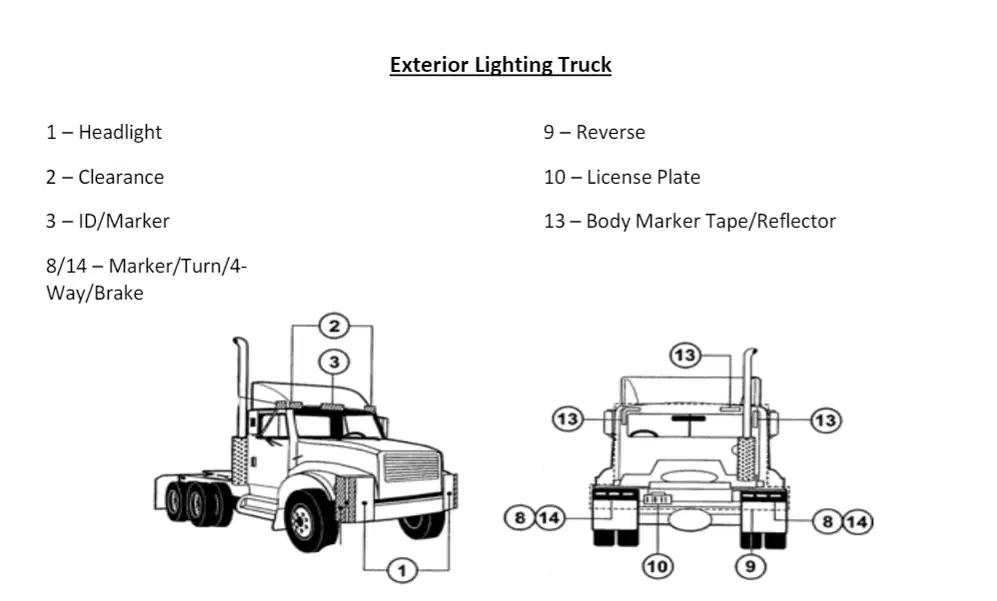
What is the function of the component labeled '1' on the Exterior Lighting Truck diagram?
License Plate
Headlight
Body Marker Tape/Reflector
Reverse
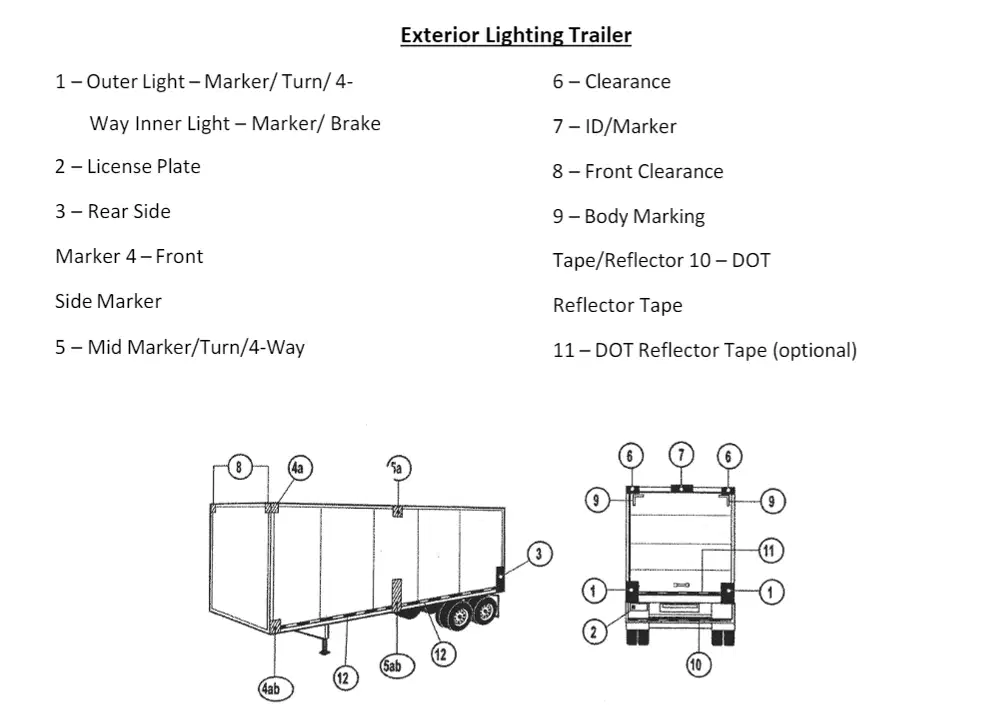
Which component is labeled as '10' on the Exterior Lighting Trailer diagram?
DOT Reflector Tape
License Plate
Body Marker Tape/Reflector
Clearance
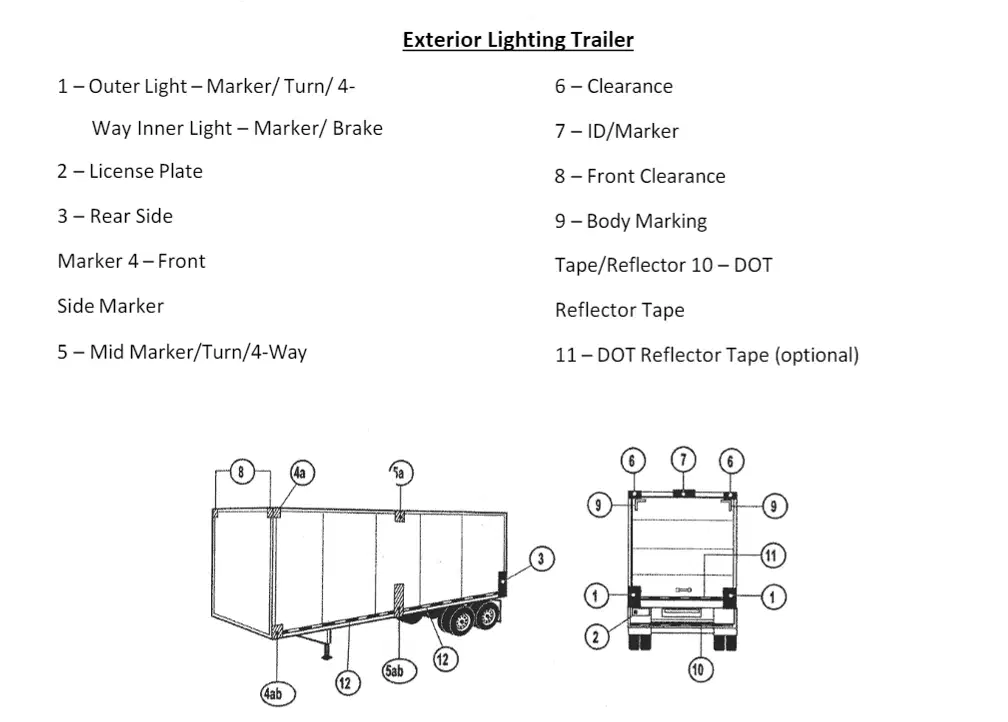
What is indicated by label '8' in the Exterior Lighting Trailer diagram?
Rear Side
Front Clearance
Mid Marker/Turn/4-Way
DOT Reflector Tape
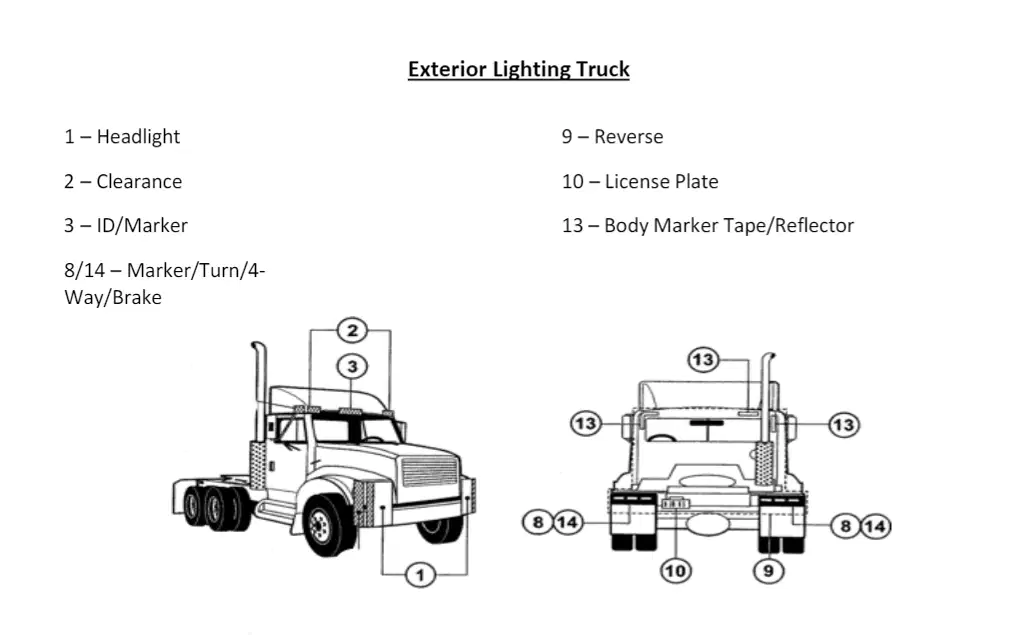
Which label corresponds to the 'Reverse' light in the Exterior Lighting Truck diagram?
3
9
13
10
What is the first step in the uncoupling process of a trailer as described in the safety steps?
Raise the landing gear legs
Lower the landing gear legs to level ground
Pull the release handle to unlock the locking jaws
Remove the glad hands and electric 7 pin electric cord
According to the safety steps, what should be done immediately after backing up to the trailer during the coupling process?
Lower your suspension and back underneath the trailer
Raise your suspension
Do a tug test
Check that the skid plate of the fifth wheel is at the proper angle and is lined up with the king pin
What is the purpose of doing a tug test in the coupling steps?
To ensure the trailer is aligned properly
To check the functionality of the electric cord
To verify the locking jaws are securely locked around the king pin
To test the suspension system
What should be visually inspected to ensure safety after getting out of the truck in the coupling process?
The alignment of the truck with the trailer
There is no gap between the apron and the skid plate, and the locking jaws are around the king pin
The condition of the tires on the trailer
The level of the trailer suspension
When are cargo securement inspections required according to the regulations?
After every trip
Within the first 50 miles after loading and every 3 hours or 150 miles
Only at the beginning and end of the trip
Every 100 miles
What should a driver do if they discover a low or flat tire while transporting hazardous materials?
Continue driving to the destination
Replace the tire immediately
Proceed to the nearest place to have it repaired
Ignore it until the end of the trip
Which of the following is NOT included in the quick walkaround inspection of the vehicle?
Checking the tires, lights, and hubs for heat or leaks
Cargo securement
Checking engine oil levels
Having the running lights and 4-way flashers on
According to 49 CFR 396.11, how many Driver Vehicle Inspection Reports (DVIRs) are required if a driver operates three commercial motor vehicles in a day and each has a defect?
One DVIR for all vehicles
Three DVIRs, one for each vehicle
No DVIRs are required
Two DVIRs, one for the first two vehicles
What must the DVIR include for it to be considered complete?
Only the driver's signature
Vehicle identification and list of defects
Repair status and mechanic's signature
List of cargo items
Who must sign the DVIR if a defect was noted and repairs were deemed unnecessary?
The next driver of the vehicle
The original inspector only
Both the mechanic and the driver
No additional signatures are required
For how long must the original DVIR be kept after its preparation?
One month
Six months
Three months
One year

